Tanzania Military Forces
Tanzania ranks #91 of 170 militaries worldwide in 2026, with 27,000 active troops. The Tanzanian Army fields 587 ground vehicles, including 62 main battle tanks; the Air Force flies 43 aircraft, including 20 combat aircraft. Tanzania has no nuclear weapons.
Armed Forces in 2026
| Domain | Strength | Composition |
|---|---|---|
| Tanzania Air Force Command | 43 aircraft | 20 combat 15 helicopters +1 on order |
| Ground Forces | 587 vehicles | 62 main battle tanks |
| Personnel | 27,000 active | 80,000 reserve 1,400 paramilitary |
ATLAS Index (Aggregate Total of Land, Air and Sea strength)
Full ranking →| Pillar | Weight | Score | Basis |
|---|---|---|---|
| Manpower | 10% | 37.2 | Active, reserve & paramilitary personnel |
| Ground forces | 20% | 25.6 | ARMS inventory power: armour & artillery by type and era, attack helicopters, armament |
| Naval power | 20% | 0.0 | SEAS inventory power: hulls by type, size and era, air wing, sustainment, armament |
| Air power | 25% | 18.3 | AIRS inventory power: aircraft by type and generation, enablers, armament |
| Nuclear deterrent | 10% | 0.0 | No declared nuclear capability |
| Defense budget | 15% | 18.3 | Annual spending, purchasing-power adjusted |
| Availability | modifier | ground ×0.89 · naval ×1.00 · air ×1.00 | Budget per point of each force, from the branch indexes |
Country File
| Population | 68.6M (2024) |
| GDP | $78.8 billion (2024) |
| GDP per capita | $1,150 |
| Military budget | $1B (2024) |
| Share of GDP | 1.3% (2024) |
| Military spending per capita | $15 (2024) |
| Inflation rate | 3.06% (2024) |
| Capital | Dodoma |
| Region | Africa |
| Land area | 885,800 km² |
| Coastline | 1,424 km |
| Land borders | 3,861 km |
| Bordering countries | 8 |
| Currency | TZS |
Strategic Overview in 2026
Strategic Position
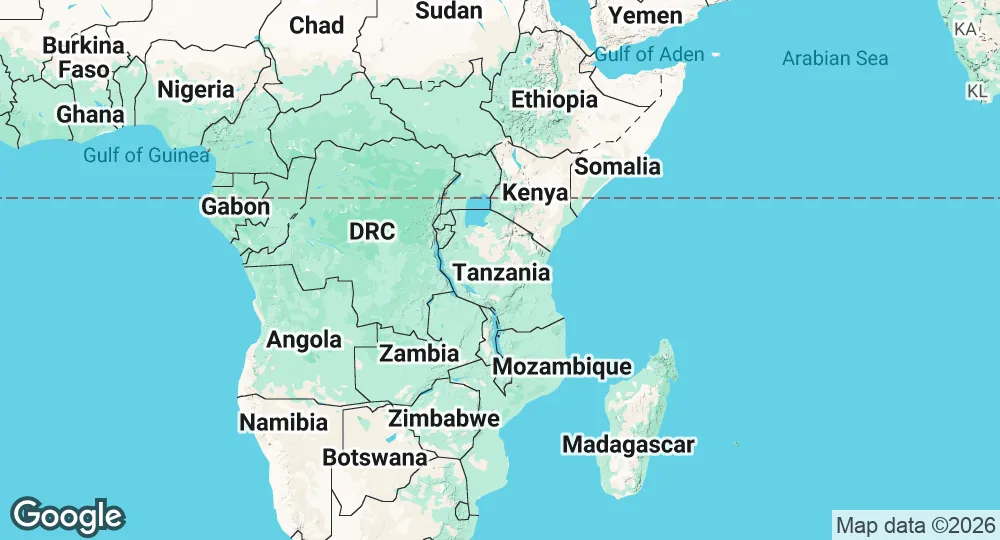
Tanzania occupies a central position in East Africa, bordering eight countries and maintaining a 1,424-kilometer coastline on the Indian Ocean. Its security posture is defined by its memberships in the Southern African Development Community (SADC) and the East African Community (EAC).
Primary security concerns involve the spillover of instability from neighboring regions. This includes the insurgency in Mozambique's Cabo Delgado province and the protracted conflict in the eastern Democratic Republic of the Congo (DRC). While the SADC Mission in Mozambique (SAMIM) concluded in 2024, Tanzania continues to maintain a bilateral military presence in Mozambique’s Nangade district to secure its southern border along the Rovuma River and prevent cross-border recruitment by extremist groups.
In 2025, Tanzania served as a coordinator for the phased withdrawal of the SADC Mission in the Democratic Republic of Congo (SAMIDRC). The Tanzania People’s Defence Force (TPDF) facilitated the transit of regional troops through its territory following the termination of the mission’s mandate in March 2025.
Defense doctrine emphasizes territorial integrity, non-interference, and active participation in multilateral peacekeeping. Tanzania maintains a long-standing military partnership with China, which serves as a primary supplier of equipment and training. Simultaneously, it engages in Western security cooperation, exemplified by the Justified Accord 2025 exercise with U.S. and regional land forces focused on counter-terrorism and medical evacuation.
Military Forces
The Tanzania People's Defence Force (TPDF) is a unified command structure under the President, who serves as Commander-in-Chief. The force is organized into three primary commands: the Land Force Command (Army), the Air Force Command, and the Naval Command. Total active personnel are approximately 27,000 to 30,000, supported by a reserve force of approximately 80,000. The National Service (Jeshi la Kujenga Taifa or JKT) provides mandatory two-year training for youth, contributing to the reserve pool.
-
Land Force Command: The largest branch, operating a variety of Soviet-era and Chinese-origin equipment. Armor includes Type 59G main battle tanks and Type 62/63 light tanks. Mechanized units utilize BTR-60 and BTR-80 armored personnel carriers, alongside various Chinese-made wheeled armored vehicles. Artillery capabilities consist of field guns, mortars, and multiple rocket launchers.
-
Air Force Command: Centered at bases in Dar es Salaam, Mwanza, and Ngerengere. The combat fleet operates J-7G fighter aircraft. Transport is provided by Y-8 and C-130 Hercules aircraft. The command also operates a fleet of Bell and Harbin helicopters for utility and transport roles.
-
Naval Command: Focused on maritime domain awareness and coastal defense. The fleet includes fast attack craft (FAC) and patrol boats, many of which are Chinese-designed. Capabilities include search and rescue, anti-smuggling, and securing the Exclusive Economic Zone (EEZ).
Defense Industry
Tanzania maintains a limited domestic defense industrial base focused on sustainment and small-caliber production. The state-owned Mzinga Corporation, based in Morogoro, is the primary manufacturer of small arms ammunition and explosives for both military and civilian use. In 2025, the government inaugurated a new board for the corporation to enhance productivity and support national projects, including military infrastructure rehabilitation.
The Tanzania Automotive Technology Centre (TACT) and SUMA-JKT provide engineering and vehicle maintenance support. Current policy aims to increase self-reliance by collaborating with the private sector to expand domestic production of essential military equipment and reduce dependency on foreign imports for basic supplies.
Strategic Trends
The defense budget for the 2025/2026 fiscal year is approximately TZS 3.65 trillion (roughly $1.3–1.4 billion), representing a 10% increase over the previous period. This increase is allocated toward systematic modernization, infrastructure upgrades, and the expansion of the National Service.
Modernization priorities include:
-
Technological Integration: Efforts to digitize training and enhance cyber capabilities to address evolving regional threats.
-
Counter-Terrorism: Shifting resources toward mobile, light infantry units capable of conducting counter-insurgency (COIN) operations along the southern border.
-
Infrastructure Development: Construction of military referral hospitals and the rehabilitation of training centers.
The military faces constraints related to equipment maintenance cycles for its aging legacy fleet and the logistical demands of frequent deployments to regional peacekeeping missions. Strategic efforts in 2026 continue to focus on stabilizing the southern border while professionalizing the force ahead of national electoral cycles to maintain an apolitical stance.
Military Expenditure: CIA World Factbook. Last updated on 4 August 2026. Suggest a change
Frequently Asked Questions
How large is Tanzania's military?
What is Tanzania's defense budget?
How does Tanzania rank militarily in the world?
Does Tanzania have nuclear weapons?
How many aircraft does Tanzania's air force have?
How many tanks does Tanzania have?
What percentage of GDP does Tanzania spend on defense?
What is Tanzania's military personnel per capita?
Does Tanzania have paramilitary forces?
- AUG 42026 Updated Global Military Index updated in a site-wide editorial pass
- AUG 32026 Updated Global Military Index updated
- JUL 162026 Updated Global Military Index updated in a site-wide editorial pass
- JUN 162026 Updated Yearly statistics, military spending and 2 more fields updated
- JAN 172026 Updated Main battle tank count and Global Military Index updated
- JAN 132026 Updated Description added