Galil ACE
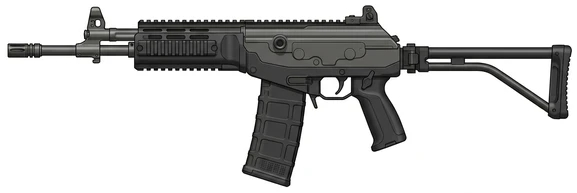
| Fire rate | 680 - 880 rounds/min. |
| Caliber | 5.56 x 45 mm NATO |
| Magazine | 30 - 35 rounds |
| Length | 847 mm (33.3 in) |
| Weight | 3.4 kg (7.5 lb) |
| Range | 500 m (1640 ft) |
Description
The Galil ACE series of assault and battle rifles was designed by Israel Military Industries and is manufactured by Israel Weapon Industries (IWI). Introduced to service in 2008, the series is based on the original Galil design, which featured a machined solid steel billet receiver. The Israel Defense Forces criticized the weight of the original weapon, prompting IWI to develop the Galil ACE as a lighter and more accurate successor. In addition to production in Israel, the rifle is manufactured under license by FAMAE in Chile, Indumil in Colombia, RPC Fort in Ukraine, and the Z111 Factory in Vietnam.
The rifle operates via a gas-operated, rotating bolt action utilizing a long-stroke piston system. To reduce weight, the design combines a machined steel upper receiver with a polymer lower receiver. The gas tube is mounted via a dovetailed slide machined on the receiver's upper-front block, preventing gas block movement from influencing barrel vibration. The weapon features a cold hammer-forged, chrome-lined barrel and a two-stage trigger modeled after the M1 Garand. Ergonomics are managed through a six-position telescopic buttstock, which is also available in a right-folding configuration, and a forearm equipped with Picatinny rails and detachable polymer covers. Sighting is provided by a tritium front post and rear diopter iron sights, alongside a receiver-mounted Picatinny rail. Selected models also feature a last round bolt catch.
The firearm is used by military and law enforcement organizations and has been deployed in the Colombian conflict and the Mexican drug war. The Chilean Armed Forces selected the rifle as their standard-issue platform in 2014, while the People's Army of Vietnam adopted localized versions designated STV-215 and STV-380 to replace legacy infantry rifles. The Indian Armed Forces signed a contract to acquire an optimized variant manufactured by PLR Systems under the name Jeet. In Colombia, Indumil produced the licensed Córdova variant, which is scheduled for replacement by a new platform in 2026. Ukraine produces licensed versions under the designations Fort-227, Fort-228, and Fort-229. Additional users include the Philippine National Police, the Haitian National Police, and the Guatemalan Police, alongside state forces in Peru, South Sudan, and Mexico. Variants include the Gen II line, which features a free-floating M-LOK handguard, and the Vietnamese STL variant.
Frequently Asked Questions
What type of firearm is the Galil ACE?
What caliber is the Galil ACE?
What is the effective range of the Galil ACE?
What is the rate of fire of the Galil ACE?
What magazine does the Galil ACE use?
How heavy is the Galil ACE?
- JUL 232026 Created Page created: Galil ACE