Mossberg 590A1
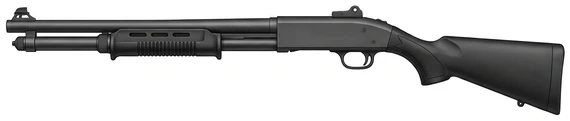
| Fire rate | 240 rounds/min. |
| Caliber | 12 (19.5 x 76 mm) |
| Magazine | 6 - 9 rounds |
| Length | 1041 mm (41.0 in) |
| Weight | 3.5 kg (7.7 lb) |
| Range | 50 m (164 ft) |
Description
O.F. Mossberg & Sons developed the weapon series based on a design created by Carl Benson in 1961. Originally intended for civilian use, the base design was adopted by law enforcement agencies due to its reliability and low cost. During the 1970s, the manufacturer submitted the design for United States military evaluation, though initial models did not meet the MIL-SPEC 3443E protocol requiring a maximum of two malfunctions over a test of thousands of rounds. Following limited acquisitions by the United States Navy and Coast Guard, the manufacturer designed the M590 in 1987 specifically for military applications. In response to subsequent Navy requirements, the design was modified with a thickened barrel, an extended magazine, a barrel shroud, and a bayonet lug, resulting in the M590A1 configuration.
The weapon operates via a manual pump-action mechanism using a hammerless repeater design, twin action bars, dual extractors, and a sliding tang safety located on the top rear of the receiver. Unlike preceding models where the barrel bolts into a threaded hole at the end of a closed magazine tube, the magazine tube opens at the muzzle end, with the barrel held in place by a capnut. This configuration facilitates cleaning and the replacement of internal magazine components. To comply with military materials requirements under the 3443G standard and withstand heavy door-closing forces on naval vessels, the construction utilizes a reinforced heavy barrel along with an aluminum trigger guard and safety, replacing the polymer components used in civilian variants. The receiver is pre-drilled and tapped for mounting optical rails. Standard features include a bayonet lug, with some variants utilizing a sling swivel on the rear of the lug and a swivel mount on the buttstock. Due to the increased thickness of the barrel, standard heat shields cannot be fitted without a model-specific component.
The shotgun entered service as the standard-issue shotgun for the United States military, seeing deployment in the Gulf War for defending supply depots and in the conflicts in Iraq and Afghanistan primarily for door breaching. US Army Special Forces utilized modification kits to standardize configurations with collapsible stocks, receiver rails, and breaching barrels. The weapon has been adopted by numerous international military and law enforcement organizations, including agencies in the Netherlands, Poland, and Portugal, and units were donated to the Ukrainian Army during the Russian invasion. Production variants include the 590-SP, which features the military-specification heavy barrel and metal trigger group for the civilian market, and the 590M, which utilizes detachable double-stack magazines. The compact Shockwave variant employs a bird's-head grip without a shoulder stock, while the Cruiser variant features a pistol grip configuration.
Frequently Asked Questions
What type of firearm is the Mossberg 590A1?
What caliber is the Mossberg 590A1?
What is the effective range of the Mossberg 590A1?
What is the rate of fire of the Mossberg 590A1?
What magazine does the Mossberg 590A1 use?
How heavy is the Mossberg 590A1?
- JUL 232026 Created Page created: Mossberg 590A1