Tavor X95
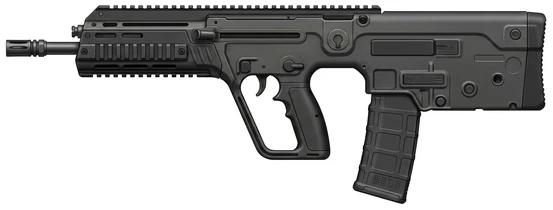
| Fire rate | 750 - 950 rounds/min. |
| Caliber | 5.56 x 45 mm NATO |
| Magazine | 30 rounds |
| Length | 580 mm (22.8 in) |
| Weight | 3.3 kg (7.3 lb) |
| Range | 300 m (984 ft) |
Description
Designed by Israel Weapon Industries (IWI) between 2003 and 2009, the X95 was developed as part of the Tavor bullpup firearm family, alongside the TAR and Tavor 7. Formerly designated as the Micro-Tavor, MTAR, or MTAR-21, the weapon was created as a compact platform. Manufacturing is conducted by IWI in Israel, with licensed production also established in Ukraine by RPC Fort and in India by PLR Systems.
The X95 utilizes a long-stroke gas-operated system with a rotating bolt. Certain production runs feature upgraded recoil mechanisms, and the system can be adapted into a submachine gun configuration that relies on a blowback operating system and dedicated pistol-caliber magazines. Ergonomically, the platform differs from the preceding TAR-21 by placing the charging handle closer to the pistol grip, incorporating a redesigned buttstock, and positioning the magazine release near the pistol grip. The firearm permits operators to swap the standard pistol grip with alternative trigger guard options. Optics and accessories mount via Picatinny rails. The weapon accommodates multiple handguard configurations, including a rounded military-issue handguard designed for internal suppressor mounting, a rectangular handguard with integrated rails and removable covers, and an elongated variant. The platform also accepts dedicated underslung grenade launchers.
The Israel Defense Forces (IDF) selected the X95 in 2009 to become its standard-issue infantry weapon, later introducing updated versions with longer barrels and modified triggers. While some front-line Israeli units began transitioning to the M4 in 2021—with existing inventory reassigned to reserve brigades—the IDF also maintained plans to continue procurement. The weapon is used globally by military, law enforcement, and security agencies, including the Angolan Armed Forces, Azerbaijani State Border Service and Marine Infantry, National Police of Colombia, Cypriot Special Forces, Georgian security services, Honduran Army, Indian Central Reserve Police Force, Indonesian Kopasgat, Moroccan DGSN, North Macedonian Special Anti-terrorist Unit, Philippine Coast Guard and National Police, Senegal, Ukrainian National Guard, and the Pennsylvania Capitol Police. Notable configurations include the semi-automatic X95-L equipped with an integrated bipod, the grenade-launcher compatible X95-GL, and dedicated submachine gun variants. Licensed versions include the Ukrainian Fort-223 and Fort-224, as well as the Indian Zittara. Semi-automatic-only variants are produced for the United States and Canadian civilian markets, configured with modified handguards and stocks to comply with regional legal requirements.
Frequently Asked Questions
What type of firearm is the Tavor X95?
What caliber is the Tavor X95?
What is the effective range of the Tavor X95?
What is the rate of fire of the Tavor X95?
What magazine does the Tavor X95 use?
How heavy is the Tavor X95?
- JUL 232026 Created Page created: Tavor X95