Type 81
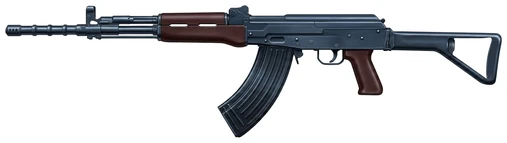
| Fire rate | 650 rounds/min. |
| Caliber | 7.62 x 39 mm |
| Magazine | 30 - 75 rounds |
| Length | 955 mm (37.6 in) |
| Weight | 3.4 kg (7.5 lb) |
| Range | 500 m (1640 ft) |
Description
The Type 81 originated from the People's Liberation Army's search for a replacement for the Type 56 carbine and Type 56 assault rifle, Chinese licence-built copies of the SKS and AK-47. An earlier attempt, the Type 63 assault rifle, was withdrawn after a series of defects returned the PLA to its older weapons. The 1979 Sino-Vietnamese War exposed the shortcomings of both Type 56 patterns and prompted the Chinese state to fund a new service rifle combining features of the two. Development was directed by Wang Zi Jun following the 1979 border clashes. The design requirements specified accuracy of 4.5 cm R50 at 100 m, better controllability in full-automatic fire, reliability equal to the AK with a longer service life, and compatibility with existing AK and SKS production tooling.
The Type 81 is a selective-fire, gas-operated rifle drawing on the Dragunov, SKS and AK series. It retains the general layout of the AK-47 and Type 56 but substitutes an SKS-type short-stroke gas piston, reducing recoil and muzzle climb. The stock, action length, bayonet and front sight position differ from those of the Type 56. The front sight was moved rearward, leaving the muzzle exposed and formed into a spigot-type launcher for 22 mm rifle grenades, which is the rifle's most recognisable external feature. A horizontal crossbar was fitted over the rear sight notch after the unhooded rear sight leaves of Type 56 rifles were found to wear during the Sino-Vietnamese conflicts, producing glare; the resulting T-shaped opening can serve as an improvised aperture. A gap separates the trigger guard from the magazine well, unlike the Type 56. The folding spike bayonet of the earlier weapons was replaced by the detachable Type 81 knife-bayonet. Picatinny rails, a bipod, foregrip and flashlight can be fitted; one rail package was marketed by Bao Wa, a Hong Kong law enforcement supplier.
The rifle entered PLA service in 1981 but was not widely issued until the late 1980s. Its first combat use came in the later phase of the Sino-Vietnamese border conflicts of the mid-1980s. Most PLA Type 81s have since been replaced by the Type 95 and Type 03 series, though the rifle remains with reserve units, second-line units and the armed police. The family comprises the fixed-stock Type 81, of which 400,000 were built, the side-folding Type 81-1 with bakelite stock panels that became the standard-issue rifle, and the Type 81 LMG, an RPK-equivalent squad automatic weapon with a drum magazine and its front sight relocated to the muzzle. The Type 87 and Type 87A/QBZ87 served as test-beds for 5.8×42 mm DBP87 ammunition ahead of the QBZ-95; neither reached full-scale production, though the Type 87A saw limited service with PLA special forces. The Type 81A, with new stock and rails, appeared at the 2018 Zhuhai Airshow. Norinco marketed the NAR-10 in 7.62×51 mm from 2014, exported as the CS/LR-14. Bangladesh Ordnance Factories produces the BD-08 under licence at over 10,000 rifles per year, and the Defence Industries Corporation of Nigeria also holds a licence. Users include Cambodia, Gabon, Guinea, Iraq, Ivory Coast, Kyrgyzstan, Myanmar, Niger, Pakistan, Sri Lanka, Sudan, Syria, Tajikistan and Uganda. The Kachin Independence Army and United Wa State Army manufacture copies, the former designated M23.
Frequently Asked Questions
What type of firearm is the Type 81?
What caliber is the Type 81?
What is the effective range of the Type 81?
What is the rate of fire of the Type 81?
What magazine does the Type 81 use?
How heavy is the Type 81?
- AUG 302026 Updated Description updated
- JUL 232026 Updated Service entry year updated in a site-wide editorial pass
- APR 82026 Updated Sources and cross-references refreshed