Vz.58
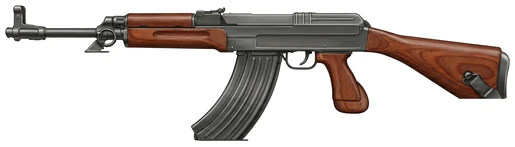
| Fire rate | 800 rounds/min. |
| Caliber | 7.62 x 39 mm |
| Magazine | 30 rounds |
| Length | 845 mm (33.3 in) |
| Weight | 3.1 kg (6.8 lb) |
| Range | 400 m (1312 ft) |
Description
Development of the vz. 58 began in 1956 at the Konstrukta Brno facility, with chief engineer Jiří Čermák leading the project. The work responded to Soviet pressure for Warsaw Pact forces to standardise on common ammunition, so the prototype — designated "Koště" ("broom") — was chambered for the Soviet intermediate M43 cartridge instead of the Czechoslovak round used by the earlier vz. 52 rifle and vz. 52 light machine gun. The weapon was accepted into service in 1958 as the 7.62 mm samopal vzor 58, replacing the vz. 52 self-loading rifle and the Sa 24 and Sa 26 submachine guns. Production ran until 1984, with over 920,000 units built.
Despite an external resemblance to the Kalashnikov, the vz. 58 is an unrelated design. It is a selective-fire, gas-operated weapon using a short-stroke piston housed in a cylinder above the barrel. There is no gas regulator; the piston is driven rearward a short distance before a shoulder on the rod arrests its travel, and a light return spring restores it. The piston rod is chromium-plated to reduce fouling. Locking is achieved by a piece hinged from the bolt and carried in the bolt carrier, whose two lugs drop into shoulders in the receiver's guide rails; the carrier's wedge surface lifts the locking piece clear during unlocking and provides primary extraction. The rifle uses a linear hammer — a hollow steel cylinder containing its own spring — rather than a rotating one, driving a free-floating firing pin. The fire selector doubles as a manual safety, with settings for single fire, automatic fire and safe, supplemented by an internal safety preventing discharge out of battery. Feeding is from a detachable box magazine of light aluminium alloy, not interchangeable with Kalashnikov-pattern magazines; the bolt holds open on an empty magazine, and the carrier incorporates a guide for loading from SKS stripper clips. Iron sights comprise an adjustable front post and a tangent rear sight with a sliding notch, the leaf marked "U" for snap shooting and night engagement. The front sight base also mounts the vz. 58 bayonet. Stocks are changed by removing a single bolt at the rear of the receiver, allowing fixed beech or composite stocks, folding steel stocks, or aftermarket adapters.
Three principal service variants were produced: the vz. 58 P infantry model with fixed stock, the vz. 58 V with a side-folding metal stock for vehicle crews and airborne units, and the vz. 58 Pi, fitted with a receiver-mounted dovetail bracket for the NSP-2 night sight, a folding bipod and a conical flash suppressor. Experimental developments included the AP-Z 67 and ÚP-Z 70 in NATO calibres, the EZ-B bullpup of 1976, the KLEČ light machine gun, the vz. 58/97 marksman rifle and the vz. 58/98 "Bulldog" submachine gun. Civilian semi-automatic derivatives include the CZ 858, CZH 2003 Sport, the FSN series, the CSA vz. 58 Sporter and the Century Arms Vz 2008. Thailand's Rung Paisarn Heavy Industries produced the RPS-001 adaptation from 1986. The rifle served with Czechoslovakia and its successor states, Cuba, and numerous African and Asian armies. The Czech Army began replacing it with the CZ-805 BREN in 2011. It remains the Slovak service rifle, with replacement by the Grand Power M4M scheduled for completion in 2028. The Czech Republic donated 5,000 rifles to Ukraine.
Frequently Asked Questions
What type of firearm is the Vz.58?
What caliber is the Vz.58?
What is the effective range of the Vz.58?
What is the rate of fire of the Vz.58?
What magazine does the Vz.58 use?
How heavy is the Vz.58?
- AUG 302026 Updated Description updated
- JUL 232026 Updated Service entry year updated in a site-wide editorial pass
- APR 82026 Updated Sources and cross-references refreshed
- MAR 172026 Updated Description updated