Zastava M70
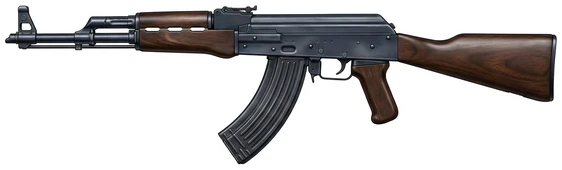
| Fire rate | 600 - 650 rounds/min. |
| Caliber | 7.62 x 39 mm |
| Magazine | 30 rounds |
| Length | 890 mm (35.0 in) |
| Weight | 3.7 kg (8.2 lb) |
| Range | 350 m (1148 ft) |
Description
Development of the Zastava M70 began in Yugoslavia under the design direction of Zastava Arms, spanning from 1962 to 1968. Yugoslavia's research into domestic automatic rifles began in 1952, initially utilizing captured German StG 44 rifles. In 1959, Zastava engineers analyzed Soviet AK-47 rifles acquired from defecting Albanian soldiers, followed by additional specimens obtained from an unidentified nation, likely Egypt. Because Yugoslavia refused to join the Warsaw Pact, political differences prevented the acquisition of technical specifications from the Soviet Union, prompting Zastava to reverse-engineer the Type 3 AK-47. The resulting unlicensed derivative underwent trials as the M64 prototype series in 1964. After adjustments to reduce production costs and standardize parts, the Yugoslav government approved the design for serial production in 1970 under the official designation AP M70.
The M70 is a gas-operated firearm utilizing a rotating bolt system. Initial production models featured milled receivers based on the Soviet Type 3 design, which Zastava later simplified by removing the left-side machined cuts. In the mid-1970s, production transitioned to stamped steel receivers. To handle the stresses of launching rifle grenades, Zastava introduced a thicker receiver and a reinforced barrel trunnion derived from the RPK light machine gun, recognizable by a distinct bulge on the forward receiver. The barrel, which is not chrome-lined, transitioned from a threaded design to a pressed and pinned installation. The weapon features a handguard longer than standard Soviet equivalents, an integral folding ladder sight on the gas block that automatically shuts off the gas system when raised, and a specialized spring-loaded lock on the receiver dust cover to prevent displacement during grenade launching. Sights consist of iron sights, occasionally fitted with tritium vials or luminescent paint for night use, and selective models feature optical mounting brackets. The proprietary magazine follower functions as a bolt hold-open device, and the fire selector features safety, automatic, and semi-automatic settings.
Adopted as the standard infantry weapon of the Yugoslav People's Army in 1970, the M70 superseded the Zastava M59/66. It served during the Yugoslav Wars and has been deployed in global conflicts, including the Iran-Iraq War, the Gulf War, and conflicts in Afghanistan, Libya, and Ukraine. Current operators include regional successor states, several African and Middle Eastern nations, and the United Kingdom for training purposes. Variants include the folding-stock M70A and M70AB2, and the fixed-stock M70B1. Later iterations, such as the M70B3 and M70AB3, replaced the folding grenade sight with a BGP underslung grenade launcher. Foreign derivatives include the Iraqi Tabuk series, encompassing carbine and sniper variants. Zastava continues to manufacture the M70 for export alongside the PAP series, a semi-automatic version configured for the civilian market.
Frequently Asked Questions
What type of firearm is the Zastava M70?
What caliber is the Zastava M70?
What is the effective range of the Zastava M70?
What is the rate of fire of the Zastava M70?
What magazine does the Zastava M70 use?
How heavy is the Zastava M70?
- JUL 232026 Created Page created: Zastava M70