Admiral Kuznetsov-class
Summary
| Origin country | 🇷🇺 Russia |
| Category | Cruiser |
| Subtype | Aircraft carrier |
| Manufacturer | Nikolayev South |
| Year commissioned | 1991 |
| Unit | 063 Admiral Flota Sovetskogo Soyuza Kuznetsov |
Operators
Technical specifications
| Displacement | 58600 tons |
| Range | 8500 km at 18 knots |
| Endurance | 45 |
| Crew | 1690 members |
| Width | 72.0 m (236.2 ft) |
| Length | 305.0 m (1000.7 ft) |
| Air Park | |
| Propulsion | Steam turbines, 8 turbo-pressurised boilers, 4 shafts, 200,000 hp (150 MW) |
| Armament |
|
| Maximum speed | 29 knots |
Description
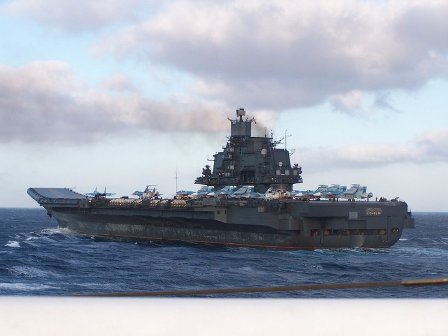
Ordered in 1981 and laid down in 1983, the vessel was constructed at the Nikolayev South shipyard in the Ukrainian SSR. Originally named Riga, it was launched in 1985 as Leonid Brezhnev and underwent sea trials as Tbilisi before being renamed Admiral Flota Sovetskogo Soyuza Kuznetsov. The ship entered service in 1991 and reached fully operational status in 1995. It was intended as the lead ship of a two-unit class, but the second hull was sold to China.
Classified as a heavy aircraft-carrying missile cruiser (TAVKR), the ship is designed to support and defend strategic missile-carrying submarines and surface vessels. It utilizes a ski-jump at the bow for the launch of fixed-wing aircraft rather than a catapult system. The vessel is conventionally powered by steam turbines using mazut fuel. Its air wing includes multi-role fighters, trainers, and helicopters configured for anti-submarine warfare, search and rescue, and reconnaissance. For self-defense and strike roles, the ship is equipped with surface-to-surface missiles, surface-to-air missiles, and anti-submarine rocket launchers.
In December 1991, the ship was transferred from the Black Sea to the Northern Fleet. It conducted its first Mediterranean deployment from 1995 to 1996, during which it operated off the coast of Syria. In 2000, the vessel participated in the rescue and salvage operations for the submarine Kursk. Between 2007 and 2014, the carrier performed multiple deployments to the Atlantic and Mediterranean. During a 2012 return voyage, the ship lost propulsion in the Bay of Biscay and required a tow to return to base.
The vessel's only combat deployment occurred between 2016 and 2017 off the Syrian coast. Aircraft from the carrier conducted strikes in the provinces of Idlib and Homs. During this period, the ship experienced two landing accidents involving a MiG-29K and a Su-33 due to arresting gear failures. Following these incidents, the air wing was transferred to a shore-based air facility to continue operations.
The ship began an overhaul and modernization program in Murmansk in 2017. This process has been marked by several accidents, including the 2018 sinking of the PD-50 floating drydock, which caused a crane to damage the flight deck. Fires occurred on board in 2019 and 2022 during the refit. In 2024, reports indicated that the ship's crew had been reassigned to land-based combat units in Ukraine. By July 2025, reports stated that repair work had been suspended and the Russian Ministry of Defence was considering dismantling the vessel due to its condition and the cost of continued repairs.