MiG-29K Fulcrum-D
Soviet multirole fighter, famously employed by Indian Navy in the late 20th century for carrier-based operations. Key figures: top speed 2,200 km/h, range 3,000 km, service ceiling 17,500 m, max takeoff weight 24,500 kg, unit price $35M, built 81. In service with 2 air forces as of 2026 — Russia (256), India (40).
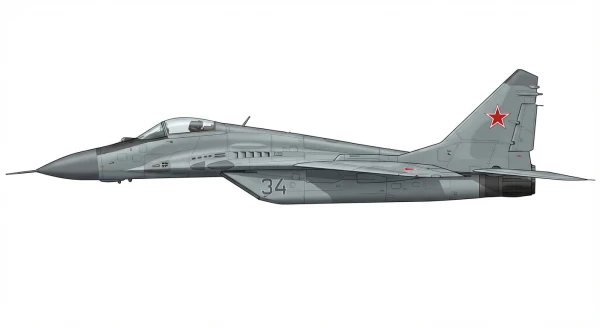
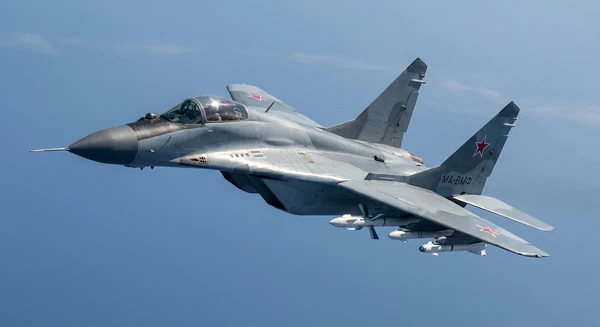
| Crew | 1 |
| Length | 17.3 m (56.8 ft) |
| Wingspan | 12.0 m (39.3 ft) |
| Height | 4.4 m (14.4 ft) |
| Wing area | 43 m² (462.8 sqft) |
| Empty weight | 12,000 kg (26,455 lbs) |
| Max. takeoff weight | 24,500 kg (54,013 lbs) |
| Powerplant | 2 × turbofans Klimov RD-33MK 9,000 kgf each |
| Ejection seat | Zvezda K-36DM |
| Maximum speed | 2200 km/h (Mach 2.2) |
| Operational range | 3,000 km (1,864 mi) |
| Service ceiling | 17,500 m (57,415 ft) |
| Climb rate | 330.0 m/s (1082.7 ft/s) |


- Air-to-Surface Vympel Kh-25 (AS-10 Karen)
- Air-to-Surface Vympel Kh-29 (AS-14 Kedge)
- Anti-Radiation Vympel Kh-31 Taifun (AS-17 Krypton)
- Air-to-Air Long-Range Vympel R-27 / K-27 (AA-10 Alamo)
- Air-to-Air Short-Range Vympel R-73 (AA-11 Archer)
- Air-to-Air Medium-Range Vympel R-77 RVV-AE (AA-12 Adder)
- Air-to-Surface Zvezda Kh-35 Uran (AS-20 Kayak)
Recent Events — MiG-29K Fulcrum-D
3 events →
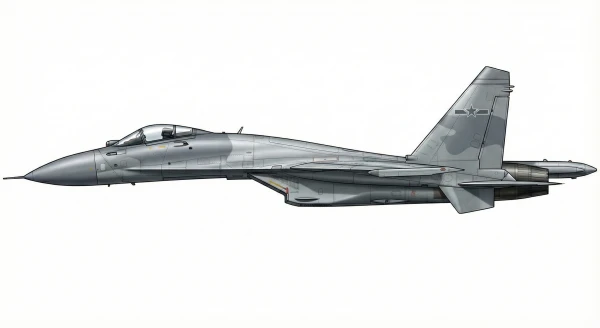
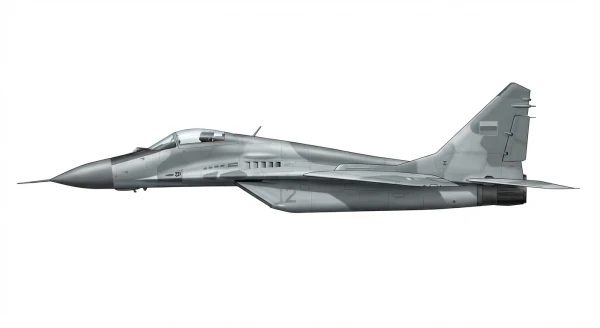
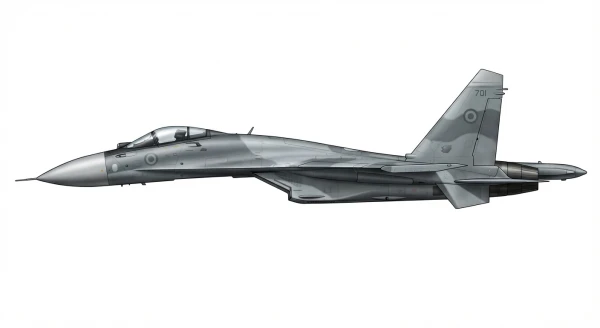
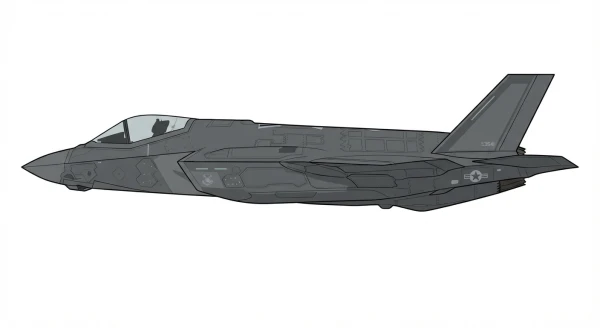
Description
The Mikoyan MiG-29K, NATO reporting name Fulcrum-D, is a Russian all-weather carrier-based multirole fighter developed from the MiG-29M in the late 1980s and described by its maker as a 4+ generation aircraft. Its history is unusual: the design lost the original Soviet Navy competition to the Su-27K, was kept alive by Mikoyan with essentially no funding through the 1990s, and was then revived by an export customer. India ordered it for the carrier it had bought from Russia, took delivery from 2009, and only afterwards did the Russian Navy order the type as a replacement for its ageing Su-33s.
Development
The MiG-29K project began in the late 1970s when the Soviet Navy issued a requirement for a supersonic carrier fighter. Mikoyan first built a proof-of-concept aircraft, the MiG-29KVP, a standard MiG-29 with stronger undercarriage, a reinforced tail section and an arrestor hook. It flew on 21 August 1982 and demonstrated that a MiG-29 could safely operate from a ski-jump, but also that a production aircraft would need more power and more wing area. The definitive naval version was therefore based on the advanced MiG-29M then in development, with new undercarriage and folding wings of greater area, designated MiG-29K for korabelniy, "ship-based".
The MiG-29K first flew on 23 July 1988 at Saky with test pilot Toktar Aubakirov at the controls. On 1 November 1989, the same day as the Su-27K, Aubakirov made the first carrier landing on the aircraft-carrying cruiser Tbilisi, later the Admiral Kuznetsov, and took off from her deck the same day. Testing aboard the ship continued until 1991, when the collapse of the Soviet Union ended state funding; the Navy chose the Su-33 and only two MiG-29K prototypes had been built. Mikoyan continued development at its own expense.
The programme revived when India decided in 2004 to acquire the former Soviet carrier Admiral Gorshkov. The ship, originally a V/STOL carrier, was rebuilt with a ski-jump and arrestor wires for MiG-29K operations, and the Indian Navy preferred the MiG to the Su-33 partly because the smaller aircraft allowed more of them on deck. Indian requirements shaped the production standard: the Zhuk-ME radar, RD-33MK engines, a four-channel digital fly-by-wire system, thirteen weapon stations and a payload of up to 5,500 kg. The two-seat MiG-29KUB first flew on 20 January 2007 and the production single-seater on 25 June 2007.
Design
The airframe and undercarriage are reinforced for carrier landings, the undercarriage track is wider, and folding wings, an arrestor hook and catapult attachments were added. Unlike the early land-based MiG-29, the K can both receive air-to-air refuelling and act as a buddy tanker. Retractable intake grilles replace the FOD doors and louvres of the land-based aircraft.
Two widely spaced Klimov RD-33MK turbofans of 9,000 kgf each deliver about 7 per cent more power than the base RD-33 through improved turbine blade materials, and were engineered to reduce infrared signature. Internal fuel was increased to give a combat radius of 850 km, extensible to some 2,000 km with four underwing drop tanks, and maximum take-off weight rose to 24,500 kg. Mikoyan states that extensive use of radar-absorbent material cuts the radar signature to a fourth or a fifth of that of the basic MiG-29.
The cockpit has three multifunction colour liquid-crystal displays — seven in the KUB — a four-channel digital fly-by-wire system, a passive homing system for anti-radiation missiles, a Sigma-95 GPS receiver, a TopGun helmet-mounted sight, electronic countermeasures and an onboard oxygen generating system in place of heavy canisters. The Zhuk-ME radar, developed from the N010 Zhuk, adds terrain mapping and following, tracks up to ten targets and engages four simultaneously, and scans ±85° in azimuth. An infrared search and track system with integrated optical and laser channels can be fitted, giving all-round coverage and missile trajectory data at shorter ranges.
Armament
A GSh-30-1 30 mm cannon is mounted in the port wing root. For air combat the aircraft carries the R-73 short-range, R-27ER/ET medium and long-range, and RVV-AE (R-77) active radar missiles. Against surface targets it can employ the Kh-25ML and Kh-25MP, Kh-29T, Kh-31A and Kh-31G, and Kh-35U missiles as well as unguided rockets, laser-guided and electro-optical bombs including the KAB-500, and free-fall FAB-500s. Kh-31P missiles provide a dedicated anti-radiation capability and the Kh-35 and Kh-31A the anti-ship role. The aircraft is also adaptable to foreign weapons, a requirement of the Indian order.
Operational History
India ordered twelve MiG-29K and four MiG-29KUB in January 2004, with deliveries from December 2009 and entry into operational service in February 2010. A second contract worth 1.2 billion dollars for 29 more aircraft followed in January 2010. The fighters were based at Goa until INS Vikramaditya, the rebuilt Admiral Gorshkov, joined the fleet in late 2013, and they also operate from the indigenous carrier INS Vikrant, where a MiG-29K made its first night landing on 26 May 2023.
Service has been troubled. A MiG-29KUB crashed in Russia during pre-delivery testing, which Russia attributed to pilot error; India's national auditor reported in 2016 that serviceability stood at 37.6 per cent for the MiG-29K and between 21 and 47 per cent for the KUB, with 62 per cent of engines rejected or withdrawn for design defects. Availability has since improved, reported at around 70 per cent, after India cancelled manufacturer warranties over spares delivery failures and moved to indigenous replacement of components; the Indian Air Force's Base Repair Depot at Nashik has also upgraded the fleet and overhauled its ejection seats. In 2025 India selected the Rafale M as a successor, ordering 26 aircraft. Fifteen MiG-29Ks deployed with the INS Vikrant carrier battle group in the Arabian Sea during the India–Pakistan conflict of 2025.
The Russian Navy, whose Su-33s were reaching the end of their service lives around 2010, ordered the MiG-29K as a replacement, operating the type from the Admiral Kuznetsov.
Frequently Asked Questions
What type of aircraft is the MiG-29K Fulcrum-D?
What is the maximum speed of the MiG-29K Fulcrum-D?
What is the range of the MiG-29K Fulcrum-D?
When did the MiG-29K Fulcrum-D first fly?
How many MiG-29K Fulcrum-D have been built?
Which countries operate the MiG-29K Fulcrum-D?
How much does a MiG-29K Fulcrum-D cost?
What is the service ceiling of the MiG-29K Fulcrum-D?
- AUG 132026 Updated Service entry corrected to the February 2010 Indian Navy induction
- AUG 122026 Updated Range corrected to the ferry range with 3 drop tanks
- AUG 52026 Updated Description, maximum weight and 4 more fields updated
- AUG 12026 Updated Manufacturer updated
- JUL 232026 Updated Sources and cross-references refreshed
- APR 72026 Updated Picture credits updated in a site-wide editorial pass
- JAN 242026 Updated Thrust updated