Duke-class (Type 23)
Summary
| Origin country | 🇬🇧 United Kingdom |
| Category | Frigate |
| Subtype | Anti-submarine warfare frigate |
| Manufacturer | Yarrow Shipbuilders |
| Year commissioned | 1987 |
| Approx. unit cost | $165 million |
| Units |
FF-05 Almirante Cochrane FF-06 Almirante Condell FF-07 Almirante Lynch |
Operators
Technical specifications
| Displacement | 4900 tons |
| Range | 7500 km at 15 knots |
| Crew | 185 members |
| Width | 16.1 m (52.8 ft) |
| Length | 133.0 m (436.4 ft) |
| Air Park | |
| Propulsion | CODLAG: 4 × 1,510 kW (2,025 hp) Paxman Valenta 12CM diesel generators or 4 × 1,650 kW (2,210 shp) MTU 12V4000 M53 diesel generators; 2 × GEC electric motors delivering 2,980 kW (3,996 hp) each; 2 × Rolls-Royce Marine Spey SM1C delivering 19,500 kW (26,150 hp) |
| Armament |
|
| Maximum speed | 28 knots |
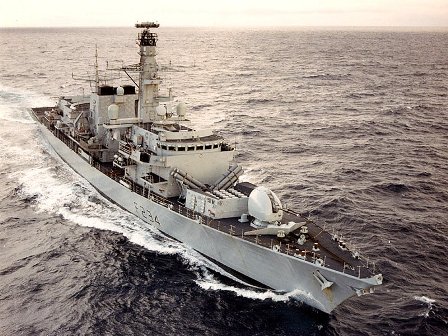
Description
The Type 23 frigate, also known as the Duke class, was conceived in the late 1970s as a light anti-submarine vessel intended to counter Soviet nuclear submarines in the North Atlantic. Replacing the Leander and Type 21 classes, the design was announced in the 1981 Defence White Paper as a simpler alternative to the Type 22. Experience from the Falklands War led to design revisions that integrated anti-air and anti-surface capabilities, transforming the class into general-purpose warships. HMS Norfolk, the lead ship, entered service in 1989.
The class utilizes combined diesel-electric and gas (CODLAG) propulsion, which allows for quiet running during anti-submarine operations. The design incorporates radar cross-section reduction measures and automation to reduce crew requirements. Primary sensors include the Artisan 3D radar and, on specialized anti-submarine variants, the Sonar 2087 towed array. For anti-air defense, ships have been refitted with the Sea Ceptor vertical launching system, replacing the original Sea Wolf missiles. Anti-ship capabilities are transitioning from Harpoon missiles to the Naval Strike Missile. The vessels are equipped with a Mark 8 naval gun, automated small caliber guns, and Sting Ray torpedoes. Aviation facilities support the embarkation of Wildcat or Merlin helicopters and uncrewed aerial vehicles.
Sixteen vessels were completed by Yarrow Shipbuilders and Swan Hunter. The class forms a central component of the Royal Navy's surface fleet. Between 2006 and 2008, the Royal Navy transferred three vessels—the former Norfolk, Marlborough, and Grafton—to the Chilean Navy, where they remain in active service. Operational history includes naval gunfire support during the 2003 Al Faw assault in Iraq and the 2011 destruction of gun batteries in Libya. In March 2024, the Sea Ceptor system was used operationally for the first time by HMS Richmond to intercept attack drones. Several vessels have been retired since 2021, with the remainder scheduled for replacement by the Type 26 Global Combat Ship and Type 31 frigate.