AW159
British multi-role helicopter, deployed for battlefield utility, search and rescue, and anti-submarine warfare since modern warfare era. Key figures: top speed 311 km/h, range 963 km, service ceiling 4,000 m, max takeoff weight 6,000 kg, unit price $32M, built 67. In service with 3 air forces as of 2026 — United Kingdom (62), South Korea (8), Philippines (2).
| Crew | 2 |
| Length | 15 m (49.2 ft) |
| Wingspan | 12.8 m (42.0 ft) |
| Height | 3.8 m (12.3 ft) |
| Empty weight | 3,300 kg (7,275 lbs) |
| Max. takeoff weight | 6,000 kg (13,228 lbs) |
| Powerplant | 2 × turboshafts LHTEC CTS800-4N 1,015 kW each |
| Maximum speed | 311 km/h (193 mph) |
| Operational range | 963 km (598 mi) |
| Endurance | 2 hours |
| Service ceiling | 4,000 m (13,123 ft) |



- Anti-Surface Martlet (Lightweight Multirole Missile)
- Anti-Ship Sea Venom
- Anti-Surface Spike NLOS
- Anti-Submarine Sting Ray torpedo
- Anti-Submarine K745 Blue Shark torpedo
- Anti-Submarine Mk.11 depth charges
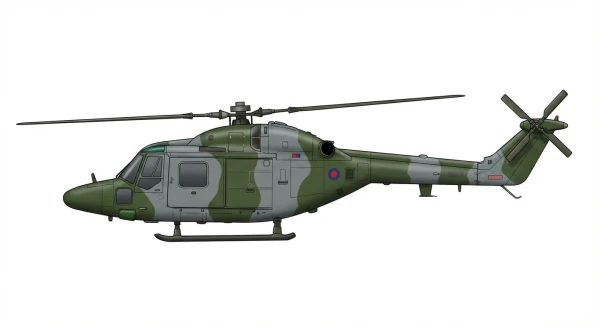
Description
Development commenced during the early 2000s under the name Future Lynx, intended to replace existing Lynx helicopters for both the Royal Navy and British Army. AgustaWestland received a contract for a formal assessment phase in July 2002 and collaborated with Thales Group on core avionics development. By July 2004, upgrading first generation Lynx was deemed uneconomical. On 22 June 2006, the MOD awarded AgustaWestland a £1 billion contract for 70 Future Lynx helicopters. The program proceeded to manufacturing in October 2007, with the first complete airframe delivered in November 2008. On 24 April 2009, AgustaWestland designated the Future Lynx as AW159, known as the Wildcat in British military service. The first Lynx Wildcat conducted its maiden flight on 12 November 2009.
Design
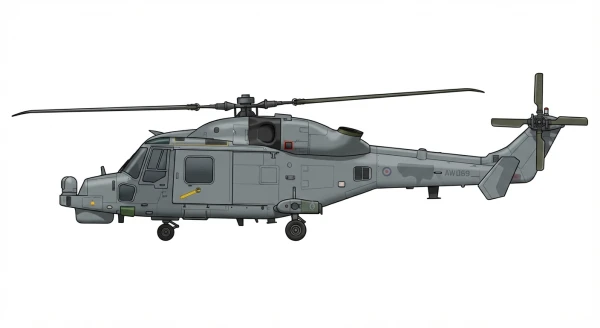
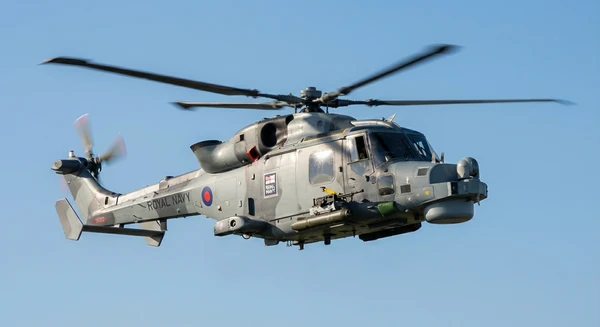
The AW159 Wildcat incorporates 95% new components compared to the Westland Lynx while retaining some interchangeability with older Lynx variants. Designed in a digital environment, the Wildcat features enhanced durability, stealth characteristics, and an extended airframe lifespan of 12,000 flight hours. These attributes are supported by marinization and a strengthened undercarriage suitable for naval operations. It is powered by two 1,362 hp LHTEC CTS800 turboshaft engines and utilizes BERP IV rotor blades, contributing to an increased maximum take-off weight. Its structure includes a redesigned composite tailboom, tailplane, tail rotor, and nose. The naval variant is equipped with a Selex Galileo Seaspray 7000E active electronically scanned array (AESA) radar and an L-3 Wescam MX-15HDi electro-optical/infrared nose turret. The primary human-machine interface is a glass cockpit, featuring four multifunction displays.
Armament
The AW159 Wildcat is capable of carrying a diverse array of weaponry. Army variants are equipped with a pintle-mounted machine gun, such as the FN MAG. The Naval HMA2 variant can be outfitted with air-to-surface missile systems and ASW weapons. Available air-to-surface weapons include up to 20 Thales Martlet Lightweight Multirole Missiles or up to 4 MBDA Sea Venom missiles. ASW weapons include Sting Ray torpedoes and Mk.11 depth charges. South Korean and Philippine naval configurations incorporate K745 Blue Shark torpedoes and Spike NLOS ATGM-based antiship missiles. The Wildcat can carry four launchers, each capable of holding five Martlet missiles.
Operational History
The Wildcat AH1 formally entered service with the Army Air Corps on 29 August 2014. The Royal Navy's first Wildcat HMA2 commenced initial operational deployment at sea aboard HMS Lancaster on 23 March 2015. By 2024, all 62 Wildcats had been delivered to the British Army and Royal Navy. Recorded operational metrics include over 10,000 flight hours logged across the services and achieving 100 percent availability at sea during certain periods, alongside over 1,200 recorded deck landings. A Wildcat HMA.2 of 825 Naval Air Squadron deployed aboard HMS Duncan in September 2015 for high temperature trials in the Persian Gulf. On 4 July 2019, Royal Marines utilized a Wildcat during the boarding and detention of the Grace 1 oil tanker off Gibraltar. The Republic of Korea Navy and the Philippine Navy also operate the Wildcat for missions including search-and-rescue, anti-submarine warfare, and surveillance. ROK Navy Wildcats are fitted with a Seaspray 7400E radar providing 360-degree coverage and operate from Incheon-class frigates. For anti-submarine duties, the helicopter can utilize the Thales FLASH dipping sonar; endurance is over three hours with the sonar, two hours with the sonar and one Blue Shark torpedo, and over an hour with the sonar and two torpedoes. Sonobuoys can also be deployed. Philippine Navy helicopters are assigned for operation from Jose Rizal-class Frigates.
Variants
Main Variants:
-
Wildcat AH1: The initial battlefield reconnaissance model, designed for the British Army Air Corps, emphasizes reconnaissance and battlefield support capabilities.
-
Wildcat HMA2: The initial maritime model, tailored for the Royal Navy, focuses on maritime operations, including anti-surface and anti-submarine warfare.
Frequently Asked Questions
What type of aircraft is the AW159?
What is the maximum speed of the AW159?
What is the range of the AW159?
When did the AW159 first fly?
How many AW159 have been built?
Which countries operate the AW159?
How much does a AW159 cost?
What is the service ceiling of the AW159?
- AUG 302026 Updated Range corrected to the ferry range
- AUG 102026 Updated Bombs, missiles and endurance added; top speed updated
- AUG 52026 Updated Powerplant updated in a site-wide editorial pass
- JUL 232026 Updated Sources and cross-references refreshed
- APR 82026 Updated Empty weight added
- APR 72026 Updated Sources and cross-references refreshed
- FEB 72026 Updated Ceiling added; wingspan added