Foudre-class
Summary
| Origin country | 🇫🇷 France |
| Category | Amphibious vessel |
| Subtype | Landing platform dock |
| Manufacturer | DCN Brest |
| Year commissioned | 1990 |
| Approx. unit cost | $80 million |
| Units |
G40 Bahia LSDH-91 Sargento Aldea |
Technical specifications
| Displacement | 11880 tons |
| Range | 11000 km at 15 knots |
| Endurance | 30 |
| Crew | 215 members |
| Width | 23.5 m (77.1 ft) |
| Length | 168.0 m (551.2 ft) |
| Air Park |
|
| Propulsion | 2 × SEMT-Pielstick 16 PC 2.5 V400 diesel engines (15,480 kW), 2 × controllable-pitch propellers, 1 × bow thruster (750 kW) |
| Thrust | 4250 hp |
| Armament |
|
| Maximum speed | 21 knots |
Description
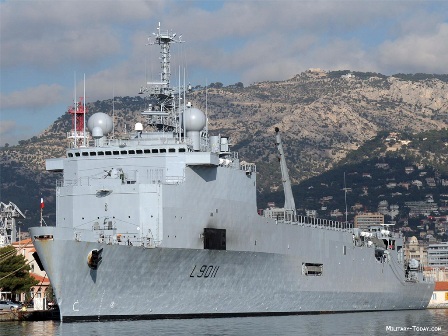
The Foudre class is a series of landing platform docks designed for the French Navy to replace the preceding Ouragan class. Designated Transport de Chalands de Débarquement, the vessels were intended to embark and provide logistical support for a mechanized regiment of the Rapid Action Force. While four ships were originally planned, only two—Foudre and Siroco—were completed by DCN Brest. The remaining two planned units were reordered as Mistral-class amphibious assault ships.
The design incorporates a docking well, a helicopter hangar, and a side ramp for dockside loading. The well deck supports the operation of landing craft, which are put to sea by using a ballasting system to flood the deck. Internal stowage includes dedicated areas for battle tanks and vehicles, serviced by an elevator and a crane for cargo transfer between decks. Aviation facilities consist of a flight deck and a hangar for helicopters. For medical support, the class features a hospital area located beneath the flight deck containing surgical suites and beds. The ships are also equipped with an NBC-protected citadel, repair facilities, and electronic warfare systems, including jammers and torpedo decoys.
Both vessels were based at Toulon and assigned to the Naval Action Force. Foudre entered service in 1990 and operated with the French Navy until 2011. During its service, the vessel was offered to Argentina before being sold to the Chilean Navy, where it was renamed Sargento Aldea. Siroco entered service in 1998 and conducted operations in East Timor as part of an international force in 1999 and provided aid in Haiti following the 2010 earthquake. Following the 2013 French White Paper on Defence and National Security, Siroco was decommissioned in 2014. The ship was sold to the Brazilian Navy in 2015 and renamed Bahia.