Gwanggaeto the Great-class (KDX-1 Okpo)
Summary
| Origin country | 🇰🇷 South Korea |
| Category | Destroyer |
| Subtype | Destroyer or Frigate |
| Manufacturer | Daewoo Heavy Industries Co. |
| Year commissioned | 1998 |
| Units |
971 (광개토대왕 (廣開土大王)) Kwanggaeto the Great 972 (을지문덕 (乙支文德)) Ulchi Moonduk 973 (양만춘 (楊萬春)) Yang Manchoon |
Operators
Technical specifications
| Displacement | 3885 tons |
| Range | 4500 km at 18 knots |
| Crew | 286 members |
| Width | 14.2 m (46.6 ft) |
| Length | 135.5 m (444.6 ft) |
| Air Park |
|
| Propulsion | 2 × General Electric LM2500-30 gas turbines, 2 × SsangYong Motor Company 20V 956 TB 82 diesel engines, 2 shafts |
| Armament |
|
| Maximum speed | 30 knots |
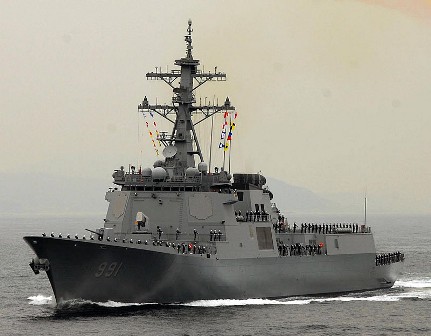
Description
The Gwanggaeto the Great class, designated KDX-I, represents the initial phase of the Republic of Korea Navy (ROKN) Korean Destroyer eXperimental program. Developed to replace vessels transferred from the United States Navy in the 1950s and 1960s, the class was designed to facilitate the ROKN's transition from a coastal defense force to a blue-water navy. Daewoo Heavy Industries commenced work on the design in 1989, utilizing domestic design engineering. Although twelve vessels were originally planned, three were completed.
The class utilizes a Combined Diesel or Gas (CODOG) propulsion system consisting of General Electric gas turbines and SsangYong diesel engines driving two shafts. The primary weapon system is the Super Lynx helicopter, which operates in conjunction with shipboard sensors for anti-submarine warfare. Supplemental anti-submarine capability is provided by Mark 46 torpedoes launched from triple tubes. Anti-surface operations are supported by Harpoon missiles in canisters, while anti-aircraft defense relies on Sea Sparrow missiles launched from a vertical launch system. Point-defense against incoming missiles and aircraft is provided by Goalkeeper close-in weapon systems and an OTO Melara main gun. Sensor suites include air search, surface search, and fire control radars, alongside a hull-mounted sonar. Electronic warfare equipment includes towed torpedo decoys, electronic countermeasures, and chaff launchers.
The three vessels—ROKS Gwanggaeto the Great, ROKS Eulji Mundeok, and ROKS Yang Man-chun—entered service between 1998 and 2000. Following their commissioning, the ships participated in international anti-piracy missions and military operations other than war. Between 2016 and 2021, the class underwent a mid-life upgrade program to replace obsolete equipment. This modernization replaced the original command and control systems with domestic combat management systems and integrated Link-16 data links and towed array sonar systems. The final upgraded vessel was delivered in December 2021. A modified variant of the design featuring stealth characteristics was produced for the Royal Thai Navy as the Bhumibol Adulyadej class.