Invincible-class
Summary
| Origin country | 🇬🇧 United Kingdom |
| Category | Aircraft carrier |
| Subtype | Light aircraft carrier |
| Manufacturer | Swan Hunter |
| Year commissioned | 1980 |
| Units |
RSS Illustrious RSS Impeccable RSS Inimitable RSS Invincible |
Operators
Technical specifications
| Displacement | 22000 tons |
| Range | 7000 km at 18 knots |
| Crew | 650 members |
| Width | 36.0 m (118.1 ft) |
| Length | 209.0 m (685.7 ft) |
| Air Park | |
| Propulsion | COGAG: 4 × Rolls-Royce Olympus TM3B gas turbines, 8 × Paxman Valenta diesel generators, 100,000 shp (75 MW), 2 shafts |
| Thrust | 14000 hp |
| Armament |
|
| Maximum speed | 28 knots |
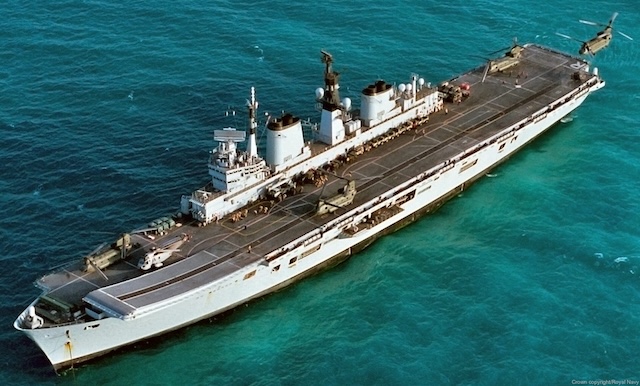
Description
The Invincible class originated from a 1960s requirement for a 6,000-ton guided-missile escort cruiser intended to complement CVA-01-class fleet carriers. Following the cancellation of the CVA-01 project in 1966, the design evolved to provide the Royal Navy with anti-submarine warfare (ASW) and command and control facilities. To distinguish the vessels from traditional aircraft carriers after the cancellation of the fleet carrier program, the Ministry of Defence designated the ships as "through-deck cruisers." The official aircraft carrier designation was not applied until 1980. The order for the first ship in the class was placed in 1973.
The vessels were designed with a continuous flight deck and utilized a COGAG propulsion system. Although initially conceptualized as helicopter platforms, the design was modified to accommodate the Sea Harrier. To facilitate the launch of fixed-wing aircraft, the ships were equipped with a bow ski-jump to assist with short take-off rolls. During the 1990s, the class underwent modernizations that included the removal of the Sea Dart missile system to expand the flight deck and increase air-to-surface weapon storage. Defensive capabilities were updated post-1982 to include Phalanx or Goalkeeper close-in weapon systems. The ships were also configured to operate Merlin and Chinook helicopters in secondary roles.
The class consisted of three ships: HMS Invincible, HMS Illustrious, and HMS Ark Royal. Their primary Cold War mission was to serve as the center of ASW hunter-killer groups in the North Atlantic. In 1982, HMS Invincible deployed to the South Atlantic for the Falklands War, where the air group provided fleet air defense and power projection. The class later saw active service in the Adriatic during the Bosnian War and in the Middle East during the 2003 Invasion of Iraq.
International interest in the class included an aborted purchase by Iran in the 1970s and a 1981 proposal to sell HMS Invincible to the Royal Australian Navy, which was cancelled following the Falklands War. HMS Invincible was decommissioned in 2005 and sold for scrap in 2011. HMS Ark Royal was decommissioned in 2011. HMS Illustrious served as a dedicated helicopter carrier from 2011 until its decommissioning in 2014, marking the end of the class's service life. The class was succeeded by the Queen Elizabeth-class aircraft carriers.