Harrier
British vertical and short takeoff and landing jet, known for Falklands War deployments and Cold War service. Key figures: top speed 1,183 km/h, range 1,500 km, service ceiling 14,996 m, max takeoff weight 11,500 kg, unit price $24M, built 380.
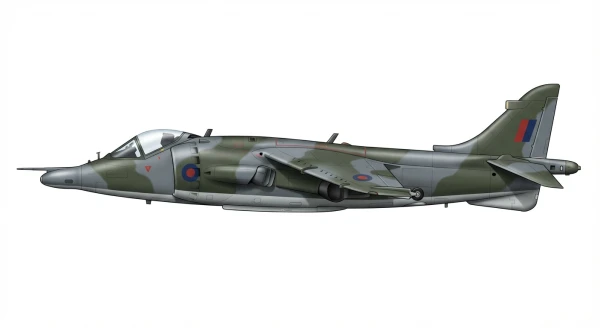
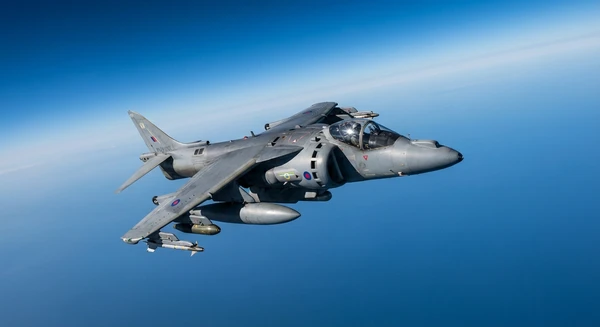
| Crew | 1 |
| Length | 13.9 m (45.6 ft) |
| Wingspan | 7.7 m (25.3 ft) |
| Height | 3.5 m (11.3 ft) |
| Wing area | 18.7 m² (201.1 sqft) |
| Empty weight | 5,530 kg (12,192 lbs) |
| Max. takeoff weight | 11,500 kg (25,353 lbs) |
| Powerplant | 1 × turbofan Rolls-Royce Pegasus 101 8,618 kgf each |
| Ejection seat | Martin-Baker Mk 9 |
| Maximum speed | 1183 km/h (735 mph) |
| Operational range | 1,500 km (932 mi) |
| Service ceiling | 14,996 m (49,199 ft) |
| Climb rate | 74.8 m/s (245.4 ft/s) |
- Air-to-Surface AS.37 Martel
- Air-to-Air Short-Range Raytheon AIM-9 Sidewinder
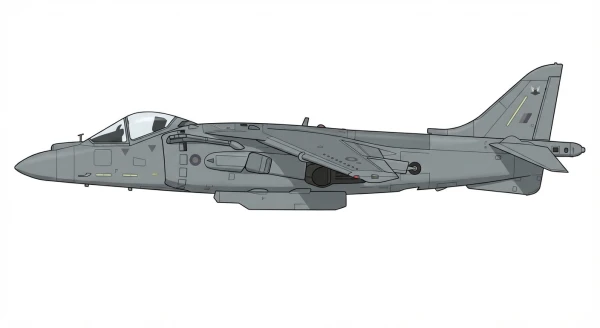
Description
The Hawker Siddeley Harrier is a British jet-powered V/STOL ground attack and reconnaissance aircraft produced by Hawker Siddeley. It entered service with the Royal Air Force in April 1969. The Harrier is known for being the first operational fixed-wing aircraft with vertical/short takeoff and landing capabilities.
Development
Development originated from the Hawker P.1127 prototype, initiated in 1957 following the cancellation of the supersonic P.1121 project. The design led to the evaluation of nine Kestrel FGA.1 aircraft by a joint UK, US, and West German squadron between 1964 and 1965. Following the cancellation of the supersonic P.1154, the Royal Air Force issued Requirement ASR 384 for a V/STOL ground attack jet, ordering six pre-production P.1127 (RAF) aircraft in 1965 and 60 production Harrier GR.1s in 1967. The GR.1 made its first flight on 28 December 1967. The United States Marine Corps subsequently procured 102 single-seat AV-8A and eight two-seat TAV-8A aircraft between 1971 and 1976.
Design
The Harrier is powered by a single fuselage-mounted Pegasus turbofan engine using four swivelling nozzles for thrust vectoring, along with reaction thrusters at the nose, tail, and wingtips for hover control. Landing gear consists of two central fuselage units and two wingtip outriggers. Avionic equipment includes a head-up display and moving map display linked to a Ferranti FE541 inertial navigation and attack system. Thrust vector angles range from 0° for forward flight to 98° for vertical and low-speed maneuvers.
Armament
The aircraft features four underwing hardpoints and one centerline fuselage pylon with a combined payload capacity of 5,000 lb (2,268 kg). It carries two 30 mm ADEN cannon pods mounted underneath the fuselage. Ordnance options include four Matra pods containing 18 SNEB 68 mm rockets each, two AIM-9 Sidewinder air-to-air missiles, unguided iron bombs, BL755 cluster bombs, or laser-guided bombs.
Operational History
The RAF introduced the Harrier GR.1 in April 1969, stationing units in West Germany, Belize, and Norway. During the 1982 Falklands War, ten RAF Harrier GR.3s operated from HMS Hermes alongside Royal Navy Sea Harriers, executing close air support and ground-attack missions. USMC AV-8A aircraft entered service in 1971, operating from amphibious assault ships before being upgraded to AV-8C standard and retired by 1987. Spain operated the AV-8S Matador from the carrier Dédalo beginning in 1976, later selling seven single-seat and two twin-seat airframes to the Royal Thai Navy in 1998, where they served until retirement in 2006.
Variants
- Harrier GR.1: The initial single-seat RAF ground-attack production variant powered by the Pegasus 6 engine.
- Harrier GR.3: An upgraded RAF single-seat variant featuring a nose-mounted laser tracker, electronic countermeasures, and a Pegasus Mk 103 engine.
- AV-8A Harrier: The single-seat export variant produced for the US Marine Corps equipped with US avionics and AIM-9 Sidewinder capability.
- AV-8S Matador: The export version of the AV-8A built for the Spanish Navy and later sold to the Royal Thai Navy.
- Harrier T.2: A two-seat training variant built for the RAF featuring a stretched fuselage and taller tail fin.
Frequently Asked Questions
What type of aircraft is the Harrier?
What is the maximum speed of the Harrier?
What is the range of the Harrier?
When did the Harrier first fly?
How many Harrier have been built?
Which countries operate the Harrier?
How much does a Harrier cost?
What is the service ceiling of the Harrier?
- AUG 272026 Updated Operators corrected: US, Spanish and Thai first-generation Harriers added, India moved to the Sea Harrier
- AUG 62026 Updated Powerplant updated; description updated
- AUG 52026 Updated Climb rate added
- JUL 232026 Updated Sources and cross-references refreshed
- APR 72026 Updated Sources and cross-references refreshed