Kilo-class
Ex-USSR Kilo submarine, introduced in 1980, utilizes diesel-electric propulsion. Key figures: displacement 2,325 tons, length 73 m, top speed 17 knots, crew 52, unit cost $200M, built 75. In service with 7 navies — Russia (7), India (6), Vietnam (6) and 4 others.
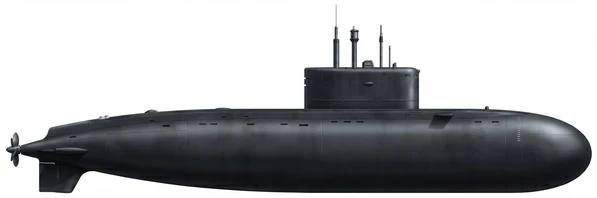
| Subtype | Attack submarine |
| Displacement | 2325 tons |
| Displacement submerged | 3075 tons |
| Crew | 52 members |
| Width | 9.9 m (32.5 ft) |
| Length | 72.6 m (238.2 ft) |
| Max. depth | 300 m (984.3 ft) |
| Propulsion | Diesel-electric propulsion, 2 × 1000 kW diesel generators, 1 × 5,500–6,800 shp propulsion motor, 1 × fixed-pitch 6-bladed or 7-bladed propeller |
| Range | 6,000 nm at 7 knots |
| Endurance | 45 days |
| Maximum speed | 17 knots |
| Max. speed submerged | 20 knots |
- 6 × 533 mm (21 in) torpedo tubes
- 18 torpedoes
- 4 Kalibr/Club land-attack cruise missile, anti-ship missile and anti-submarine missile
- 24 mines
- 8 9K34 Strela-3 (SA-N-8 Gremlin) or 8 9K310 Igla-1 (SA-N-10 Gimlet) surface-to-air missiles
4 losses recorded here in the Russia-Ukraine War.
1 loss recorded here in the 2026 Iran Conflict.
Description
The Kilo-class is a series of diesel-electric attack submarines designed by the Rubin Design Bureau. The initial version, designated Project 877 Paltus, entered service with the Soviet Navy in 1980. Developed for Warsaw Pact nations, the class received the Russian nickname Varshavyanka. Production continued through several iterations, including the Project 636 Varshavyanka (Improved Kilo) introduced for export in 1993 and the Project 636.3 (Improved Kilo II) adopted by the Russian Navy in the mid-2010s.
The class is designed for anti-shipping and anti-submarine warfare, primarily in shallow waters. The hull is covered in anechoic tiles to absorb active sonar waves and reduce passive noise emissions. Propulsion is provided by a diesel-electric system driving a fixed-pitch propeller, although one unit, B-871 Alrosa, utilizes pump-jet propulsion. Project 877 boats are equipped with the Rubikon MGK-400 sonar system and MG-519 Arfa mine detection sonar. Project 636 variants feature the upgraded MGK-400EM sonar suite, which utilizes automated consoles to reduce operator requirements. Project 636 and 636.3 variants are capable of launching Kalibr and Club cruise missiles through their torpedo tubes.
Over 70 hulls have been completed. Beyond Russia, the class is operated by the navies of Algeria, China, Vietnam, India, Iran, Myanmar, and Poland. In 2014, the Chinese submarine Yuanzheng 72 survived a buoyancy loss event caused by a sudden change in seawater density. Operational deployment includes the first combat launch of cruise missiles from a Kilo-class submarine in 2015, when the Rostov-na-Donu struck targets in Syria. Since 2022, Black Sea Fleet units have conducted missile strikes during the Russian invasion of Ukraine. Following the loss of the cruiser Moskva in 2022, Kilo-class units were the only Black Sea Fleet vessels permitted to operate in Ukrainian waters near Odesa.
The class has sustained several operational losses and technical failures. The Indian Navy's Sindhurakshak was scuttled following a munitions explosion in 2013. In 2023, the Rostov-na-Donu was damaged while in drydock by a missile strike, with subsequent reports of its destruction in 2024. In late 2025, the Novorossiysk reported a technical failure in the Mediterranean, and the Kolpino was reportedly damaged by a sub-sea drone at the Port of Novorossiysk. Despite the development of the successor Lada-class, the Russian Navy has continued production of the Project 636.3 variant into the 2020s.
Frequently Asked Questions
What type of ship is the Kilo-class?
What is the displacement of the Kilo-class?
What is the maximum speed of the Kilo-class?
What is the range of the Kilo-class?
How many crew members serve on the Kilo-class?
How many Kilo-class ships have been built?
Which countries operate the Kilo-class?
How much does a Kilo-class cost?
- JUL 232026 Updated Sources and cross-references refreshed
- APR 72026 Updated Description updated in a site-wide editorial pass
- JAN 182026 Updated Max depth and cost added; manufacturer, number built and 8 more fields updated