Narwhal-class (SSN-671)
Summary
| Origin country | 🇺🇸 United States |
| Category | Submarine |
| Subtype | Nuclear submarine |
| Manufacturer | General Dynamics Electric Boat |
| Year commissioned | 1969 |
| Units | USS Narwhal (SSN-671) |
Operators
Technical specifications
| Displacement | 5027 tons |
| Displacement submerged | 5378 tons |
| Range | Unlimited, except by food supplies |
| Crew | 107 members |
| Width | 10.0 m (32.8 ft) |
| Length | 95.91 m (314.7 ft) |
| Max. depth | 400 m (1312.3 ft) |
| Propulsion | 1 × S5G pressurized water reactor; 1 × steam turbine, 17,000 shp (13,000 kW); 1 shaft |
| Armament | |
| Maximum speed | 20 knots |
| Max. speed submerged | 25 knots |
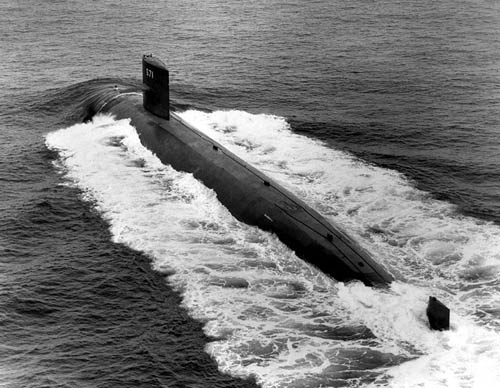
Description
USS Narwhal (SSN-671) was the third United States Navy vessel of its name. Built by General Dynamics Electric Boat under project SCB 245, the submarine was a one-off design commissioned on 12 July 1969.
While the forward section shared characteristics with the Sturgeon class, Narwhal featured a larger diameter and an auxiliary diesel generator located in the operations compartment. The propulsion system consisted of an S5G natural circulation pressurized water reactor and a direct-drive turbine. This arrangement eliminated the need for reduction gears by utilizing a large turbine that operated at low shaft speeds. Noise reduction features included scoop seawater injection for main condensers to allow the shutdown of seawater pumps at speed, low-RPM turbine generators, and the removal of waist ballast tanks. Two separate reactor tunnels provided access to the engine room. A "turtleback" structure was installed forward of the rudder for the housing of towed sonar arrays or remote-controlled underwater vehicles.
The design encountered specific technical challenges, including generator blade failures during testing and a requirement for complex turbine thermal procedures. The seawater injection piping required hull penetrations that were not compliant with later SUBSAFE regulations and was not repeated on subsequent classes. However, the S5G reactor technology was later scaled for use in the S8G plant of the Ohio-class submarines.
Narwhal maintained a high deployment rate throughout its career, including operations in Arctic waters for the tracking of Soviet vessels. The submarine’s service record includes a Navy Unit Commendation for a 1972 deployment and Meritorious Unit Commendations for operations in 1971, 1977, 1979, 1994, and 1998. The vessel also received five Battle Efficiency E awards. In September 1989, the submarine broke its moorings during Hurricane Hugo in Charleston, South Carolina. After drifting into the Cooper River, the crew submerged the vessel until only the sail was exposed to ride out the storm.
The submarine was deactivated in January 1999 and decommissioned on 1 July 1999. Following the cancellation of a proposed museum exhibit in 2006 due to lack of funding, the vessel was processed through the Nuclear Powered Ship and Submarine Recycling Program. Dismantling was completed by October 2020.