Narwhal-class (SSN-671)
American nuclear submarine, 1969 introduction year, powered by an S5G pressurized water reactor. Key figures: displacement 5,027 tons, length 96 m, top speed 20 knots, crew 107, built 1. In service with 1 navy — United States.
| Subtype | Nuclear-powered attack submarine |
| Displacement | 5027 tons |
| Displacement submerged | 5378 tons |
| Crew | 107 members |
| Width | 10.0 m (32.8 ft) |
| Length | 95.91 m (314.7 ft) |
| Max. depth | 400 m (1312.3 ft) |
| Propulsion | 1 × S5G pressurized water reactor; 1 × steam turbine, 17,000 shp (13,000 kW); 1 shaft |
| Units | USS Narwhal (SSN-671) |
| Range | Unlimited, except by food supplies |
| Maximum speed | 20 knots |
| Max. speed submerged | 25 knots |
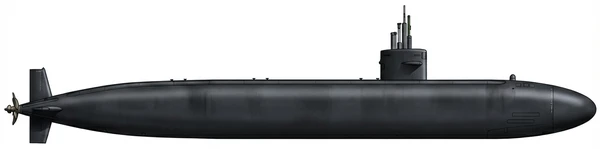
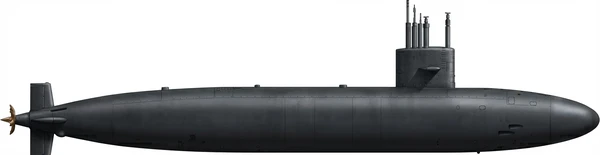
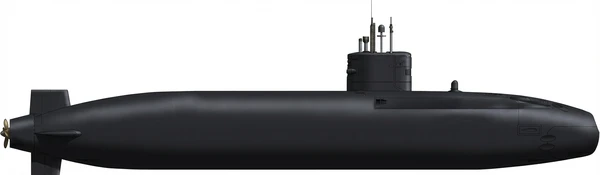
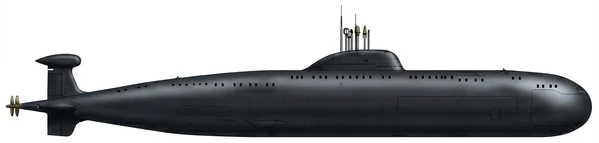
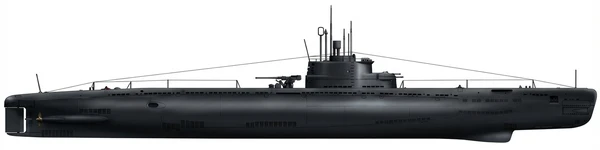
Description
The Narwhal class consisted of a single boat, USS Narwhal (SSN-671), built for the United States Navy as a quieting testbed under project SCB 245. Her keel was laid on 17 January 1966 at the Electric Boat Division of General Dynamics in Groton, Connecticut. She was launched on 9 September 1967, sponsored by Vice Admiral Glynn R. Donaho (ret.), and commissioned on 12 July 1969. She was the third US Navy vessel named for the narwhal.
Forward of the reactor compartment, Narwhal was broadly similar to the Sturgeon-class attack submarines, with a slightly larger hull diameter and the auxiliary diesel generator moved from the bow compartment to the auxiliary machine room in the operations compartment. Aft of that point the design diverged: the boat used a natural-circulation S5G reactor coupled to a direct-drive turbine, with two separate reactor tunnels, each fitted with its own watertight doors, giving access to the engine room.
The quieting measures were the point of the design. The S5G plant used main coolant pumps with only two settings, on and off, and could run without them at lower power. Scoop seawater injection fed the main condensers, allowing the main seawater pumps to be secured at speed, and the main and auxiliary seawater systems could be cross-connected. The single direct-drive propulsion turbine turned at 300 rpm and required no reduction gears. Ship service turbine generators ran at 1,200 rpm rather than the 3,600 rpm of earlier classes. Deleting the waist ballast tanks removed vibration noise from the thin outer hull. Narwhal was among the quietest submarines of her period.
The plant had drawbacks. The propulsion turbine had to be very large to run at so low a shaft speed and needed a complex warm-up and cooldown procedure. The turbine generators suffered blade failures in testing because of their low rotational speed, and later quieting techniques let subsequent classes run generators at 3,600 rpm with comparable noise levels. The seawater injection piping required large hull penetrations and long runs of piping under full submergence pressure, was incompatible with SUBSAFE requirements, and was not repeated. Other features carried over to later designs, and the S5G reactor was scaled up and roughly doubled in power to become the S8G plant of the Ohio-class ballistic missile submarines. A "turtleback" structure just forward of the rudder may have housed remote-controlled underwater vehicles or an experimental towed sonar array.
Narwhal's service record is largely classified but included a heavy deployment rate broken only by three overhauls, two of them involving reactor refueling. She operated in Arctic waters and shadowed Soviet vessels, and may have been used for special operations. She received a Navy Unit Commendation for a 1972 deployment and Meritorious Unit Commendations for 1971, 1977, 1979, 1994 and 1998, along with five Battle Efficiency E awards and four Engineering E awards.
On 22 September 1989 Hurricane Hugo struck Charleston, South Carolina, while Narwhal was moored with nine double wires and two three-inch lines. All but one line parted and she drifted into the Cooper River; after tugs and her crew failed to return her to the pier, she submerged in the river with only part of her sail exposed and rode out the storm, sustaining minor damage.
Narwhal was deactivated while still in commission on 16 January 1999 at Norfolk, Virginia, decommissioned and stricken on 1 July 1999, and entered the Nuclear Powered Ship and Submarine Recycling Program at Bremerton, Washington, on 1 October 2001. Legislation signed on 30 September 2003 authorised her transfer to a planned National Submarine Science Discovery Center in Newport, Kentucky, with the reactor and propulsion equipment to be replaced by a plug containing a theatre and classroom. The project was cancelled on 26 April 2006 after fundraising reached $0.5 million of the $2 million required, and the boat was dismantled by October 2020.
Frequently Asked Questions
What type of ship is the Narwhal-class?
What is the displacement of the Narwhal-class?
What is the maximum speed of the Narwhal-class?
What is the range of the Narwhal-class?
How many crew members serve on the Narwhal-class?
How many Narwhal-class ships have been built?
Which countries operate the Narwhal-class?
- AUG 302026 Updated Description updated
- JUL 242026 Updated Type updated
- JUL 232026 Updated Sources and cross-references refreshed
- APR 72026 Updated Description updated in a site-wide editorial pass
- JAN 242026 Updated Range added
- JAN 182026 Updated Number built added; type, units and 5 more fields updated