Sturgeon-class (SSN-637)
Summary
| Origin country | 🇺🇸 United States |
| Category | Submarine |
| Subtype | Nuclear-powered attack submarine |
| Manufacturer | General Dynamics Electric Boat |
| Year commissioned | 1967 |
| Units | Sturgeon (SSN-637), Whale (SSN-638), Tautog (SSN-639), Grayling (SSN-646), Pogy (SSN-647), Aspro (SSN-648), Sunfish (SSN-649), Pargo (SSN-650), Queenfish (SSN-651), Puffer (SSN-652), Ray (SSN-653), Sand Lance (SSN-660), Lapon (SSN-661), Gurnard (SSN-662), Hammerhead (SSN-663), Sea Devil (SSN-664), Guitarro (SSN-665), Hawkbill (SSN-666), Bergall (SSN-667), Spadefish (SSN-668), Seahorse (SSN-669), Finback (SSN-670), Pintado (SSN-672), Flying Fish (SSN-673), Trepang (SSN-674), Bluefish (SSN-675), Billfish (SSN-676), Drum (SSN-677), Archerfish (SSN-678), Silversides (SSN-679), William H. Bates (SSN-680), Batfish (SSN-681), Tunny (SSN-682), Parche (SSN-683), Cavalla (SSN-684), L. Mendel Rivers (SSN-686), Richard B. Russell (SSN-687) |
Operators
Technical specifications
| Displacement | 3640 tons |
| Displacement submerged | 4640 tons |
| Range | Unlimited, except by food supplies |
| Crew | 107 members |
| Width | 9.65 m (31.7 ft) |
| Length | 89.08 m (292.3 ft) |
| Max. depth | 400 m (1312.3 ft) |
| Propulsion | 1 × S5W pressurized water reactor, 2 × steam turbines, total 15,000 shp (11,000 kW), 1 shaft |
| Armament | |
| Maximum speed | 15 knots |
| Max. speed submerged | 26 knots |
Description
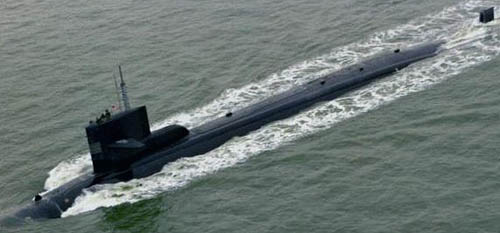
The Sturgeon class, designated as the 637 class, was a series of 37 nuclear-powered fast attack submarines in service with the United States Navy. Developed as an improved variant of the preceding Thresher/Permit class, construction took place between 1963 and 1975. The class remained in commission from 1967 until 2004, when it was replaced by the Los Angeles, Seawolf, and Virginia classes.
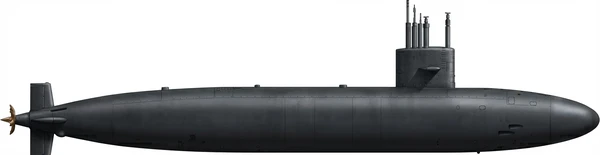
The design utilized a five-compartment arrangement consisting of the bow, operations, reactor, auxiliary machinery, and engine rooms. Internal modifications were made to meet SUBSAFE requirements, specifically regarding seawater and ballast systems. The sail was enlarged compared to previous classes to accommodate a second periscope and additional masts for intelligence gathering. This larger sail also served to prevent the submarine from broaching the surface in heavy seas. Fairwater planes mounted on the sail were designed to rotate 90 degrees, allowing the submarines to surface through thin ice.
Propulsion was provided by an S5W pressurized water reactor. While early units shared a standard length, the final nine boats featured a hull lengthened by 10 feet to accommodate additional electronic equipment and improve habitability. The class underwent mid-life upgrades during the 1980s, which integrated the BQQ-5 sonar suite, retractable towed arrays, and updated torpedo fire control systems. Torpedo tubes were positioned amidships to allow for a bow-mounted sonar sphere, which used either steel or glass-reinforced plastic domes.
Operational variants included seven boats modified to carry Dry Deck Shelters for the deployment of special forces and their delivery vehicles. The USS Parche was further modified with a 100-foot hull extension for research and development. Several units, including the Parche, L. Mendel Rivers, and Richard B. Russell, were utilized for reconnaissance and cable-tapping missions in the Barents and Okhotsk seas. The Parche received nine Presidential Unit Citations for its mission performance.
The Navy also utilized the Sturgeon design for experimental platforms. The USS Glenard P. Lipscomb was completed with a turbo-electric propulsion system, while the USS Narwhal incorporated a natural circulation reactor and additional noise-reduction features. Throughout their service history, Sturgeon-class submarines were employed in anti-submarine warfare, intelligence gathering, and Arctic operations. Phasing out of the class began in the 1990s, with the final unit retired in 2004.