Ticonderoga-class (CG-47)
Summary
| Origin country | 🇺🇸 United States |
| Category | Cruiser |
| Subtype | Guided-missile cruiser |
| Manufacturer | Ingalls Shipbuilding |
| Year commissioned | 1983 |
| Approx. unit cost | $1000 million |
| Units |
CG-52 Bunker Hill CG-53 Mobile Bay CG-56 San Jacinto CG-57 Lake Champlain CG-58 USS Philippine Sea CG-59 USS Princeton CG-60 USS Normandy CG-61 Monterey CG-62 USS Robert Smalls CG-64 USS Gettysburg CG-65 USS Chosin CG-66 Hué City CG-67 USS Shiloh CG-68 Anzio CG-70 USS Lake Erie CG-71 USS Cape St. George CG-72 Vella Gulf CG-73 Port Royal |
Operators
Technical specifications
| Displacement | 9800 tons |
| Range | 6000 km at 20 knots |
| Crew | 330 members |
| Width | 16.8 m (55.1 ft) |
| Length | 173.0 m (567.6 ft) |
| Air Park |
|
| Propulsion | 4 × General Electric LM2500 gas turbine engines, 2 × controllable-reversible pitch propellers, 2 × rudders |
| Thrust | 7500 hp |
| Armament |
|
| Maximum speed | 32 knots |
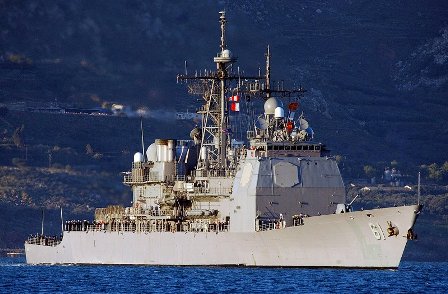
Description
The Ticonderoga class is a class of guided-missile cruisers operated by the United States Navy. Authorized in fiscal year 1978, the vessels were originally designated as guided-missile destroyers (DDG-47). The Navy reclassified the design as guided-missile cruisers (CG-47) prior to construction to reflect the integration of the Aegis Combat System, the AN/SPY-1 radar, and flagship facilities. The class utilizes a hull design based on the Spruance-class destroyer. A total of 27 ships were built between 1980 and 1994 by Ingalls Shipbuilding and Bath Iron Works.
The design centers on the Aegis Combat System, which enables the simultaneous scanning, tracking, and engagement of multiple targets. The superstructure houses the AN/SPY-1 phased-array antenna arrays in separate forward and aft deck-houses. Construction utilized modular techniques. Early vessels featured the Mark 26 twin-arm missile launcher, while ships from USS Bunker Hill (CG-52) onward were equipped with the Mark 41 Vertical Launch System. This system allows the class to carry a variety of munitions, including Tomahawk cruise missiles, Standard Missiles, Evolved SeaSparrow Missiles, and Vertical Launch ASROCs. For anti-submarine warfare, the ships employ the SQQ-89 sonar suite and operate two Seahawk helicopters. Upgrades to the Aegis system have enabled members of the class to operate as anti-ballistic missile and anti-satellite platforms.
The first ship in the class entered service in 1983. In July 1988, USS Vincennes shot down Iran Air Flight 655 during an engagement with Iranian gunboats. In February 2008, USS Lake Erie intercepted the non-functional satellite USA-193 using an SM-3 missile. In December 2024, USS Gettysburg shot down a U.S. Navy F/A-18F Super Hornet in a friendly fire incident. As of September 2025, seven vessels remain in active service.
Decommissioning of the class began in 2004, starting with the five units equipped with the Mark 26 launcher. The remaining vessels are undergoing retirement based on maintenance costs and hull age, with the final units scheduled for decommissioning through 2029 following a modernization program. The Flight III Arleigh Burke-class destroyer and the DDG(X) program are the planned replacements for the class.