Type 209-class
Summary
| Origin country | 🇩🇪 Germany |
| Category | Submarine |
| Subtype | Diesel-electric attack submarines |
| Manufacturer | Howaldtswerke-Deutsche Werft |
| Year commissioned | 1971 |
| Approx. unit cost | $285 million |
| Units |
S-31 Sábalo S-32 Caribe S111 HS Nireus S112 HS Triton S116 HS Poseidon S117 HS Amfitriti S118 HS Okeanos S119 HS Pontos S44 INS Shishumar S45 INS Shankush S46 INS Shalki S47 INS Shankul SO-28 ARC Pijao SO-29 ARC Tayrona SS-31 BAP Angamos SS-32 BAP Antofagasta SS-33 BAP Pisagua SS-34 BAP Chipana SS-35 BAP Islay SS-36 BAP Arica |
Operators
Technical specifications
| Displacement | 1285 tons |
| Displacement submerged | 1810 tons |
| Range | 11000 km at 10 knots |
| Endurance | 50 days |
| Crew | 36 members |
| Width | 6.5 m (21.3 ft) |
| Length | 64.4 m (211.3 ft) |
| Max. depth | 500 m (1640.4 ft) |
| Propulsion | Diesel-electric, 4 diesels, 1 shaft, 6,100 shp (4,500 kW) |
| Armament |
|
| Maximum speed | 11 knots |
| Max. speed submerged | 22 knots |
Description
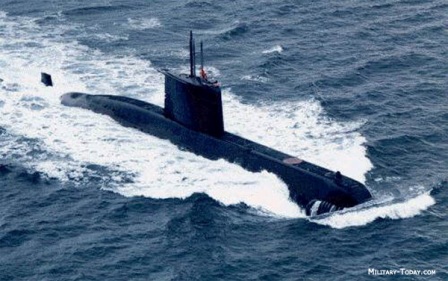
The Type 209 is a series of diesel-electric attack submarines developed for export by Howaldtswerke-Deutsche Werft. Designed in the late 1960s by Ingenieurkontor Lübeck, the class was based on the earlier Type 206 but incorporated increased equipment. The design was intended to replace World War II-era vessels and GUPPY conversions for navies seeking units with lower operational costs than standard Cold War-era designs. Greece became the first operator, commissioning the initial variant in 1971.
The submarine uses a single-hull construction, allowing the commanding officer to view the interior from bow to stern while at the periscope. Propulsion consists of four diesel engines and four generators, with battery banks located forward and aft of the command center. The class includes five primary variants, with several nations utilizing modified versions. Indian vessels include an integrated escape sphere, while Chilean units feature higher masts and additional escape hatches. Modernization programs for some navies have integrated air-independent propulsion systems, updated combat management suites, and the capability to deploy mines or anti-ship missiles.
Fifteen navies have operated the Type 209. Turkey is the largest operator of the class, while seven Latin American countries have adopted the design. During the 1982 Falklands War, the Argentine submarine ARA San Luis conducted a patrol and launched torpedoes against British naval forces. Although technical issues affected the weapon systems, the submarine remained undetected during the operation. Most units built since the 1970s remain in commission, though Greece and Turkey have begun replacing older vessels with newer designs. In 2021, the Indonesian Navy lost the KRI Nanggala during a training exercise. South Korea produces a variant known as the Jang Bogo class and serves as an independent exporter of the design, supplying units to Indonesia.