Oplot T-84U
Summary
| Origin country | 🇺🇦 Ukraine |
| Category | Main Battle Tank |
| Sub-type | Medium Main Battle Tank |
| Manufacturer | Malyshev HMB Plant |
| Number built | None units |
| Est. avg unit price | $5 million |
Technical specifications
| Crew | 3 personnels |
| Range | 540 km |
| Mass | 48.0 tons |
| Height | 2.28 m (7.5 ft) |
| Width | 3.56 m (11.7 ft) |
| Length | 9.72 m (31.9 ft) |
| Max. speed | 75 km/h (47 mph) |
| Engine | Diesel Engine with 1200 - 1500 hp |
| Weapon 1 | 1 2A46 125mm smoothbore barrel (40 shells) gun |
| Weapon 2 | 1 NSV 12.7mm machine gun (450 rounds) |
| Weapon 3 | 1 7.62mm PKT machine gun (1,250 rounds) |
Historical operators
Profile of Oplot T-84U
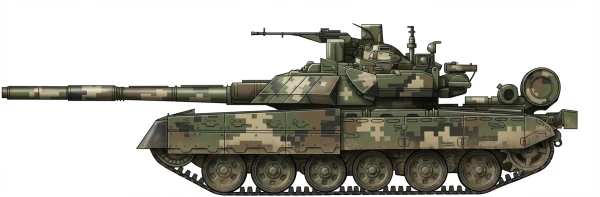
Description
The T-84 is a Ukrainian main battle tank developed by the Kharkiv Morozov Machine Building Design Bureau (KMDB). It is a derivative of the Soviet T-80UD, a version of the T-80 utilizing a diesel engine rather than a gas turbine. Development began in the mid-1970s with various prototypes under the Object 478 designation. Following the dissolution of the Soviet Union, the Malyshev Factory in Kharkiv transitioned to producing welded turrets to replace cast units previously sourced from Russia. The first T-84 prototype was completed in 1994, and the vehicle officially entered service with the Armed Forces of Ukraine in 1999 under the designation BM Oplot.
The vehicle features a conventional layout with a three-man crew. Primary armament consists of a 125 mm KBA-3 smoothbore cannon serviced by an automatic loading system. The main gun fires armor-piercing fin-stabilized discarding sabot (APFSDS), high-explosive anti-tank (HEAT), and high-explosive fragmentation (HE-FRAG) rounds. It is also capable of launching laser-guided missiles against armored vehicles and helicopters at ranges up to 5,000 meters. Secondary armament includes a KT-7.62 coaxial machine gun and a KT-12.7 anti-aircraft machine gun. The T-84-120 Yatagan variant was developed as an export prototype, featuring a 120 mm gun and a cassette-style bustle autoloader compatible with NATO-standard ammunition.
Protection is provided by a combination of multilayer passive armor and Duplet explosive reactive armor (ERA), which is designed to defeat tandem-charge warheads and kinetic energy penetrators. The tank utilizes the Varta optronic countermeasures system, integrating laser warning sensors, infrared jammers, and aerosol screen launchers to disrupt anti-tank guided missiles. Some models are also equipped with the Zaslin active protection system. The T-84 is powered by a 6TD-2E six-cylinder opposed-piston diesel engine, designed for performance in high-temperature environments. The chassis uses torsion bar suspension with hydraulic shock absorbers on the first, second, and sixth road wheel stations.
The T-84 is operated by the Armed Forces of Ukraine and the Royal Thai Army. In Ukrainian service, the tank has seen combat during the Russo-Ukrainian War, including deployment with the 3rd Tank Brigade and the 14th Mechanized Brigade in the Donbas region. Thailand acquired the Oplot-T variant, which was deployed during the 2025 Cambodia-Thailand conflict. Several units were also delivered to the United States for technical evaluation, including variants designated Object 478BEM and Object 478DU10.