T-84 Oplot vs T-80
T-84 Oplot vs T-80 at a glance — weight 48,000 vs 46,000 kg, top speed 75 vs 70 km/h, range 540 vs 415 km, crew 3 vs 3.
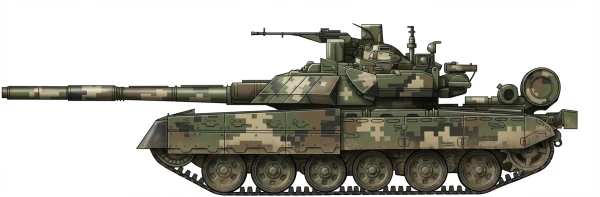
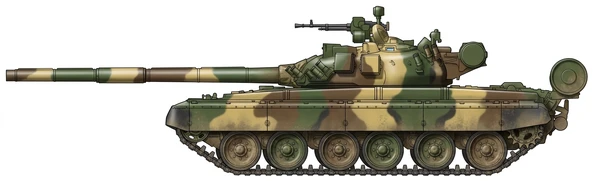
| T-84 Oplot | T-80 | |
|---|---|---|
| Origin country | 🇺🇦 Ukraine | 🇷🇺 Ex-USSR |
| Category | Main Battle Tank | Main Battle Tank |
| Type | Medium Main Battle Tank | Medium Main Battle Tank |
| Manufacturer | Malyshev HMB Plant | Malyshev HMB Plant |
| Number produced | 76 units | 5,500 units |
| Estimated unit price | $5 million | $2.5 million |
| Combat weight | 48.0 tons | 46.0 tons |
| Maximum speed | 75 km/h | 70 km/h |
| Operational range | 540 km | 415 km |
| Length | 9.72 m | 9.65 m |
| Width | 3.56 m | 3.60 m |
| Height | 2.28 m | 2.20 m |
| Crew | 3 | 3 |
| T-84 Oplot | T-80 | |
|---|---|---|
| Main armament | 1 2A46 125mm smoothbore barrel (40 shells) gun | 125 mm 2A46M-1 gun |
| Secondary weapon | 1 NSV 12.7mm machine gun (450 rounds) | 7.62 mm PKT coax MG |
| Engine | Diesel Engine with 1200 - 1500 hp | GTD-1250 turbine |
Detailed Comparison
The Ukrainian T-84 Oplot ($5.0 million per unit) and the Soviet-legacy T-80 ($2.5 million per unit) share a common T-64 lineage but execute different propulsion and armor configurations. The T-80 relies on a gas-turbine powerplant to equip large armored formations, prioritizing cold-start times and mass production. The T-84 replaces the turbine with a diesel engine and integrates indigenous survivability systems to sever dependence on Russian supply chains. With 5,500 units built, the T-80 acts as a primary maneuver element for Russian and Ukrainian forces. The T-84, limited to 76 units, serves as a low-volume alternative dictated by local industrial capacity.
Development and Design
The T-80 entered service in 1976 as the first mass-produced tank powered by a gas turbine. Designed at the Kirov Plant, it evolved from the T-64 chassis but integrated elements of the T-72 to support the high-torque GTD-1250 turbine engine. Following the Soviet collapse, Ukraine’s Malyshev Plant in Kharkiv—which had previously developed the diesel-powered T-80UD—initiated the T-84 project. The T-84 replaces the cast Russian-made turrets of early T-80s with welded turrets and swaps the fuel-heavy turbine for the 6TD-2E opposed-piston diesel engine. This adaptation was driven by post-1991 supply chain realities, requiring Kyiv to build an MBT independent of Russian components.
Protection and Firepower
Both tanks mount variants of the 125mm 2A46 smoothbore gun, fed by a carousel automatic loader. This autoloader dictates a three-man crew and exposes both platforms to catastrophic ammunition detonations, a vulnerability repeatedly documented in Chechnya, Syria, and Ukraine.
- The T-80 relies on Kontakt-5 or Relikt explosive reactive armor (ERA) in its modernized variants, though baseline models carry early-generation Kontakt-1 blocks.
- The T-84 integrates Ukrainian-designed Duplet ERA, built with multiple explosive layers to defeat tandem-charge warheads.
The T-84 further augments survivability with the Varta optronic countermeasure system and, on some units, the Zaslin active protection system (APS) to intercept incoming projectiles. At 48 tons, the T-84 carries two tons of additional armor compared to the 46-ton T-80.
Mobility and Logistics
The T-80's GTD-1250 turbine provides high acceleration and pushes the 46-ton vehicle to 70 km/h. This comes at the cost of high fuel consumption, limiting its operational range to 415 km and placing a heavy burden on supply lines. The T-84's 1,200 hp 6TD-2E diesel engine increases the operational range to 540 km while reaching 75 km/h. The diesel engine handles high-temperature environments better than the turbine, a factor that secured the Royal Thai Army's purchase of the Oplot-T variant.
Deployment and Combat Record
The T-80's combat record spans nearly three decades. During the 1994 First Chechen War, T-80s deployed in Grozny suffered high attrition rates due to inappropriate urban tactics and exposed roof armor. In the 2022 Russo-Ukrainian War, both sides have lost hundreds of T-80s to modern anti-tank guided missiles, loitering munitions, and artillery. The T-84 has seen limited combat. The 3rd Tank Brigade and 14th Mechanized Brigade deployed a handful of Oplots in the Donbas. While the Duplet ERA resisted tandem warheads in isolated engagements, the small fleet size prevents statistically valid conclusions regarding its overarching survivability compared to the T-80.
Conclusion
The T-84 Oplot is a better-protected and logistically sustainable platform than the baseline T-80. Its diesel engine eliminates the fuel constraints of the gas turbine, and the Duplet ERA provides a higher baseline defense against tandem-charge ATGMs than the T-80's Kontakt-series ERA. However, the T-80 wins on sheer availability and industrial backing. A tank that exists in the thousands dictates battlefield realities, whereas the T-84 remains a localized engineering exercise unable to alter the operational environment at scale.