T-84 Oplot vs T-90
T-84 Oplot vs T-90 at a glance — weight 48,000 vs 48,000 kg, top speed 75 vs 60 km/h, range 540 vs 550 km, crew 3 vs 3.
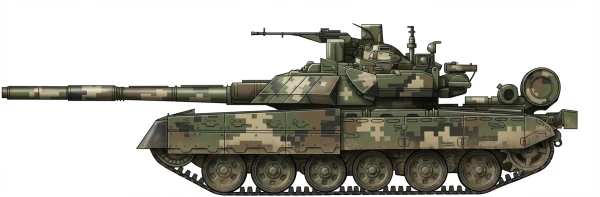
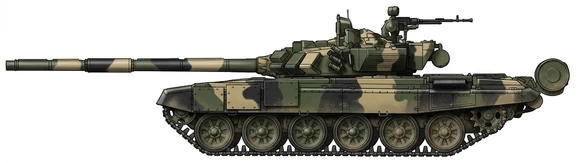
| T-84 Oplot | T-90 | |
|---|---|---|
| Origin country | 🇺🇦 Ukraine | 🇷🇺 Russia |
| Category | Main Battle Tank | Main Battle Tank |
| Type | Medium Main Battle Tank | Medium Main Battle Tank |
| Manufacturer | Malyshev HMB Plant | Malyshev HMB Plant |
| Number produced | 76 units | 4,000 units |
| Estimated unit price | $5 million | $4.5 million |
| Combat weight | 48.0 tons | 48.0 tons |
| Maximum speed | 75 km/h | 60 km/h |
| Operational range | 540 km | 550 km |
| Length | 9.72 m | 9.63 m |
| Width | 3.56 m | 3.78 m |
| Height | 2.28 m | 2.22 m |
| Crew | 3 | 3 |
| T-84 Oplot | T-90 | |
|---|---|---|
| Main armament | 1 2A46 125mm smoothbore barrel (40 shells) gun | 2A46M-5 125 mm smoothbore gun |
| Secondary weapon | 1 NSV 12.7mm machine gun (450 rounds) | 12.7mm Kord Heavy machine gun |
| Engine | Diesel Engine with 1200 - 1500 hp | V-92S2F |
Detailed Comparison
The Ukrainian T-84 Oplot and Russian T-90 are direct derivatives of the late-Cold War Soviet tank design tree. The T-84 iterates on the T-80UD chassis, while the T-90 is a modernized T-72B engineered for mass assembly. With over 4,000 T-90s built compared to just 76 T-84s, industrial scale dictates the operational footprint of these 48-ton platforms.
Development and Design
The T-90 originated as Object 188, a cheaper alternative to the Object 187, selected due to economic constraints in 1990s Russia. It retained the mechanical layout of the T-72 while integrating the fire control system of the T-80U. The T-84 evolved from the T-80UD, substituting the gas turbine for a diesel engine. Following the Soviet collapse, Kharkiv's Malyshev Factory designed a welded turret for the T-84 to sever reliance on Russian cast armor supply chains.
Protection and Firepower
Both vehicles utilize the 125mm 2A46-series smoothbore gun fed by carousel autoloaders. This configuration forces both platforms to store ammunition in the fighting compartment, creating the catastrophic detonation vulnerability documented heavily in recent conflicts. The defense schemes diverge in reactive armor application. The T-84 mounts Duplet ERA, layered to degrade tandem-charge warheads, coupled with the Varta countermeasures suite. The T-90 relies on Kontakt-5 or Relikt ERA, integrated with the Shtora electro-optical jammer. Later T-90M variants introduce multi-channel thermal sights and revised turret geometry, establishing a fire-control advantage over the older base T-84 models.
Mobility and Logistics
At 48 tons each, both tanks share a similar physical footprint, but their mobility profiles differ sharply:
- The T-84 utilizes a 6TD-2E opposed-piston diesel engine reaching 75 km/h.
- The T-90 relies on the V-92S2F powerplant, topping out at 60 km/h.
- The T-90's transmission limits reverse speed to 4 km/h, a documented liability during engagements in Ukraine.
- The T-84 transmission permits reverse speeds up to 32 km/h.
Despite inferior reverse mobility, the T-90 is sustained by an established global logistics chain supporting thousands of active units.
Deployment and Combat Record
The combat histories of both tanks are defined by the Russo-Ukrainian War. The T-90, deployed in the A, S, and M configurations, has taken high losses to top-attack ATGMs, artillery, and FPV drones, frequently suffering turret separations. Despite structural vulnerabilities, the T-90 achieved widespread export adoption, with India operating over 1,000 units. The T-84 saw limited deployment with Ukraine's 3rd Tank and 14th Mechanized Brigades. Production constraints crippled wider adoption; only 76 units were built, with a minor export batch delivered to Thailand.
Conclusion
The T-84 holds the tactical edge in direct armor engagements due to its 32 km/h reverse speed and tandem-defeating Duplet armor, allowing it to withdraw from firing lines without exposing its rear hull. However, as an operational asset, the T-90 holds the definitive advantage. The T-90M variant offsets base chassis flaws with third-generation thermals, digital battle management systems, and a mature industrial base capable of sustaining wartime attrition. The T-84 remains a mechanically refined but industrially orphaned platform, whereas the T-90 provides the sensors and supply chain required for sustained mechanized warfare.