AH-1W Super Cobra
American twin-engined attack helicopter, developed in the late 20th century, primarily operated by the United States Marine Corps for close air support and anti-armor missions. Key figures: top speed 350 km/h, range 587 km, service ceiling 3,700 m, max takeoff weight 6,690 kg, built 222. In service with 2 air forces as of 2026 — Taiwan (61), Turkey (9).
| Crew | 2 (pilot, co-pilot/gunner) |
| Length | 17.7 m (58.0 ft) |
| Wingspan | 13.9 m (45.6 ft) |
| Height | 4.2 m (13.7 ft) |
| Wing area | 140.7 m² (1515.0 sqft) |
| Empty weight | 4,627 kg (10,201 lbs) |
| Max. takeoff weight | 6,690 kg (14,749 lbs) |
| Powerplant | 2 × General Electric T700-401 1,260 kW each |
| Maximum speed | 350 km/h (217 mph) |
| Operational range | 587 km (365 mi) |
| Service ceiling | 3,700 m (12,139 ft) |
| Climb rate | 8.2 m/s (26.9 ft/s) |


- Air-to-Air Short-Range AIM-9 Sidewinder
- Anti-Tank TOW
- Anti-Tank AGM-114 Hellfire
- Air-to-Surface AGM-65 Maverick
- Rocket Pod Hydra 70
- Rocket Pod APKWS II
- Rocket Pod Zuni
Description
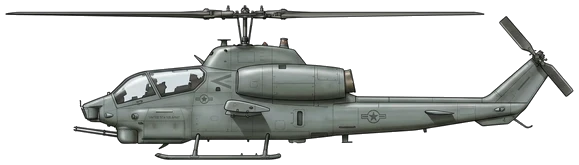
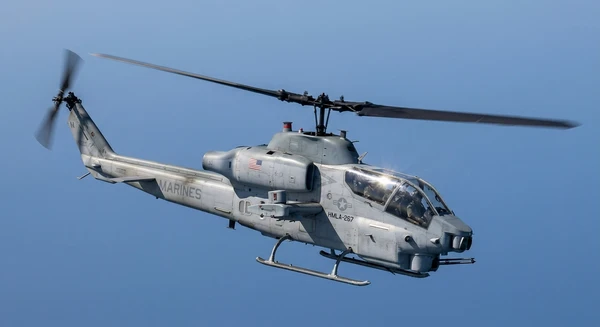
The Bell AH-1W SuperCobra is a twin-engine attack helicopter developed for the United States Marine Corps (USMC) as part of the Huey helicopter family. It was derived from the single-engine AH-1 Cobra to provide a twin-engine configuration for increased safety during maritime operations. Following the AH-1J SeaCobra and the AH-1T Improved SeaCobra, the AH-1W was developed in the early 1980s after Congress denied funding for the USMC to procure the AH-64 Apache. Deliveries of the AH-1W commenced in March 1986. Total production included 179 new-built aircraft and the upgrading of 43 existing AH-1Ts.
Design
The AH-1W is powered by two General Electric T700-401 turboshaft engines, each producing 1,690 shp. The aircraft has a maximum takeoff weight of 14,750 lb and a maximum speed of 190 knots. It features revised fire control systems to support a range of modern munitions and is designed for day and night operations. The fuselage is 45 feet 7 inches long, and the aircraft utilizes a two-blade main rotor system, although a four-blade composite rotor was later tested on the AH-1W prototype during the development of the AH-1Z Viper.
Armament
Internal armament consists of one 20 mm M197 three-barrel Gatling cannon housed in an A/A49E-7 turret with a 750-round capacity. External hardpoints allow the carriage of up to eight AGM-114 Hellfire or eight TOW anti-tank missiles. For air-to-air engagements, the aircraft carries two AIM-9 Sidewinder missiles on its outboard stations. Additional ordinance options include 70 mm Hydra 70 or APKWS II rockets, 127 mm Zuni rockets, and up to two AGM-65 Maverick missiles.
Operational History
During the Gulf War, 78 USMC SuperCobras flew 1,273 sorties and were credited with destroying 97 tanks and 104 armored personnel carriers. The type was also deployed for operations in Somalia, Haiti, and the Yugoslav Wars. In the 2003 invasion of Iraq, 46 of the 58 deployed AH-1Ws sustained battle damage, primarily from infantry weapons. The USMC retired the AH-1W in October 2020 after the fleet accumulated 933,614 flight hours. International operators include Taiwan, which maintains a fleet of 63 aircraft, and Turkey, which transferred its AH-1Ws to the Navy in 2022 for use on the TCG Anadolu. Iran utilized the earlier AH-1J variant for anti-armor and air-to-air combat during the Iran-Iraq War.
Variants
- AH-1J SeaCobra: The original twin-engine production version equipped with a three-barrel 20 mm XM197 cannon.
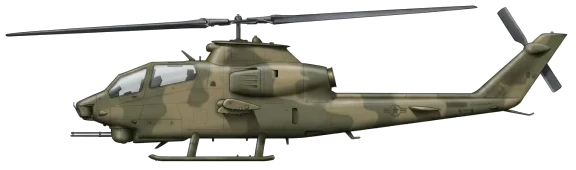
- AH-1T Improved SeaCobra: An upgraded version featuring a lengthened fuselage and tailboom, improved transmission, and full TOW missile capability.
- AH-1W SuperCobra: A day/night capable variant featuring T700-GE-401 engines and revised fire control systems for Hellfire and Sidewinder missiles.
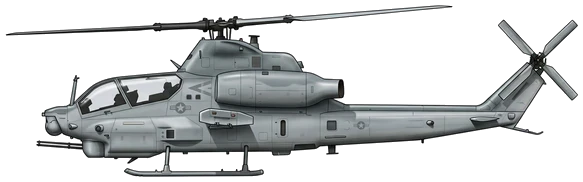
- AH-1Z Viper: A modernized development of the AH-1W featuring a four-blade composite main rotor and the Target Sight System — covered in detail on its own page.
- IAIO Toufan: An Iranian-manufactured variant of the AH-1J International featuring locally sourced avionics and weapons.
Frequently Asked Questions
What type of aircraft is the AH-1W Super Cobra?
What is the maximum speed of the AH-1W Super Cobra?
What is the range of the AH-1W Super Cobra?
How many AH-1W Super Cobra have been built?
Which countries operate the AH-1W Super Cobra?
What is the service ceiling of the AH-1W Super Cobra?
- JUL 272026 Updated Sources and cross-references refreshed
- JUL 242026 Updated Description updated
- MAY 102026 Created Page created: AH-1W Super Cobra