AH-64 Apache
American attack helicopter, developed during the Cold War, most famous for significant deployments in Gulf War and Afghanistan conflict. Key figures: top speed 293 km/h, range 480 km, service ceiling 6,096 m, max takeoff weight 10,107 kg, unit price $33M, built 2,700. In service with 19 air forces as of 2026 — United States (822), Israel (48), United Kingdom (47) and 16 others.
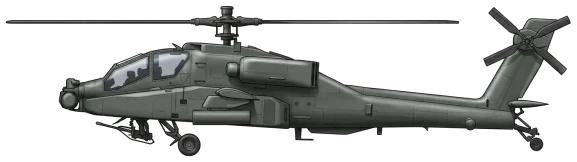

| Crew | 2 (pilot, co-pilot/gunner) |
| Length | 17.7 m (58.2 ft) |
| Wingspan | 14.6 m (48.0 ft) |
| Height | 5.0 m (16.2 ft) |
| Empty weight | 5,352 kg (11,799 lbs) |
| Max. takeoff weight | 10,107 kg (22,282 lbs) |
| Powerplant | 2 × turboshafts General Electric T700-GE-701C 1,208 kW each |
| Maximum speed | 293 km/h (182 mph) |
| Operational range | 480 km (298 mi) |
| Service ceiling | 6,096 m (20,000 ft) |
| Climb rate | 15.7 m/s (51.5 ft/s) |
-
 United States
822 +15
-
 Israel
48 +12
-
 United Kingdom
47
-
 Egypt
45 +10
-
 South Korea
36
-
 Saudi Arabia
34 +49
-
 United Arab Emirates
30 +10
-
 Taiwan
29
-
 Greece
28
-
 India
28
-
 Qatar
24
- 🇸🇬 Singapore 19
-
 Netherlands
18 +10
-
 Morocco
18 +6
-
 Kuwait
16 +8
-
 Japan
12
-
 Poland
8 +96
-
 Indonesia
8
-
 Australia
6 +23
- Anti-Tank Lockheed-Martin AGM-114 Hellfire
- Air-to-Air Short-Range Raytheon AIM-92 Stinger
- Air-to-Surface AGM-65 Maverick
- Anti-Tank Rafael Spike
Recent Events — AH-64 Apache
22 events →-
OCT 162026
 Netherlands
×2
Apaches 25 and 26 of 28 remanufactured to AH-64E standard flown into Woensdrecht by C-17; the last two are due in 2027.
Delivered
-
OCT 142026
 Israel
×12
Agreement signed with the Pentagon for 12 AH-64E Apache Echo attack helicopters; deliveries from the early 2030s, price undisclosed.
Ordered
-
SEP 172026
 Morocco
×6
Third batch of six AH-64E Apaches delivered to Khouribga by USAF C-17, bringing the Moroccan fleet to 18.
Delivered
-
AUG 122026
 United States
Crashed during a training flight near Salado, Texas; both crew members killed and a 155-acre grass fire started.
Crash
-
JUN 82026
United States
Apache patrolling near the Strait of Hormuz downed by Iranian fire; both crew rescued by a Navy drone boat within two hours.
Shot down
Description
The AH-64 Apache is an American twin-turboshaft attack helicopter with a tandem two-seat cockpit and tailwheel landing gear, developed by Hughes Helicopters for the U.S. Army, built by McDonnell Douglas from 1984 and by Boeing Defense, Space & Security since 1997. It entered U.S. Army service in April 1986 as the replacement for the AH-1 Cobra, armed with a 30 mm M230 chain gun, AGM-114 Hellfire missiles and Hydra 70 rockets and, from the AH-64D onward, fitted with the mast-mounted AN/APG-78 Longbow fire-control radar. As of March 2024, more than 2,700 had been delivered to the U.S. Army and 18 export customers.
Development
After the AH-56 Cheyenne was cancelled in 1972, the Army, barred by the 1948 Key West Agreement from operating combat fixed-wing aircraft, issued a request for proposals for the Advanced Attack Helicopter (AAH) on 15 November 1972. Five companies bid, and in July 1973 Bell and Hughes were chosen to build prototypes. The Hughes Model 77/YAH-64A first flew on 30 September 1975, a day before the Bell YAH-63A, and the Army selected it in 1976, citing its more damage-tolerant four-blade main rotor and the instability of the YAH-63's tricycle landing gear.
Operational Test II in 1981 led to the 1,260 kW (1,690 shp) T700-GE-701 engine; the helicopter was named Apache in late 1981 and approved for full-scale production in 1982. McDonnell Douglas bought Hughes Helicopters for $470 million in 1984 and merged into Boeing in August 1997. The AH-64D Apache Longbow was approved in August 1990; its prototype flew on 15 April 1992, full-scale production was approved on 13 October 1995 and the first production AH-64D flew on 17 March 1997. The Block III, redesignated AH-64E Guardian in 2012, began deliveries in November 2011 and passed 500 aircraft by April 2020. In 2024 the Mesa, Arizona, line was building 82 a year, but in April 2025 the Army said it would stop procuring the type after a Pentagon directive against obsolete manned aircraft.
Design
The Apache has four-blade main and tail rotors and seats the pilot behind and above the co-pilot/gunner; either can fly the aircraft and fire its weapons. Two General Electric T700 turboshafts with high-mounted exhausts power it: the 1,409 kW (1,890 shp) T700-GE-701C from 1990 and, since 2004, the 1,500 kW (2,000 shp) T700-GE-701D. Some 1,100 kg (2,500 lb) of ballistic protection lets the crew compartment and rotor blades absorb 23 mm hits, the fuel system is self-sealing and the structure meets the MIL-STD-1290 crash standard. Empty weight is 5,165 kg (11,387 lb) and maximum take-off weight 10,433 kg (23,000 lb); maximum speed is 293 km/h (158 kn), combat range 480 km (260 nmi) and service ceiling 6,100 m (20,000 ft).
The Integrated Helmet and Display Sighting System (IHADSS) slaves the M230 to either crew member's head movements, while the nose-mounted Target Acquisition and Designation System/Pilot Night Vision System (TADS/PNVS), replaced on later aircraft by Lockheed Martin's Arrowhead (MTADS) turret, provides day, night and adverse-weather targeting. The AH-64D's AN/APG-78 Longbow millimetre-wave radar sits above the rotor so the aircraft can detect targets from behind terrain; it can track up to 128 targets and prioritise up to 16 for engagement. The AH-64E adds the L-3 MUMT-X datalink for controlling RQ-7 Shadow and MQ-1C Gray Eagle UAVs up to full flight control, and Link 16.
Armament
The under-nose 30 mm M230 chain gun carries 1,200 rounds. Four pylon stations on the stub wings carry up to 16 AGM-114 Hellfire missiles (including the thermobaric AGM-114N fielded since 2005), designed to defeat stationary or moving tanks at up to 6,500 m (4 mi), or Hydra 70, CRV7 and laser-guided APKWS 70 mm rockets. Longbow aircraft add wingtip stations for AIM-92 Stingers. The MBDA Brimstone completed testing in July 2016, the Army began fielding the Spike NLOS on AH-64Es in January 2020 as an interim stand-off weapon, and Israeli Apaches can carry Spike instead of Hellfire.
Operational History
The Army accepted its first production AH-64A in January 1984, and 7th Battalion, 17th Cavalry Brigade began training on it at Fort Hood in April 1986. The Apache first fought in Panama in 1989. In Operation Desert Storm, eight AH-64As led by four MH-53 Pave Lows opened the air campaign on 17 January 1991 by destroying part of Iraq's radar network; 277 AH-64s then destroyed 278 tanks and more than 500 vehicles in total during the ground war for one loss to a rocket-propelled grenade.
From 2001 the AH-64 flew close combat attack in Afghanistan, including Operation Anaconda. On 24 March 2003 an attack on an Iraqi Republican Guard brigade near Karbala left 31 Apaches damaged and one down with its crew captured, and by 2006 the Army had scaled back deep attack missions. The 1st Battalion, 229th Aviation Regiment fielded the first AH-64Es on 21 February 2013 and took 24 to Afghanistan in March 2014. Apaches joined Operation Inherent Resolve against Islamic State on 4 October 2014. On 9 June 2026, during the 2026 Iran war, a U.S. AH-64 was shot down over the Strait of Hormuz by what the U.S. President said was Iranian drone fire; a Task Force 59 sea drone recovered both crew. As of January 2025 the Army had about 750 Apaches: an estimated 160 AH-64Ds and 590 AH-64Es.
The Israeli Air Force received AH-64As from 1990 and its first AH-64D in April 2005. Israeli Apaches killed Hezbollah's secretary-general in Lebanon on 16 February 1992, fought in Lebanon and Gaza and downed an Iranian UAV on 10 February 2018. The British Army replaced its 67 Westland-built Apache AH1s with 50 AH-64Es ordered in July 2016 for $2.3 billion, in service from 2022. Saudi and Emirati Apaches have flown against the Houthis since 2009 and 2015, and UAE AH-64s used their cannon against Iranian Shahed drones in 2026, losing one to a technical fault on 9 March 2026. Other operators include the Netherlands, Egypt, Greece, Singapore, Kuwait, Japan, Taiwan, South Korea, Qatar, Indonesia and India, whose air force inducted 22 AH-64Es from September 2019 and whose army received the last of six on 17 December 2025. Poland selected 96 AH-64Es in September 2022, Australia took the first two of 29 in September 2025 and Morocco had received 12 of 36 by April 2026.
Variants
- AH-64A: Original production model with TADS/PNVS and T700-GE-701 engines, switched to the -701C in 1990; the Army retired its last in July 2012.
- AH-64D Apache Longbow: Glass-cockpit rebuild with -701C engines, enlarged forward fuselage and the mast-mounted AN/APG-78 radar, delivered from March 1997; Block II added digital communications from February 2003.
- AH-64E Apache Guardian: Former Block III with T700-GE-701D engines, face gear transmission, composite blades, MUMT-X UAV control and a maritime-capable Longbow radar, delivered since November 2011.
- AH-64DJP: Japanese AH-64D built under licence by Fuji Heavy Industries with AIM-92 Stinger capability; 13 of 50 planned were completed.
- AH-64D-I / AH-64Ai: Israeli standards with Elta communications, Elbit mission management, Rafael Combat Net and Elisra self-protection suites, the Ai being an upgraded AH-64A.
- Apache AH1 (WAH-64): British licence-built AH-64D Block I with Rolls-Royce RTM322 engines and folding rotor blades for shipboard use, 67 built and retired by 2024.
Frequently Asked Questions
What type of aircraft is the AH-64 Apache?
What is the maximum speed of the AH-64 Apache?
What is the range of the AH-64 Apache?
When did the AH-64 Apache first fly?
How many AH-64 Apache have been built?
Which countries operate the AH-64 Apache?
How much does a AH-64 Apache cost?
What is the service ceiling of the AH-64 Apache?
- NOV 12026 Updated Service ceiling updated (AH-64E)
- OCT 222026 Updated Number built updated (production continues)
- OCT 32026 Updated Description expanded with the AAH programme, Longbow and AH-64E upgrades, combat record and export operators to 2026
- AUG 62026 Updated Description updated
- AUG 52026 Updated Powerplant updated in a site-wide editorial pass
- JUL 232026 Updated Sources and cross-references refreshed
- JUN 262026 Updated Missiles updated