AH-1 Cobra
American attack helicopter, distinguished for its service in the Vietnam War, designed for rapid frontline response and anti-armor operation. Key figures: top speed 277 km/h, range 570 km, service ceiling 6,096 m, max takeoff weight 8,391 kg, unit price $13M, built 1,116. In service with 9 air forces as of 2026 — South Korea (60), Japan (50), Pakistan (50) and 6 others.
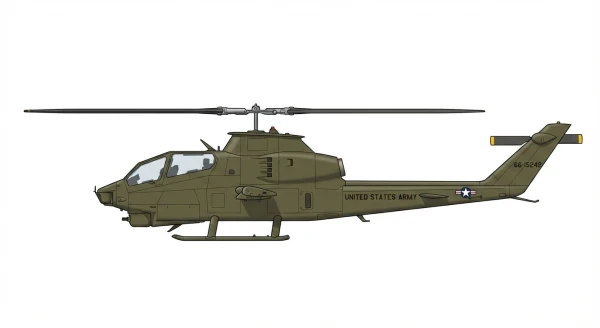
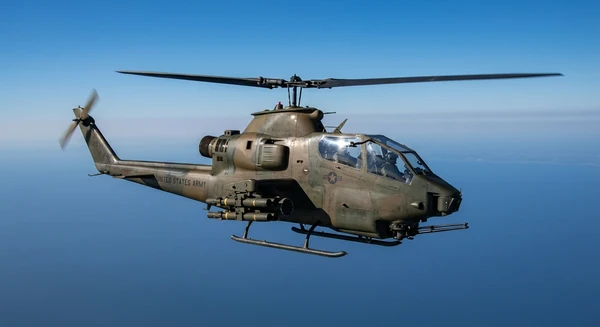
| Crew | 2 (pilot, co-pilot/gunner) |
| Length | 17.8 m (58.3 ft) |
| Wingspan | 13.4 m (44.0 ft) |
| Height | 4.4 m (14.4 ft) |
| Empty weight | 5,579 kg (12,300 lbs) |
| Max. takeoff weight | 8,391 kg (18,499 lbs) |
| Powerplant | 2 × turboshafts General Electric T700-GE-401C 1,342 kW each |
| Maximum speed | 277 km/h (172 mph) |
| Operational range | 570 km (354 mi) |
| Service ceiling | 6,096 m (20,000 ft) |
| Climb rate | 14.2 m/s (46.6 ft/s) |


- Anti-Tank Lockheed-Martin AGM-114 Hellfire
- Air-to-Surface Lockheed-Martin AGM-179 JAGM
- Air-to-Air Short-Range Raytheon AIM-9 Sidewinder
Recent Events — AH-1 Cobra
5 events →

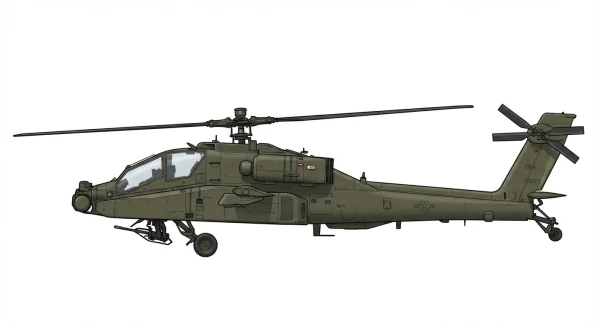
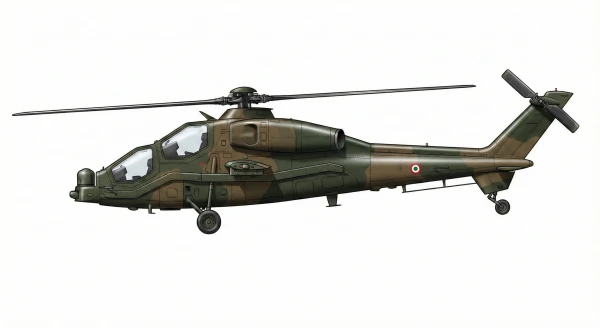
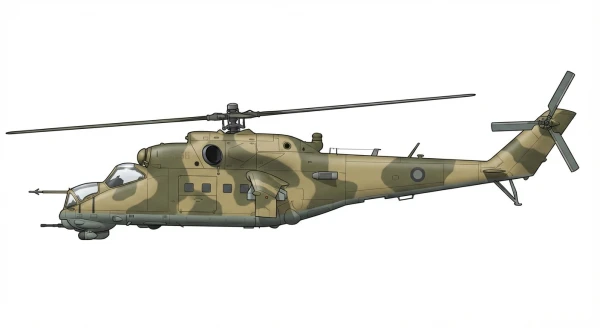
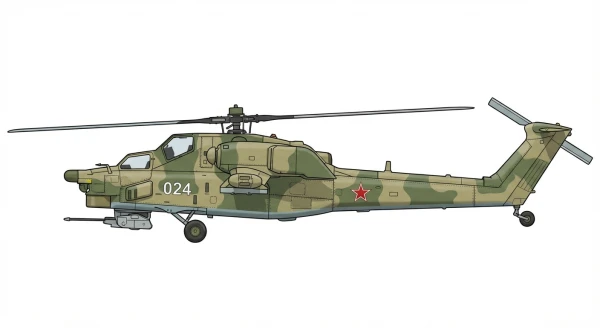
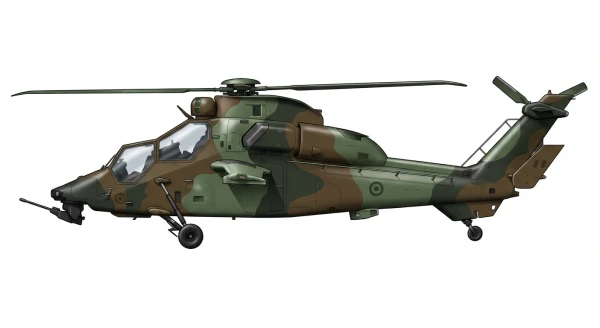
Description
The Bell AH-1 Cobra is an American single-engine attack helicopter developed by Bell Helicopter to escort transport helicopters and provide close air support. Derived from dynamic components of the UH-1 Iroquois, the aircraft entered service with the United States Army in June 1967. It features a narrow airframe with a chin-mounted turret and a two-seat tandem cockpit.
Development
Bell developed the Model 209 prototype in 1965 using company funds to meet an urgent U.S. Army requirement for an armed escort in Vietnam. The design mated the T53 turboshaft engine, transmission, and rotor system of the UH-1 with a narrow fuselage. The Model 209 first flew on 7 September 1965, leading to an initial Army contract for 110 aircraft in April 1966. Bell produced 1,116 AH-1Gs for the U.S. Army between 1967 and 1973. Production modifications included fixed landing skids, a right-side tail rotor, and composite rotor blades.
Design
The AH-1 features a tandem cockpit where the gunner sits in the front seat and the pilot in the rear, both equipped with flight controls and armor protection. Power is provided by a single Lycoming T53 turboshaft engine. Avionics and defensive systems include the Stability Control Augmentation System, a helmet-mounted sight, a laser rangefinder, a head-up display, and an infrared jammer on later variants.
Armament
Primary turret armament consists of a chin turret housing two 7.62 mm Miniguns, two 40 mm grenade launchers, or an M197 20 mm three-barreled cannon. Stub wings provide four hardpoints capable of mounting 7-round or 19-round 2.75-inch rocket pods, as well as quad-launchers for TOW anti-tank missiles using a nose-mounted Telescopic Sight Unit.
Operational History
The U.S. Army deployed the AH-1 to Vietnam in 1967, where the fleet logged over one million flight hours in fire support, transport escort, and hunter-killer missions, losing approximately 300 aircraft. The type saw combat in Grenada, Panama, and the Gulf War before U.S. Army retirement in 2001 following replacement by the Boeing AH-64 Apache. Israel operated the AH-1 extensively in Lebanon to destroy armor, while Fuji Heavy Industries licensed 89 units for Japan. Turkey, Jordan, Pakistan, and the Philippines also operated the type.
Variants
- AH-1G HueyCobra: Initial production variant for the U.S. Army powered by a 1,400 shp Avco Lycoming T53-13 engine.
- AH-1Q HueyCobra: Upgraded AH-1G equipped with the M65 Telescopic Sight Unit and TOW missile system.
- AH-1S: Variant upgraded with an 1,800 shp T53-L-703 turboshaft engine and composite main rotor blades.
- AH-1E: Production variant equipped with the Enhanced Cobra Armament System featuring a 20 mm M197 cannon.
- AH-1F: Modernized model incorporating a head-up display, laser rangefinder, and infrared jammer.
Frequently Asked Questions
What type of aircraft is the AH-1 Cobra?
What is the maximum speed of the AH-1 Cobra?
What is the range of the AH-1 Cobra?
When did the AH-1 Cobra first fly?
How many AH-1 Cobra have been built?
Which countries operate the AH-1 Cobra?
How much does a AH-1 Cobra cost?
What is the service ceiling of the AH-1 Cobra?
- AUG 62026 Updated Description updated
- AUG 52026 Updated Powerplant updated in a site-wide editorial pass
- JUL 242026 Updated Description updated
- JUL 232026 Updated Sources and cross-references refreshed
- APR 72026 Updated Sources and cross-references refreshed
- JAN 122026 Updated Range updated in a site-wide editorial pass