TAI Anka-3
Turkish flying-wing stealth unmanned combat aerial vehicle developed by Turkish Aerospace Industries for strike, electronic warfare and loyal-wingman missions alongside the KAAN fighter. Key figures: top speed 787 km/h, range 1,075 km, service ceiling 12,000 m, max takeoff weight 7,250 kg.
| Length | 8.9 m (29.2 ft) |
| Wingspan | 13.1 m (43.0 ft) |
| Height | 2.6 m (8.5 ft) |
| Max. takeoff weight | 7,250 kg (15,983 lbs) |
| Powerplant | 1 × Ivchenko-Progress AI-322 |
| Maximum speed | 787 km/h (489 mph) |
| Operational range | 1,075 km (668 mi) |
| Endurance | 10 hours |
| Service ceiling | 12,000 m (39,370 ft) |
- SOM-J air-launched cruise missile
- IIR-guided air-to-air missile (planned)
- Radar-guided air-to-air missile (planned)
- Tolun guided glide bomb
- Teber-82 laser-guided bomb
- Mk 82 general-purpose bombs



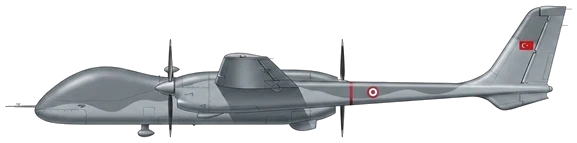
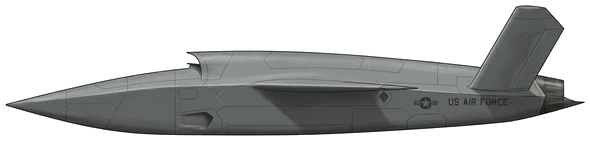
Description
The TAI Anka-3 is a flying-wing stealth unmanned combat aerial vehicle (UCAV) developed by Turkish Aerospace Industries (TAI). Alongside Baykar's Bayraktar Kızılelma, it is one of two Turkish jet-powered stealth UCAV programs, designed for deep strike, electronic warfare, signals intelligence and manned-unmanned teaming, including operation as a loyal wingman for the KAAN fighter. It shares its ground segment and avionics architecture with the TAI Anka and Aksungur.
In prototype form the Anka-3 is 8.9 m long with a 13.1 m wingspan, a maximum takeoff weight of 7,250 kg and a 1,600 kg payload carried in an internal bay and on five external stations. Powered by a single Ivchenko-Progress AI-322 turbofan, it reaches 787 km/h, a 12,000 m service ceiling, a 1,075 km combat range and around 10 hours of endurance; production aircraft are planned to receive twin TEI-TF10000 engines. Sensors include the ASELSAN MURAD 100-A AESA radar and electro-optical targeting systems, with weapons including the SOM-J cruise missile and Tolun and Teber-82 guided bombs.
Development
The maiden flight took place on 28 December 2023. Milestones include a first live-fire test in September 2024, control by another aircraft in the loyal-wingman role in October 2024, and an internal-munitions strike test in January 2025. One of two prototypes was lost in a landing accident during the Anatolian Eagle exercise on 25 June 2025. TAI subsequently froze the production design, with two updated prototypes and a Turkish Air Force order reported to exceed 50 aircraft expected in 2026; the type was not yet in service as of mid-2026.
Frequently Asked Questions
What type of aircraft is the TAI Anka-3?
What is the maximum speed of the TAI Anka-3?
What is the range of the TAI Anka-3?
When did the TAI Anka-3 first fly?
What is the service ceiling of the TAI Anka-3?
- JUL 272026 Updated Name updated
- JUL 232026 Created Page created: Anka-3