GlobalMilitary.net Open-source military intelligence Updated daily

KAAN

Turkish fifth-generation stealth twin-engine air superiority fighter under development by Turkish Aerospace Industries to replace the Turkish Air Force's F-16 fleet from the late 2020s.

Origin country
🇹🇷 Turkey
First flight
2024Feb 21
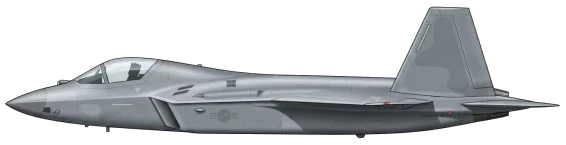
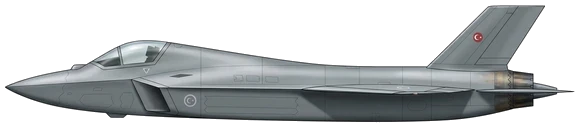
TAI KAAN combat aircraft side profile drawing
Side profile · TAI KAAN · length 20.3 m
Technical Specifications
Crew1
Length20.3 m (66.6 ft)
Wingspan13.4 m (44.0 ft)
Height5 m (16.4 ft)
Wing area71.6 m² (770.7 sqft)
Max. takeoff weight34,750 kg (76,611 lbs)
Powerplant2 × General Electric F110-GE-129 66 kN each
Performance
Maximum speed1912 km/h (Mach 1.91)
Service ceiling16,764 m (55,000 ft)
Operators — 2026
No country is operating the KAAN in 2026.
Armament
Missiles payload
  • Gökdoğan BVR air-to-air missile
  • Gökhan ramjet-powered BVR air-to-air missile
  • Bozdoğan short-range IR air-to-air missile
  • SOM cruise missile family
  • Kuzgun air-to-surface missile family
  • Akbaba anti-radiation missile
  • Çakır cruise missile family
Bombs payload
  • HGK-82/83/84 precision-guided bombs
  • KGK-82/83 wing-assisted guidance kits
  • Teber-81/82 laser-guided bombs
  • SARB-83 and NEB-84 penetrator bombs
  • MAM-T smart micro munition
Compare This Aircraft

Description

The TAI KAAN, previously known as the TF-X and MMU (Milli Muharip Uçak, "National Combat Aircraft"), is a fifth-generation stealth, twin-engine, all-weather air superiority fighter developed by Turkish Aerospace Industries (TAI). Approved in 2010 and formally contracted in 2016, the program aims to replace the Turkish Air Force's F-16 Fighting Falcons, with BAE Systems providing design assistance under a 2017 agreement.

Design

The KAAN features internal weapons bays, an airframe optimized for low radar cross-section, and supercruise ambitions. TAI's preliminary specifications list a length of 20.3 m, a maximum takeoff weight of 34,750 kg, a top speed of Mach 1.8, and a 16,764 m service ceiling. Prototypes and initial Block 10 aircraft use two General Electric F110-GE-129 turbofans of 131 kN each in afterburner, pending the indigenous TEI TF35000 engine planned after 2030. The sensor suite includes ASELSAN's MURAD AESA radar, distributed electro-optical apertures, and provisions for controlling unmanned wingmen such as the Anka-3 and Kızılelma.

The first prototype, P0, flew on 21 February 2024 at Mürted Airfield. In February 2026 TAI unveiled three prototypes, with the redesigned P1 expected to fly in mid-to-late 2026 and six prototypes planned in total. In June 2026 the United States moved to approve a $705 million export of F110 engines for KAAN Block 10. The Turkish Air Force plans around 100 aircraft, with 20 Block 10 jets targeted from 2028; Indonesia signed for 48 aircraft in July 2025, alongside Egyptian participation in the program.

Frequently Asked Questions

What type of aircraft is the KAAN?
The TAI KAAN is a combat aircraft aircraft developed by TAI.
What is the maximum speed of the KAAN?
The TAI KAAN has a maximum speed of 1,912 km/h (Mach 1.5).
When did the KAAN first fly?
The TAI KAAN made its first flight on February 21, 2024.
What is the service ceiling of the KAAN?
The TAI KAAN has a service ceiling of 16,764 meters (55,000 feet). This is the maximum altitude at which the aircraft can maintain controlled flight.
Wikipedia (CC BY-SA) and other open sources. Illustrations generated by AI. Last updated on 23 July 2026. Suggest a change