Air Tractor AT-500
Taiwanese trainer aircraft, utilized for basic flight training during the late 20th-century. Key figures: top speed 248 km/h, range 1,300 km, service ceiling 11,000 m, max takeoff weight 4,754 kg, unit price $0.5M, built 470.
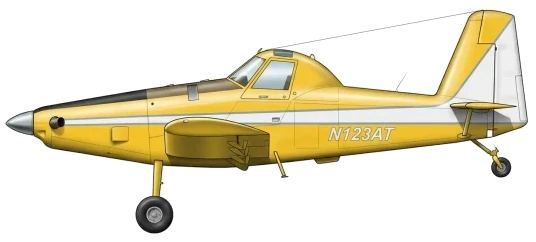
| Crew | 2 |
| Length | 10.2 m (33.5 ft) |
| Wingspan | 15.9 m (52.0 ft) |
| Height | 3.0 m (9.8 ft) |
| Wing area | 26.8 m² (288.0 sqft) |
| Empty weight | 2,109 kg (4,650 lbs) |
| Max. takeoff weight | 4,754 kg (10,481 lbs) |
| Powerplant | 1 × Pratt & Whitney PT6A-34AG turboprop 560 kW each |
| Maximum speed | 248 km/h (154 mph) |
| Operational range | 1,300 km (808 mi) |
| Service ceiling | 11,000 m (36,089 ft) |
| Climb rate | 18.0 m/s (59.1 ft/s) |
Description
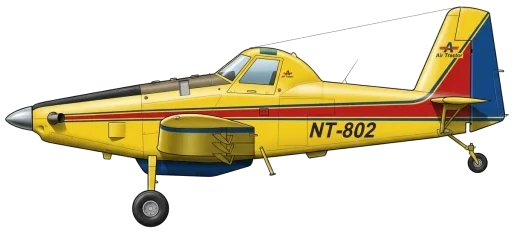
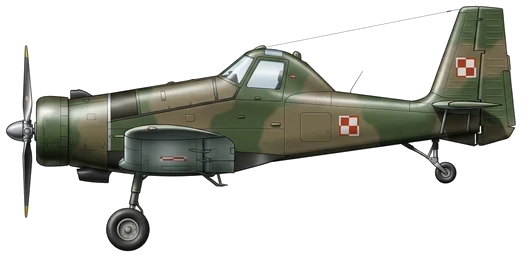
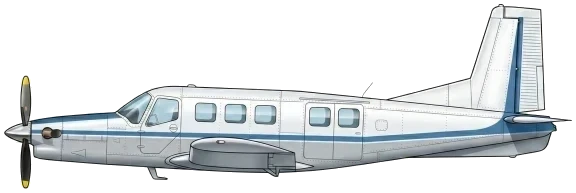
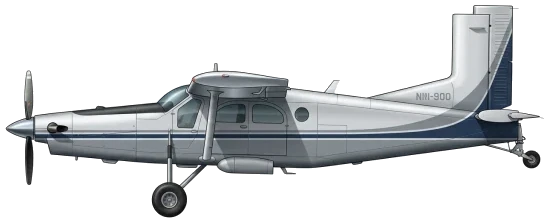
The Air Tractor AT-500 family of agricultural aircraft was first flown on April 25, 1986, in the United States by Air Tractor Inc. The AT-500 is a monoplane with a low-wing and taildragger configuration. It was designed with a chemical hopper situated between the engine firewall and the cockpit. A key feature distinguishing the AT-500 from its predecessors was its increased wingspan of 50 inches (12.7 cm) and a fuselage stretch of 22 inches (56 cm), which allowed for a larger chemical hopper. Almost all variants were designed to accommodate a widened "buddy" seat or a tandem seat for a passenger, observer, or loader, and trainer aircraft with full dual controls were also offered.
Armament
The Air Tractor AT-500 family is primarily designed for agricultural applications and is not equipped with traditional military armament. Its main payload is a chemical hopper located between the engine firewall and the cockpit, capable of carrying 500 US gal (420 imp gal; 1,900 L). The aircraft has a substantial payload capacity of 5,830 lb (2,640 kg), allowing it to effectively disperse agricultural chemicals.
Operational History
As an agricultural aircraft, the Air Tractor AT-500 family has seen extensive operational use in various regions around the globe, wherever aerial application of chemicals and fertilizers is required. Its deployment spans a wide range of agricultural settings, from large-scale farming operations to smaller, more specialized applications. The aircraft's operational strengths include its robust design, high payload capacity, and efficient performance, making it well-suited for demanding agricultural tasks. The AT-502B became the world's top-selling agricultural aircraft between 2011 and 2018, with 388 deliveries.
Variants
Main Variants:
-
AT-501: The initial piston-powered version featured a 600 shp Pratt & Whitney R-1340 engine, accommodating a single seat, and had a gross weight of 6,500 lb.
-
AT-502: An upgraded version of the AT-501, it was equipped with either a 680 shp Pratt & Whitney Canada PT6A-15AG or a 750 shp PT6A-34AG engine, and offered one or two seats with a gross weight of either 6,500 lb or 8,000 lb depending on production date and wing spar type.
-
AT-502A: Optimized for high-altitude and high-temperature environments, this variant utilized a more powerful 1,100 shp PT6A-65AG or 1,050 shp PT6A-60AG engine, and provided options for one or two seats in either a tandem or side-by-side arrangement.
-
AT-502B: Serving as the primary production model, it evolved from the AT-502, featuring a 750 shp PT6A-34AG engine, and offering one or two seats configured in tandem or side-by-side.
-
AT-504: This dual-control trainer variant of the AT-502B was equipped with side-by-side seating, replacing the tandem-seat AT-503 trainers, and was introduced in 2009.
Frequently Asked Questions
What type of aircraft is the Air Tractor AT-500?
What is the maximum speed of the Air Tractor AT-500?
What is the range of the Air Tractor AT-500?
When did the Air Tractor AT-500 first fly?
How many Air Tractor AT-500 have been built?
Which countries operate the Air Tractor AT-500?
How much does a Air Tractor AT-500 cost?
What is the service ceiling of the Air Tractor AT-500?
- JUL 272026 Updated Name updated
- APR 72026 Updated Sources and cross-references refreshed