PC-6 Porter
Swiss light utility aircraft, renowned for its versatility and ruggedness, extensively utilized in remote areas for cargo transport and search and rescue missions. Key figures: top speed 244 km/h, range 730 km, service ceiling 10,000 m, max takeoff weight 2,800 kg, unit price $0.06M, built 604. In service with 12 air forces as of 2026 — Iran (15), Switzerland (14), Thailand (14) and 9 others.
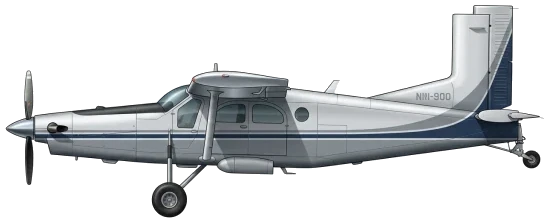
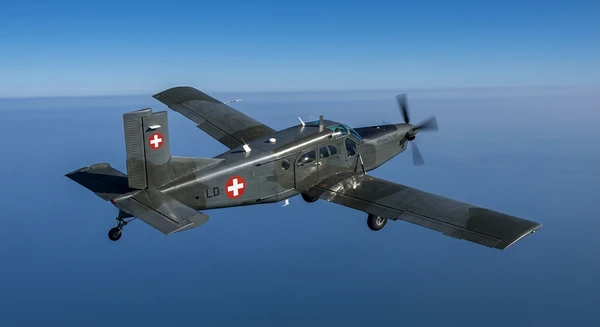
| Crew | 1 |
| Length | 10.9 m (35.8 ft) |
| Wingspan | 15.9 m (52.1 ft) |
| Height | 3.2 m (10.5 ft) |
| Wing area | 30.2 m² (324.5 sqft) |
| Empty weight | 1,260 kg (2,778 lbs) |
| Max. takeoff weight | 2,800 kg (6,173 lbs) |
| Powerplant | 1 × turboprop Pratt & Whitney Canada PT6A-27 410 kW each |
| Maximum speed | 244 km/h (152 mph) |
| Operational range | 730 km (454 mi) |
| Service ceiling | 10,000 m (32,808 ft) |
| Climb rate | 5.13 m/s (16.8 ft/s) |
| Takeoff distance | 152 m (499 ft) |
-
 Iran
15
Iran
15
-
 Switzerland
14
Switzerland
14
-
 Thailand
14
Thailand
14
-
 Austria
8
Austria
8
-
 France
5
France
5
-
 Myanmar
5
Myanmar
5
-
 Algeria
3
Algeria
3
-
 Slovenia
2
Slovenia
2
-
 Argentina
1
Argentina
1
-
 Mauritania
1
Mauritania
1
-
 Mexico
1
Mexico
1
-
 Peru
1
Peru
1
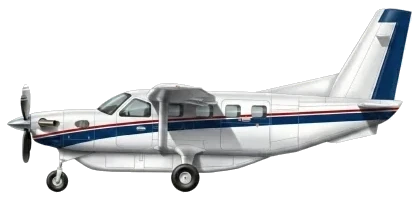
Description
Designed by Pilatus Aircraft of Switzerland, the PC-6 Porter is a single-engine STOL utility aircraft that first flew on 4 May 1959 with a 254 kW (340 shp) piston engine. In May 1961, the first Turbo Porter, equipped with a Turbomeca Astazou II turboprop engine, conducted its maiden flight. The Astazou II variant offered increased gross capacity and top speed, as well as automatic handling functions. Early turbine-powered models initially used the Astazou II powerplant, however, reliability concerns led to the adoption of the Garrett AiResearch TPE 331 as an alternative. By May 1966, the first PC-6 equipped with the Pratt & Whitney Canada PT6A engine performed its initial flight. Production primarily occurred at Pilatus Flugzeugwerke in Stans, Switzerland, but was also undertaken under license by Fairchild Hiller in the United States. To mitigate manufacturing costs, Pilatus distributed production work to other countries, including the Czechia and, later, China, with the intention of eventually transferring global production to a facility in Chongqing. After 604 deliveries, Pilatus ended production in 2022.
Design
Most PC-6s are powered by a single Pratt & Whitney Canada PT6A turboprop engine, driving a fully reversible, constant-speed, three-bladed HC-B3TN-3D or a four-bladed HC-D4N-3P Hartzell aluminium propeller. The aircraft’s undercarriage is designed to provide high wing and propeller clearances, reducing its susceptibility to damage on unprepared surfaces; various landing gear types, including floats and skis, can be installed. The airframe is constructed to be rugged and require low maintenance, with high accessibility and interchangeability of parts. The wings, fuselage, and empennage are manufactured using conventional semi-monocoque construction techniques, with the primary structure composed of aluminium, treated for corrosion resistance; the central structure retains critical strength despite the cutout areas for the main cabin’s sliding doors. For role flexibility, individual aircraft can be converted for various mission types, such as transport, paradrop, aerial photography, surveillance, air medical services, and search and rescue.
Operational History
The PC-6 has seen deployment in various theaters around the world, often operating from challenging environments that would be inaccessible to most fixed-wing aircraft. During the Vietnam War, the CIA-controlled airline Air America operated up to 23 PC-6s for missions including paradropping supplies, transporting passengers, conducting psychological warfare, performing reconnaissance, and other intelligence operations. Since 1976, the Austrian Air Force has utilized a fleet of 12 PC-6 Porters in support roles such as transport, search and rescue, firefighting, observation, target-towing, and paradropping. The AU-23A Peacemaker, a gunship version used by the U.S. Air Force during the Vietnam War, proved troublesome and was quickly withdrawn from service. In 1996, a PC-6 was used in Zaire during the First Congo War, but it was lost due to an accident shortly after arriving. Its operational strengths lie in its STOL capabilities, allowing it to operate from short, unprepared airstrips in remote areas and at high altitudes. A noted weakness, particularly in early models, was the reliability of the Turbomeca Astazou II engine, which led some operators to retrofit their aircraft with the Garrett AiResearch TPE 331. The PC-6 has been used globally by various military, law enforcement, and civil operators, with a significant portion of the European fleet being utilized for skydiving activities.
Variants
Main Variants:
-
PC-6/340 Porter: The initial production version, it was powered by a 254-kW (340-hp) Lycoming GSO-480-B1A6 flat-six piston engine and had a maximum takeoff weight of 1,960 kg (4,320 lb).
-
PC-6/A Turbo-Porter: This was the initial turboprop-powered version, fitted with a 390 kW (523 shp) Turbomeca Astazou IIE or IIG turboprop engine.
-
PC-6/B Turbo-Porter: This variant was powered by a 410-kW (550-shp) Pratt & Whitney Canada PT6A-6A turboprop engine.
-
PC-6/B2-H4 Turbo-Porter: This version featured improved airframe structuring and extended, upturned wingtips.
-
AU-23A Peacemaker: An armed gunship, counter-insurgency, and utility transport version for the U.S. Air Force, 15 were built under license in the USA by Fairchild Industries and used during the Vietnam War in the early 1970s.
Frequently Asked Questions
What type of aircraft is the PC-6 Porter?
What is the maximum speed of the PC-6 Porter?
What is the range of the PC-6 Porter?
When did the PC-6 Porter first fly?
How many PC-6 Porter have been built?
Which countries operate the PC-6 Porter?
How much does a PC-6 Porter cost?
What is the service ceiling of the PC-6 Porter?
- APR 72026 Updated Sources and cross-references refreshed
- MAR 172026 Updated Description updated
- JAN 122026 Updated Range updated in a site-wide editorial pass