C-2 Greyhound
Summary
| Category | Military Transport Aircraft |
| Origin country | 🇺🇸 United States |
| Manufacturer | Northrop Grumman |
| First flight | 18 November 1964 |
| Year introduced | 1966 |
| Number produced | 56 units |
| Average unit price | $39 million |
Technical specifications
| Version: C-2A(R) | |
|---|---|
| Operational range | 2,400 km (1,491 mi) |
| Maximum speed | 635 km/h (395 mph) |
| Wing area | 65 m² (699.7 sqft) |
| Wingspan | 24.6 m (80.7 ft) |
| Height | 4.9 m (15.9 ft) |
| Length | 17.1 m (56.1 ft) |
| Service ceiling | 10,211 m (33,501 ft) |
| Empty weight | 15,307 kg (33,746 lbs) |
| Max. takeoff weight | 27,216 kg (60,001 lbs) |
| Climb rate | 13.3 m/s (43.6 ft/s) |
| Powerplant | 2 x turboprops Allison T56-A-425 delivering 3430 kW each |
Current operating countries
| Country | Units | ||
|---|---|---|---|

|
United States | 26 | |

|
Japan | 16 (+6) | |
All operators
Description
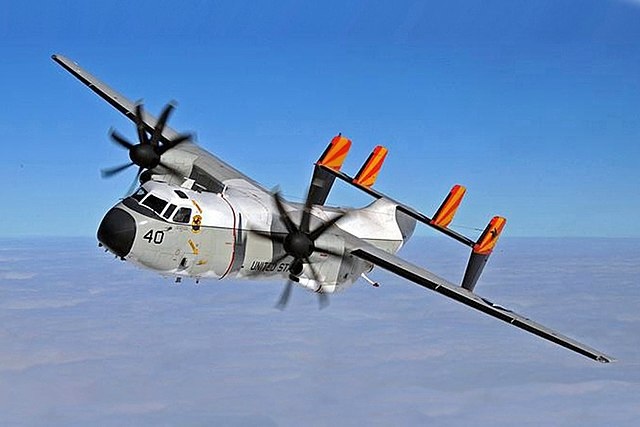
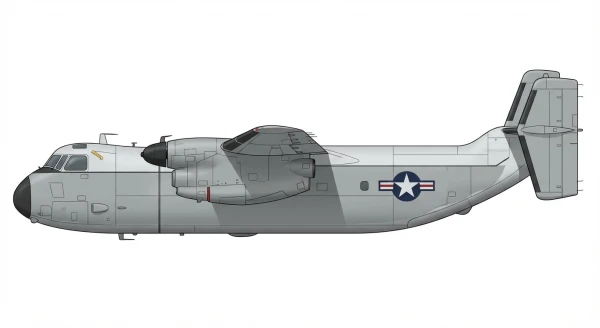
The C-2 Greyhound was developed to meet the U.S. Navy's requirement for a dedicated carrier onboard delivery (COD) aircraft, replacing the piston-engine Grumman C-1 Trader. Derived from the Northrop Grumman E-2 Hawkeye, the C-2 shares the same Allison T56 turboprop engines and folding "Sto-Wings," but features a widened fuselage and a rear loading ramp optimized for efficient cargo handling. Grumman secured the production contract, with the first of two prototypes flying in 1964, leading to production commencing in 1965. A total of 17 initial C-2A aircraft were built. These aircraft underwent an overhaul in 1973 to extend their operational service life. In 1984, the Navy ordered 39 new C-2A aircraft, officially designated C-2A(R), or Reprocured C-2A, which incorporated airframe enhancements and improved avionics, including systems based on the E-2C variant.
Powered by two Allison T56 turboprop engines, the C-2A is designed primarily for transport roles and does not carry offensive or defensive weaponry. It is capable of delivering up to 10,000 pounds (4,500 kg) of cargo or up to 28 passengers, typically operating with a mix of cargo and passengers. The aircraft can also be configured to accommodate litter patients for medical evacuations. A design element is the use of four vertical stabilizers, three of which are fitted with rudders. This configuration ensures adequate directional control without exceeding height restrictions for aircraft carrier hangar decks, positioning the outboard rudder surfaces directly in line with the propeller wash for effective yaw control at low airspeeds. Later upgrades to the C-2A(R) included structural improvements to the center wing, the integration of an eight-bladed NP2000 propeller, navigational system updates, crash-survivable flight-incident recorders, and a ground proximity warning system.
Operational deployments have included logistics support for carrier strike groups. Between November 1985 and February 1987, VR-24 with its seven reprocured C-2As transported 2,000,000 pounds of cargo, 2,000,000 pounds of mail, and 14,000 passengers in the European and Mediterranean theaters. The C-2A(R) provided support to carrier battle groups during Operation Desert Shield, Desert Storm, and Operation Enduring Freedom. In June 2011, two C-2A(R) Greyhounds were loaned to the French Navy to support logistics for the aircraft carrier Charles de Gaulle during the NATO intervention in Libya, returning to U.S. control after 16 days.
Main Variants:
-
YC-2A: The prototype variant, converted from E-2A Hawkeyes, featured a redesigned fuselage.
-
C-2A: This was the initial production variant of the Greyhound, with a total of 17 aircraft built.
-
C-2A(R): Known as the "Reprocured" C-2A, this version incorporated improved systems based on the E-2C variant.
-
Greyhound 21: A concept only, this turbofan-powered variant was proposed for various roles, including anti-submarine warfare, electronic warfare, electronic surveillance, carrier onboard delivery, and aerial refueling.