Kawasaki C-1
Japanese transport aircraft, notable for its use in the Self-Defense Forces during the Cold War era. Key figures: top speed 806 km/h, range 3,353 km, service ceiling 11,580 m, max takeoff weight 45,000 kg, unit price $50M, built 31.
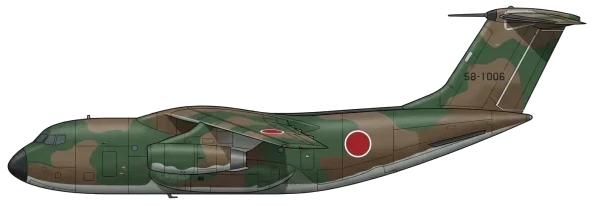
| Crew | 5 (pilot, co-pilot, WSO, flight engineer, loadmaster) |
| Length | 29 m (95.1 ft) |
| Wingspan | 30.3 m (99.4 ft) |
| Height | 10.0 m (32.8 ft) |
| Wing area | 120.5 m² (1297.0 sqft) |
| Empty weight | 24,300 kg (53,572 lbs) |
| Max. takeoff weight | 45,000 kg (99,208 lbs) |
| Powerplant | 2 × turbofans Pratt & Whitney JT8D-M-9 6,574 kgf each |
| Maximum speed | 806 km/h (501 mph) |
| Operational range | 3,353 km (2,083 mi) |
| Service ceiling | 11,580 m (37,992 ft) |
| Climb rate | 17.8 m/s (58.4 ft/s) |
| Takeoff distance | 439 m (1,440 ft) |
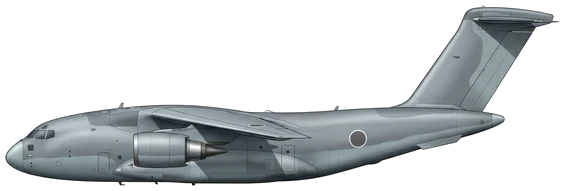
Description
The Kawasaki C-1 is a twin-engined short-range military transport aircraft developed and manufactured by Kawasaki Heavy Industries of Japan. Operated solely by the Japan Air Self-Defense Force (JASDF), it entered regular service in 1974 as an indigenous jet replacement for the Second World War-era Curtiss C-46 Commando. It formed the backbone of JASDF airlift into the 21st century and was retired in March 2025, replaced by the Kawasaki C-2.
Development
By 1966 the JASDF transport fleet consisted primarily of C-46s, and officials lobbied for a domestically designed replacement; the requirement was incorporated into the Third Defense Buildup Plan. The JASDF approached the Nihon Aircraft Manufacturing Corporation (NAMC), then producing the YS-11, and design work began in 1966. Following a design review, NAMC named Kawasaki Heavy Industries as prime contractor. Mitsubishi Heavy Industries built the tail section and the middle and rear fuselage, Fuji Heavy Industries most of the wings, Shin Meiwa the rudder, and NIPPI Corporation the flaps. The C-1 was the third indigenous postwar Japanese aircraft programme, after the Fuji T-1 and the YS-11. The XC-1 prototype first flew on 12 November 1970, with quantity production beginning the following year. Procurement was curtailed in favour of the C-130H — which entered service with the 401st Tactical Airlift Squadron in 1989 — partly because the C-1 could not fly directly to Okinawa from most of the home islands, and partly because of 1970s defence cutbacks. MITI briefly studied a commercial derivative before abandoning it in favour of collaboration on the Boeing 767.
Design
The C-1 is a twin-engine medium-range airlifter broadly resembling a scaled-down Lockheed C-141 Starlifter, powered by two Pratt & Whitney JT8D-M-9 low-bypass turbofans built under licence by Mitsubishi, each rated at 64 kN (14,500 lbf). A high-lift system comprising leading-edge slats and four-stage Fowler flaps provides short takeoff and landing performance, while electronic navigation equipment permits day, night and all-weather operation. Normal payload is 8,000 kg, and the type can carry 80 equipped troops, 45 paratroopers or 36 stretchers, plus vehicles such as a truck or two jeeps loaded through a rear ramp. Maximum speed is 806 km/h at 7,620 m, range 3,353 km with maximum fuel and a 2,300 kg payload, and maximum takeoff weight 38,700 kg. The crew numbers five: two pilots, flight engineer, navigator and loadmaster. The last five aircraft ordered received an additional 4,730-litre fuel tank.
Operational History
After about a year of flight testing, the two prototypes were handed to the JASDF for evaluation, and the type entered regular service in 1974. It equipped the 401st Tactical Airlift Squadron (1973–1989), the 403rd (1979–2018) and the 402nd, which flew it until the end. As of March 2022, seven C-1s remained in JASDF service; the last four airframes, including the EC-1 electronic-warfare trainer and the C-1FTB test aircraft, made their final flights between 12 and 14 March 2025, ending JASDF C-1 operations. Losses include two aircraft that struck a hill near Toba, Mie on 19 April 1983, killing 14; 58-1010, written off at Iruma Air Base on 18 February 1986; and one lost in the Sea of Japan on 28 June 2000 with five aboard. The National Aerospace Laboratory acquired one airframe as a research testbed.
Variants
- XC-1: Prototypes, first flown 12 November 1970.
- C-1/C-1A: Medium-range military transport production version.
- EC-1: Electronic warfare training aircraft.
- C-1FTB: Flight test bed used for trials of various equipment.
- Asuka/QSTOL: National Aerospace Laboratory quiet STOL research aircraft powered by four FRJ710 turbofans using upper-surface blowing and the Coandă effect, preserved at the Gifu-Kakamigahara Air and Space Museum.
Frequently Asked Questions
What type of aircraft is the Kawasaki C-1?
What is the maximum speed of the Kawasaki C-1?
What is the range of the Kawasaki C-1?
When did the Kawasaki C-1 first fly?
How many Kawasaki C-1 have been built?
Which countries operate the Kawasaki C-1?
How much does a Kawasaki C-1 cost?
What is the service ceiling of the Kawasaki C-1?
- SEP 252026 Updated Retirement from JASDF service in March 2025 recorded
- AUG 302026 Updated Description updated
- AUG 52026 Updated Climb rate added
- JUL 272026 Updated Name updated
- JUL 232026 Updated Sources and cross-references refreshed
- APR 72026 Updated Sources and cross-references refreshed
- JAN 122026 Updated Range updated in a site-wide editorial pass