CL-41 Tutor
Summary
| Category | Military Training Aircraft |
| Origin country | 🇨🇦 Canada |
| Manufacturer | Canadair |
| First flight | 13 January 1960 |
| Year introduced | 1963 |
| Number produced | 212 units |
Technical specifications
| Version: CT-114 | |
|---|---|
| Operational range | 1,519 km (944 mi) |
| Maximum speed | 782 km/h (486 mph) |
| Wing area | 20 m² (215.3 sqft) |
| Wingspan | 11.1 m (36.3 ft) |
| Height | 2.9 m (9.4 ft) |
| Length | 10 m (32.8 ft) |
| Service ceiling | 13,564 m (44,501 ft) |
| Empty weight | 2,195 kg (4,839 lbs) |
| Max. takeoff weight | 4,990 kg (11,001 lbs) |
| Climb rate | 21.4 m/s (70.2 ft/s) |
| Powerplant | 1 x turbojet Orenda J85-CAN-40 delivering 1202 kgf each |
Current operating countries
All operators
Description
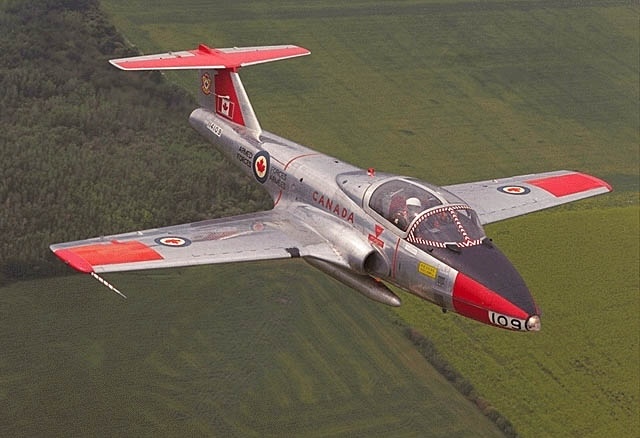
The CL-41 Tutor's development began as a private venture by Canadair to create an indigenous trainer aircraft. By August 1957, the basic configuration, featuring a turbojet engine, low-wing design, tricycle undercarriage, and side-by-side cockpit, was finalized. The aircraft was designed as a purpose-built trainer for elementary to advanced jet flight training. Despite initial lack of government support, the Royal Canadian Air Force's (RCAF) Directorate of Training’s Jet Trainer Liaison Committee engaged closely with Canadair, significantly influencing the final design. Both the Canadian Government and Canadair financed a pair of flight-capable prototypes, manufactured at Canadair’s Plant 4 facility. On 13 January 1960, the prototype completed its maiden flight, following delays due to engine development issues. Although the prototype used a Pratt & Whitney JT12A-5 engine, production aircraft were equipped with the General Electric J85 engine. The fuselage design was made to accommodate different engines without structural modifications; the Armstrong-Siddeley Viper ASV11, Continental Gabizo, Rolls-Royce RB.108, and Fairchild J83-R-1 were considered early on.
The CT-114 Tutor is a single-engine turbojet-powered trainer aircraft, purpose-designed for the training role, known for its high level of reliability and favorable operating economics. Its performance capabilities include a top speed of 795 km/h (429 kt) at altitude and a diving speed of 885 km/h (478 kt), contrasting with a stalling speed of 71 kt. Aerodynamically stable, the Tutor features manual flight controls with spring tabs. The side-by-side cockpit typically seats the instructor on the right and the student pilot on the left, with full flight controls normally only available on the left-hand side. A rear-hinged canopy covers both crew members, and the cabin can be pressurized to a differential of 3 psi (20 kPa). For aerial displays, the Tutor can be fitted with a smoke generator, including under-fuselage pods for the pressurized diesel fuel.
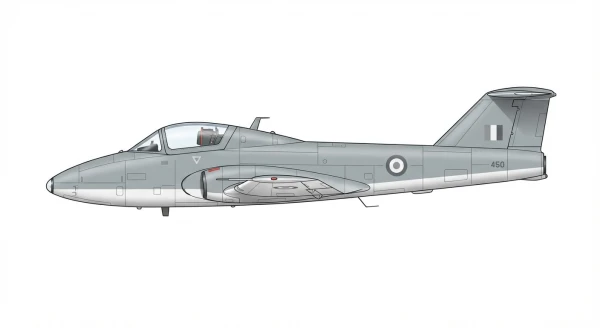
The Canadair CL-41G variant, known as the Tebuan in Royal Malaysian Air Force (RMAF) service, was adapted for armament training and light attack duties. This model featured an upgraded engine and was equipped with underwing hardpoints, enabling it to carry up to 4,000 lb (1814 kg) of external stores, including various weapons and drop tanks.
During September 1961, the Canadian government placed an order for 190 CL-41A variants on behalf of the Royal Canadian Air Force (RCAF), which designated it the CT-114 Tutor. The Tutor served as the primary trainer for over three decades, with the majority stationed at CFB Moose Jaw, Saskatchewan, and also at the Central Flying School at CFB Winnipeg, Manitoba. In 1976, 113 aircraft were upgraded with enhanced avionics and provisions for belly-mounted external fuel tanks. The Royal Malaysian Air Force (RMAF) ordered twenty CL-41G-5 Tebuan aircraft in March 1966 as counterinsurgency (COIN) aircraft. The Tebuan entered service in 1967 and was operated by the RMAF for over twenty years before being replaced by the Aermacchi MB-339A in June 1986. The CT-114 was replaced as the RCAF's principal training aircraft in 2000 by the CT-155 Hawk and CT-156 Harvard II; however, it continues to be used in limited numbers for experimental and aerial display purposes.
Main Variants:
-
CL-41: These were the two prototypes, CF-LTW-X and CF-LTX-X, utilized for internal engineering and testing programs.
-
CL-41A: This variant comprised 190 trainers produced for the RCAF and Canadian Forces, designated as the CT-114, with some later modified for the Snowbirds aerobatic team with smoke-generating systems.
-
CL-41G: This was a unique version developed for the Royal Malaysian Air Force (RMAF), consisting of 20 ground-attack variants known as the "Tebuan" in RMAF service.
-
CL-41R: Only one of this conversion was ever made; CF-LTX-X was modified with a CF-104 nose to demonstrate the use of CF-104/F-104G radar and avionics, but no production examples were built.