F-104 Starfighter
American supersonic interceptor, notable for Cold War operations, deployed extensively by NATO and several other international air forces. Key figures: top speed 2,500 km/h, range 2,623 km, service ceiling 15,240 m, max takeoff weight 13,170 kg, unit price $1.4M, built 2,578.
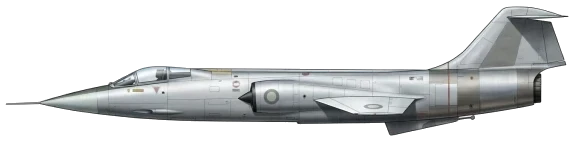
| Crew | 1 |
| Length | 16.7 m (54.7 ft) |
| Wingspan | 6.4 m (20.9 ft) |
| Height | 4.1 m (13.4 ft) |
| Wing area | 18.2 m² (196.1 sqft) |
| Empty weight | 6,350 kg (13,999 lbs) |
| Max. takeoff weight | 13,170 kg (29,035 lbs) |
| Powerplant | 1 × turbojet General Electric J79-GE-11A 7,076 kgf each |
| Ejection seat | Martin-Baker Mk 7 |
| Maximum speed | 2500 km/h (Mach 2.4) |
| Operational range | 2,623 km (1,630 mi) |
| Service ceiling | 15,240 m (50,000 ft) |
| Climb rate | 244.0 m/s (800.5 ft/s) |
Description
The Lockheed F-104 Starfighter is an American single-engine supersonic interceptor built as part of the USAF Century Series and later developed into an all-weather multirole fighter-bomber. It entered service on 26 February 1958 and was produced under licence in Europe, Canada and Japan for fifteen NATO and allied air forces. It was the first production aircraft to reach Mach 2, the first to carry the M61 Vulcan cannon, and the first to hold the world speed, altitude and time-to-climb records simultaneously.
Development
Kelly Johnson, head of Lockheed's Skunk Works, interviewed USAF pilots in South Korea in November 1951 and returned to design a small, simple fighter optimised for speed and climb. His team studied over 100 configurations before settling on a 12,000 lb airframe around the General Electric J79. Lockheed received a contract for two XF-104 prototypes on 12 March 1953; Tony LeVier flew the first on 4 March 1954 at Edwards AFB, powered by a Wright J65 as the J79 was unavailable. Seventeen YF-104As were ordered on 30 March 1955. For West Germany, Lockheed reworked the airframe as the F-104G with 96 new forgings, reinforced landing gear and NASARR radar. Four European consortia, plus Canadair, produced the type under licence, coordinated by NASMO at Koblenz. Total production reached 2,578.
Design
The all-metal airframe used duralumin with stainless steel and titanium. The straight, mid-mounted trapezoidal wing had a thickness-to-chord ratio of 3.36%, an aspect ratio of 2.45, 26-degree leading-edge sweep and 10-degree anhedral; leading edges were 0.016 in thick and required protective guards during maintenance. A boundary layer control system blew bleed air over the trailing-edge flaps, cutting landing speed by over 30 knots. The stabilator was mounted atop the fin. The J79 fed from side intakes with fixed inlet cones; the J79-GE-19 produced 79.6 kN with afterburner. Early aircraft used the downward-firing Stanley C-1 seat, later replaced by the Lockheed C-2 and, on many export aircraft, the Martin-Baker Mk.7.
Armament
The M61 Vulcan cannon was mounted in the lower port fuselage with a 725-round drum, firing at 6,000 rounds per minute. Two AIM-9 Sidewinders could be carried on wingtip stations. The F-104C added a centreline pylon capable of carrying a Mk 28 or Mk 43 nuclear weapon plus two underwing pylons; the F-104S had nine hardpoints and carried AIM-7 Sparrow and later Selenia Aspide missiles, with a maximum external load of 7,500 lb against 4,000 lb for other variants.
Operational History
The 83rd Fighter Interceptor Squadron at Hamilton AFB became operational in February 1958 and deployed to Taiwan that September during the Second Taiwan Strait Crisis. F-104As were airlifted to Europe during the 1961 Berlin Crisis. In Vietnam, Starfighters flew 5,206 combat sorties between 1965 and 1967 for 14 losses and no air-to-air kills. Pakistani F-104s claimed kills in 1965 and 1971; ROCAF F-104Gs downed two MiG-19s on 13 January 1967. The Luftwaffe lost 292 of 916 aircraft and 116 pilots between 1961 and 1989. Italy retired the last operational Starfighters on 31 October 2004.
Variants
- F-104A: Initial single-seat interceptor, 153 built, exported to Jordan, Pakistan and Taiwan.
- F-104C: USAF Tactical Air Command fighter-bomber with five pylons and in-flight refuelling, 77 built.
- F-104G: Most-produced version, 1,127 built, with strengthened structure, NASARR F15A radar and Litton LN-3 INS.
- F-104S: Final production version, 246 built by Fiat for Italy and Turkey, with nine hardpoints and Sparrow capability.
- CF-104: 200 Canadair-built nuclear strike aircraft with Orenda J79-OEL-7 engines.
Frequently Asked Questions
What type of aircraft is the F-104 Starfighter?
What is the maximum speed of the F-104 Starfighter?
What is the range of the F-104 Starfighter?
When did the F-104 Starfighter first fly?
How many F-104 Starfighter have been built?
Which countries operate the F-104 Starfighter?
How much does a F-104 Starfighter cost?
What is the service ceiling of the F-104 Starfighter?
- AUG 302026 Updated Description updated
- AUG 122026 Updated Range corrected to the ferry range
- AUG 52026 Updated Thrust updated
- JUN 262026 Updated Bombs added
- APR 72026 Updated Sources and cross-references refreshed
- JAN 242026 Updated Top speed updated
- JAN 122026 Updated Range updated in a site-wide editorial pass