GlobalMilitary.net Open-source military intelligence Updated daily
Military Training Aircraft ·British Aerospace

Hawk

British trainer jet, distinguished in Red Arrows aerobatic team, extensively operational since the 1970s worldwide. Key figures: top speed 1,028 km/h, range 2,520 km, service ceiling 15,000 m, max takeoff weight 8,340 kg, unit price $18M, built 1,000. In service with 14 air forces as of 2026 — India (119), Saudi Arabia (81), United Kingdom (41) and 11 others.

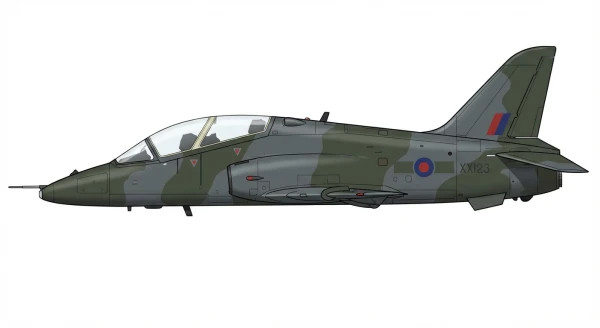
British Aerospace Hawk military training aircraft side profile drawing
Side profile · British Aerospace Hawk · length 11.9 m
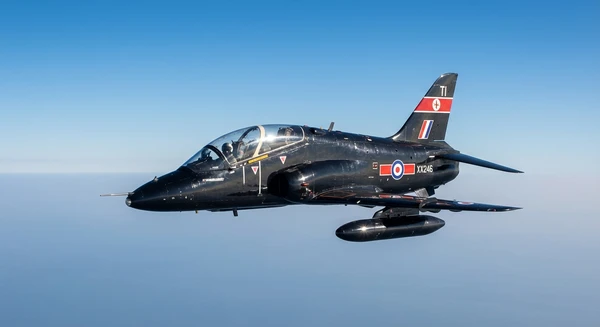
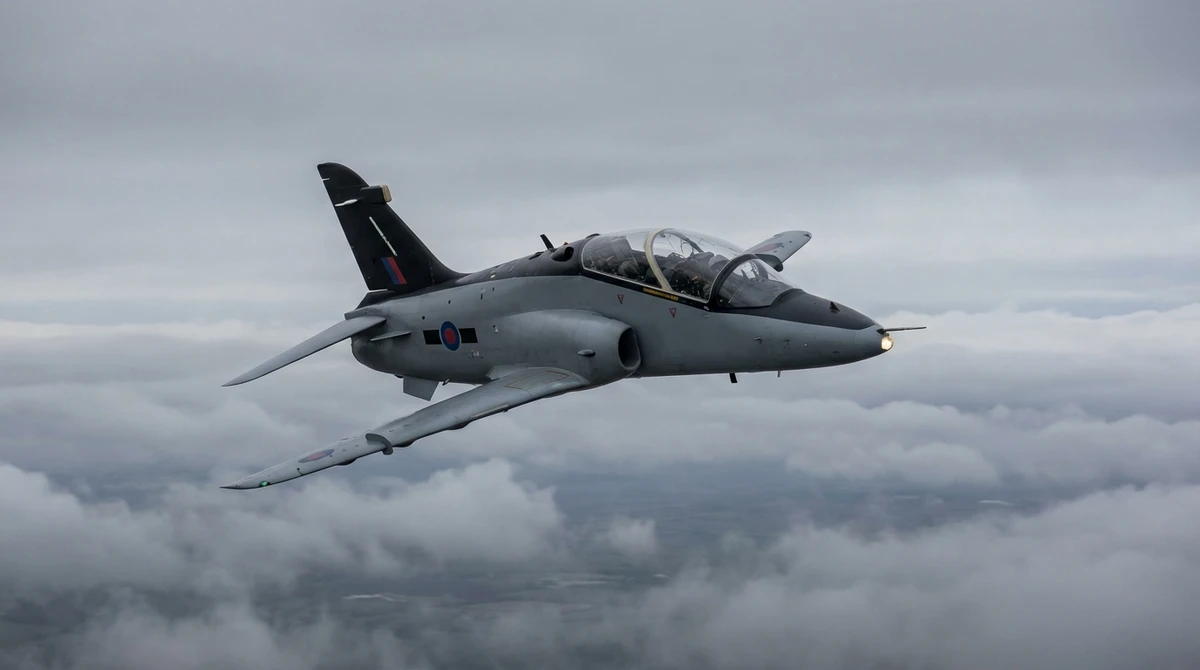
British Aerospace Hawk military training aircraft in flight
Max speed
1,028km/h
Range
2,520km
Produced
1,000units
Avg unit price
$18 million
Active worldwide
429
Technical SpecificationsVersion: Hawk
Crew2
Length11.9 m (38.9 ft)
Wingspan9.4 m (30.8 ft)
Height4.1 m (13.4 ft)
Wing area16.7 m² (179.6 sqft)
Empty weight3,635 kg (8,014 lbs)
Max. takeoff weight8,340 kg (18,387 lbs)
Powerplant1 × Rolls-Royce/Turboméca Adour 151 2,420 kgf each
Ejection seatMartin-Baker Mk 10B
PerformanceVersion: Hawk
Maximum speed1028 km/h (639 mph)
Operational range2,520 km (1,566 mi)
Service ceiling15,000 m (49,213 ft)
Operators — 2026
ActiveOn order
All Operators
🇦🇪 United Arab Emirates· 🇦🇺 Australia· 🇧🇭 Bahrain· 🇨🇦 Canada· 🇨🇭 Switzerland· 🇫🇮 Finland· 🇬🇧 United Kingdom· 🇮🇩 Indonesia· 🇮🇳 India· 🇰🇪 Kenya· 🇰🇷 South Korea· 🇰🇼 Kuwait· 🇲🇾 Malaysia· 🇴🇲 Oman· 🇶🇦 Qatar· 🇸🇦 Saudi Arabia· 🇺🇸 United States· 🇿🇦 South Africa· 🇿🇼 Zimbabwe
Similar Aircraft
Hawk vs

Description

The BAE Systems Hawk is a British single-engine, subsonic advanced jet trainer and light attack aircraft. Originally the Hawker Siddeley Hawk, it was subsequently built by British Aerospace and BAE Systems, entering RAF service in April 1976. Over 1,000 have been sold to 18 operators, and the type equips the RAF's Red Arrows display team.

Development

In 1964 the RAF issued Air Staff Target 362 for a fast jet trainer to replace the Folland Gnat. The SEPECAT Jaguar proved too complex for the role, and in 1968 Hawker Siddeley began private-venture studies as SP 117 under a design team led by Ralph Hooper. AST 397 formalised the requirement in early 1970; the RAF selected the HS.1182 on 1 October 1971 and signed a contract for 175 aircraft in March 1972. Prototype XX154 first flew from Dunsfold on 21 August 1974, piloted by Duncan Simpson. The first export Hawk 50 flew on 17 May 1976. In 1981 the US Navy selected a carrier-capable derivative, the T-45 Goshawk, which entered service in 1994. By early 1998, 734 Hawks had been sold, over 550 to export customers. A contract for the Hawk Mk 128 (T2) was awarded on 22 December 2004, with first flight from Warton on 27 July 2005 and a £450 million production order for 28 aircraft in October 2006. Production at BAE Brough ended in 2020; licence manufacture continues at Hindustan Aeronautics.

Design

The Hawk has a low-mounted cantilever wing, tandem cockpit and an aluminium alloy fuselage of conventional string-frame construction. The rear seat is raised for instructor visibility, and both positions use Martin-Baker Mk 10B zero-zero ejection seats. The rear-mounted Rolls-Royce Turbomeca Adour is fed by wing-root intakes. The airframe is stressed to +9 g, with a +7.5/-4 g limit in RAF service. Dual hydraulic systems drive flaps, airbrakes, landing gear and flight controls, backed by a ram air turbine ahead of the fin and an APU above the engine. Maximum speed is Mach 0.88 level and Mach 1.15 in a dive. Single-seat models replace the forward cockpit with an avionics bay housing a fire control computer, multi-mode radar, laser rangefinder and FLIR.

Armament

All armament is optional. A 30 mm ADEN cannon is carried in a centreline pod, with up to 6,800 lb (3,085 kg) on five hardpoints. Weapons include AIM-9 Sidewinder, ASRAAM or A-Darter on wing pylons and wingtip rails, plus Umbani, Al Tariq and the Smart Anti-Airfield Weapon. Finnish Hawks have carried R-60, AIM-9J and AIM-9M missiles, SNEB rocket pods and 12.7 mm gun pods.

Operational History

RAF deliveries began in November 1976, replacing the Gnat and Hunter. Between 1983 and 1986, 88 T1s were modified as T1A short-range interceptors with two AIM-9L and an ADEN pod, intended to work with Tornado F3s. Zimbabwean Hawks flew airstrikes during the Second Congo War in 1998–2000. Malaysian Hawk 208s struck targets at Lahad Datu on 5 March 2013. Export customers include Finland, Indonesia, India, Saudi Arabia, Australia, South Africa, Oman, Qatar and Canada.

Variants

  • Hawk T1: Original RAF version, 175 delivered from November 1976.
  • Hawk T1A: 89 T1s converted to carry two AIM-9L and a centreline ADEN pod.
  • Hawk 60: Export trainer with Adour 861 and increased weapons carriage; basis for the T-45.
  • Hawk 100: Two-seat weapons trainer with optional FLIR, redesigned wing and HOTAS.
  • Hawk 200: Single-seat multi-role combat variant for air defence, anti-shipping and ground attack.
Wikipedia (CC BY-SA) and other open sources. Illustrations generated by AI. Last updated on 30 August 2026. Suggest a change

In the News

All news →

Frequently Asked Questions

What type of aircraft is the Hawk?
The British Aerospace Hawk is a military training aircraft aircraft developed by British Aerospace and entered service in 1976.
What is the maximum speed of the Hawk?
The British Aerospace Hawk has a maximum speed of 1,028 km/h (638 mph).
What is the range of the Hawk?
The British Aerospace Hawk has an operational range of 2,520 km (1,565 miles). This range can vary based on payload, altitude, and mission profile.
When did the Hawk first fly?
The British Aerospace Hawk made its first flight on August 21, 1974. It entered operational service in 1976.
How many Hawk have been built?
Approximately 1,000 units of the British Aerospace Hawk have been produced since it entered service in 1976.
Which countries operate the Hawk?
The British Aerospace Hawk is in service with 14 countries, with approximately 429 aircraft in active service. The largest operators include India, the Saudi Arabia, and the United Kingdom. 19 countries have operated it in all.
How much does a Hawk cost?
The British Aerospace Hawk has an estimated unit cost of approximately $18.0 million. Actual prices vary based on configuration, quantity ordered, and included support packages.
What is the service ceiling of the Hawk?
The British Aerospace Hawk has a service ceiling of 15,000 meters (49,212 feet). This is the maximum altitude at which the aircraft can maintain controlled flight.
Latest Data Updates
  1. AUG 302026 Updated Description updated
  2. AUG 12026 Updated Name updated
  3. JUL 272026 Updated Name updated
  4. JUL 232026 Updated Sources and cross-references refreshed
  5. APR 72026 Updated Sources and cross-references refreshed
  6. APR 52026 Updated Ejection seat added
  7. JAN 242026 Updated Top speed updated