McDonnell Douglas DC-10
Summary
| Category | Military Transport Aircraft |
| Origin country | 🇺🇸 United States |
| Manufacturer | McDonnell Douglas |
| First flight | 29 August 1970 |
| Year introduced | 1971 |
| Number produced | 386 units |
| Average unit price | $20 million |
Technical specifications
| Version: DC-10-30 | |
|---|---|
| Operational range | 9,600 km (5,965 mi) |
| Maximum speed | 1052 km/h (654 mph) |
| Wing area | 368 m² (3961.1 sqft) |
| Wingspan | 50.4 m (165.4 ft) |
| Height | 17.7 m (58.1 ft) |
| Length | 55.5 m (182.1 ft) |
| Service ceiling | 12,802 m (42,001 ft) |
| Empty weight | 121,198 kg (267,196 lbs) |
| Max. takeoff weight | 263,083 kg (579,998 lbs) |
| Takeoff distance | 2,847 m (9,341 ft) |
| Powerplant | 3 x turbojets General Electric CF6-50C2 delivering 23814 kgf each |
Current operating countries
All operators
Description
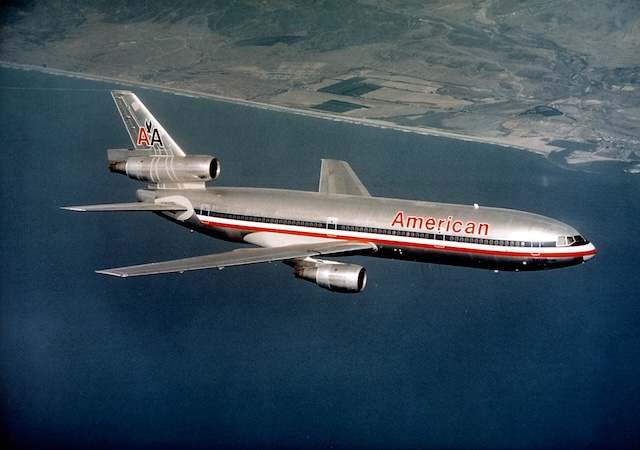
Following an unsuccessful proposal for the United States Air Force's CX-HLS (Heavy Logistics System) in 1965, Douglas Aircraft initiated design studies that served as a basis for what would eventually become the DC-10. In 1966, American Airlines provided a specification for a twin-engine wide-body aircraft which was smaller than the Boeing 747, yet still capable of flying similar long-range routes from airports with shorter runways; this specification would be highly influential in the design of the DC-10. It was the first commercial airliner from McDonnell Douglas after the merger between McDonnell Aircraft Corporation and Douglas Aircraft Company in 1967. The choice of three engines was influenced by surveys of potential customers together with a desire to enhance hot and high climb performance after an engine failure. On August 29, 1970, the first DC-10 conducted its maiden flight, commencing an extensive flight test program. The FAA issued the type certificate for the DC-10 on July 29, 1971, permitting its entry into revenue service. It entered commercial service with American Airlines on August 5, 1971.
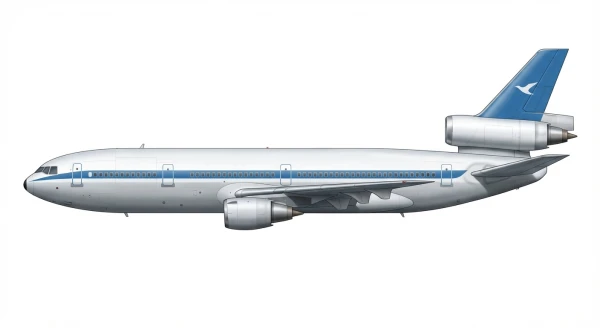
The McDonnell Douglas DC-10 is a low-wing wide-body aircraft designed for medium to long-range flights, offering similar endurance to the Boeing 747 while capable of utilizing shorter runways. The main cabin can accommodate between 250 and 380 passengers. The fuselage incorporates a main deck for passenger seating and a smaller lower level typically used for baggage and food storage. Power is provided by three turbofan engines; two are mounted on pylons beneath the wings, while the third is situated within a banjo-shaped structure atop the rear fuselage, designed to produce less noise and smoke compared to earlier jetliners. Equipped with thrust reversers, the DC-10 achieves a landing speed comparable to the Boeing 727, despite its larger size. Primary flight controls include inboard and outboard ailerons, two-section elevators, and a two-section rudder, with secondary controls consisting of leading-edge slats, spoilers, and a dual-rate movable horizontal stabilizer. For higher gross weights, the later –30 and –40 series aircraft feature an additional two-wheel main landing gear that retracts into the fuselage's center section. Originally operated by a three-person flight crew, many DC-10s have been retrofitted with a glass cockpit and the Advanced Common Flightdeck to eliminate the flight engineer, thereby allowing operation by a flight crew of two.
The DC-10 saw service across various theaters with numerous airlines, becoming a workhorse for long-range flights. However, early operations were marred by a poor safety record due to a design flaw in the cargo doors, leading to incidents such as the Turkish Airlines Flight 981 crash in 1974, then the deadliest in aviation history. Following the crash of American Airlines Flight 191, all DC-10s were temporarily banned from American airspace in June 1979. The design flaws were later rectified, and over time, its safety record improved to match other similar-era jets. The KC-10 Extender, a tanker aircraft derived from the DC-10-30, served primarily with the United States Air Force.
Main Variants:
-
DC-10-10: The initial passenger version, introduced in 1971, equipped with GE CF6-6 engines for transcontinental flights.
-
DC-10-15: Designed for hot and high airports, this variant was essentially a DC-10-10 fitted with higher-thrust GE CF6-50C2F engines.
-
DC-10-30: A long-range model and the most common version, built with General Electric CF6-50 turbofan engines, larger fuel tanks, and a larger wingspan.
-
DC-10-40: The first long-range version fitted with Pratt & Whitney JT9D engines, it featured a higher MTOW and more powerful engines than the original design.
-
KC-10 Extender: A military version of the DC-10-30CF for aerial refueling, ordered by the U.S. Air Force.