Boeing 727
American commercial jet trijet, renowned for its use in the later half of the 20th century, heavily deployed in global airlines. Key figures: top speed 1,017 km/h, range 4,720 km, service ceiling 12,802 m, max takeoff weight 95,028 kg, unit price $5M, built 1,832. In service with 2 air forces as of 2026 — Congo Democratic Republic (1), South Sudan (1).
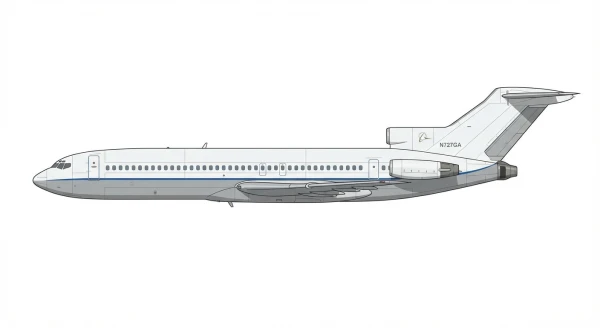
| Length | 46.7 m (153.2 ft) |
| Wingspan | 33 m (108.3 ft) |
| Height | 10 m (32.8 ft) |
| Wing area | 157.9 m² (1699.9 sqft) |
| Empty weight | 45,359 kg (99,999 lbs) |
| Max. takeoff weight | 95,028 kg (209,501 lbs) |
| Powerplant | 3 × turbofans Pratt & Whitney JT8D-9A 6,577 kgf each |
| Maximum speed | 1017 km/h (Mach 1.02) |
| Operational range | 4,720 km (2,933 mi) |
| Service ceiling | 12,802 m (42,001 ft) |
| Takeoff distance | 1,768 m (5,801 ft) |
Description
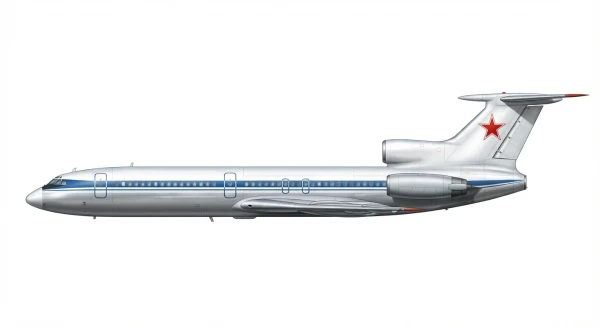
The Boeing 727 is an American narrow-body trijet airliner developed and produced by Boeing Commercial Airplanes. Designed for short- and medium-haul routes from smaller airports with short runways, it entered service with Eastern Air Lines on 1 February 1964. It was the only trijet Boeing produced, and with 1,832 built it held the record for the highest production total of any jet airliner until surpassed by the 737 in the early 1990s. Three C-22 variants served with the United States Air Force and Air National Guard, and Iraq operated a single ELINT conversion.
Development
The configuration was a compromise between United Airlines, which wanted four engines for high-altitude operations at Denver Stapleton, American Airlines, which wanted a twinjet, and Eastern Air Lines, which required a third engine for Caribbean overwater flights under the then-current 60-minute diversion rule. The programme was launched on 5 December 1960 with 40 orders each from United and Eastern. In 1959 BEA chairman Lord Douglas proposed a joint Boeing–de Havilland programme with the D.H.121 Trident; Boeing sent engineers to evaluate the design but declined, as de Havilland wanted Boeing to license-build the Trident while Boeing required six-abreast seating and 4,500 ft runway capability. Boeing initially planned three license-built Allison AR963 (Rolls-Royce RB163 Spey) engines, but at Eastern's insistence adopted the Pratt & Whitney JT8D, which became the sole powerplant. The first 727-100 rolled out on 27 November 1962 and flew on 9 February 1963, with FAA type approval on 24 December 1963. The stretched -200 flew on 27 July 1967 and was delivered to Northeast Airlines on 14 December 1967. Production ended in September 1984.
Design
Three JT8D low-bypass turbofans are mounted below a T-tail, two on the rear fuselage sides and a centre engine fed by an S-duct; flow distortion in the duct caused a centre-engine surge on the first flight and was cured with vortex generators inside the first bend. The clean wing carries Krueger flaps inboard, leading-edge slats to the tip and triple-slotted Fowler flaps, giving a maximum lift coefficient of 3.0. The fuselage has a 148 in outer diameter for six-abreast seating and shares its cross-section and cockpit with the 707. Features include a ventral airstair, an APU mounted in the keel beam web within the main gear bay, a retractable tailskid and optional nosewheel brakes reducing landing roll by up to 490 ft. After the D. B. Cooper hijacking, the Cooper vane prevented in-flight airstair deployment. Stage 3 noise compliance required hush kits, Raisbeck flap/slat modifications or exhaust mixers.
Operational History
The CIA used the openable aft airstair to drop agents and supplies in Vietnam. In early 1988 Iraq fitted a 727 with Thomson-CSF TMV-018 Syrel ESM pods and Raphael-TH side-looking radar pods; designated Faw-727, it flew ELINT missions during the 1990 invasion of Kuwait, being locked on by a Kuwaiti Mirage F1 on 2 August, and during Desert Shield. Three C-22Bs served with the 201st Airlift Squadron, District of Columbia Air National Guard. FedEx Express introduced 727s in 1978 and used them as its fleet backbone until 2007. Delta retired its last from scheduled service in April 2003; Iran Aseman Airlines flew the final scheduled passenger service on 13 January 2019.
Variants
- 727-100: Original 133 ft 2 in short-body version, 572 built including 53 -100C convertibles and 111 -100QC quick-change aircraft.
- 727-100QF: Quiet Freighter conversion for United Parcel Service, re-engined with Stage 3-compliant Rolls-Royce Tay turbofans.
- 727-200: Stretched by 20 ft with 10 ft plugs fore and aft of the wing and a round centre-engine intake; 310 delivered before the Advanced replaced it.
- 727-200 Advanced: Introduced 1970 with higher MTOW of 185,800–210,000 lb and range increased from 1,930 to 2,550 nmi; 935 passenger aircraft delivered, plus 15 -200F Advanced freighters for Federal Express.
- C-22A/B/C: Military transports comprising one 727-30, four 727-35 and one 727-212 operated by the USAF.
Frequently Asked Questions
What type of aircraft is the Boeing 727?
What is the maximum speed of the Boeing 727?
What is the range of the Boeing 727?
When did the Boeing 727 first fly?
How many Boeing 727 have been built?
Which countries operate the Boeing 727?
How much does a Boeing 727 cost?
What is the service ceiling of the Boeing 727?
- AUG 302026 Updated Description updated
- AUG 52026 Updated Powerplant updated in a site-wide editorial pass
- JUL 272026 Updated Name updated
- APR 72026 Updated Sources and cross-references refreshed
- FEB 72026 Updated 727: top speed added; 727: range added