McDonnell Douglas DC-10
American wide-body airliner, recognized for wide deployment in commercial and cargo flights from the 1970s to the early 2000s. Key figures: top speed 1,052 km/h, range 9,600 km, service ceiling 12,802 m, max takeoff weight 263,083 kg, unit price $20M, built 386.
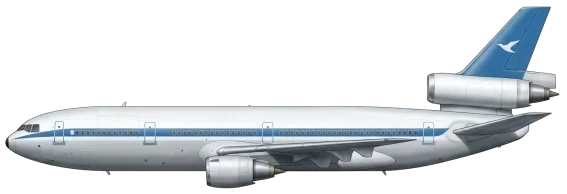
| Length | 55.5 m (182.1 ft) |
| Wingspan | 50.4 m (165.4 ft) |
| Height | 17.7 m (58.1 ft) |
| Wing area | 368 m² (3961.1 sqft) |
| Empty weight | 121,198 kg (267,196 lbs) |
| Max. takeoff weight | 263,083 kg (579,998 lbs) |
| Powerplant | 3 × turbofans General Electric CF6-50C2 23,814 kgf each |
| Maximum speed | 1052 km/h (654 mph) |
| Operational range | 9,600 km (5,965 mi) |
| Service ceiling | 12,802 m (42,001 ft) |
| Takeoff distance | 2,847 m (9,341 ft) |
Description
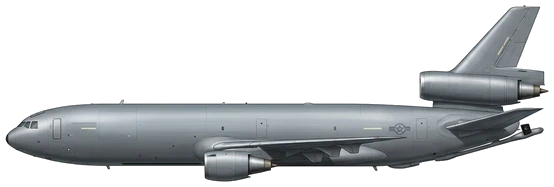
The McDonnell Douglas DC-10 is an American trijet wide-body airliner built by McDonnell Douglas at Long Beach, California. Intended to succeed the DC-8 on long-range routes, it first flew on 29 August 1970 and entered service with American Airlines on 5 August 1971. It is known for its cargo-door and engine-pylon failures of the 1970s, which produced Turkish Airlines Flight 981 and American Airlines Flight 191, and for the KC-10 Extender tanker derivative.
Development
Douglas began design studies from its unsuccessful 1965 CX-HLS submission, then reworked them around a 1966 American Airlines specification for a wide-body smaller than the Boeing 747 able to fly long routes from short runways. An early four-engine double-deck proposal seating 550 was dropped for a single-deck trijet seating up to 399. Fuselage detail design was subcontracted to Convair, which was contractually barred from contacting the FAA over safety concerns. American Airlines ordered 25 aircraft in February 1968 and United 30 with 30 options. Flight testing covered 929 flights and 1,551 hours; the type certificate was issued on 29 July 1971. Production ended in December 1988, the 446th aircraft going to Nigeria Airways in July 1989: 386 airliners and 60 KC-10s. The MD-11 was a stretched derivative of the DC-10-30.
Design
The DC-10 is a low-wing aircraft with two underwing pylon-mounted turbofans and a third in a banjo structure at the base of the fin. Engines were General Electric CF6 or Pratt & Whitney JT9D. Controls comprise inboard and outboard ailerons, two-section elevators and rudder, leading-edge slats, spoilers and a dual-rate movable stabiliser, actuated by three hydraulic systems with no manual reversion. The -30 and -40 added a two-wheel centreline main gear. The aircraft could take off and land under autopilot, with flight plans loaded from cassette tape. The original three-crew cockpit was replaced on MD-10 conversions by the Advanced Common Flightdeck using Honeywell VIA displays shared with the Boeing 717, giving common type rating with the MD-11.
Operational History
Northwest Airlines withdrew the last major-carrier passenger DC-10 on 8 January 2007; Biman Bangladesh Airlines flew the final commercial passenger service from Dhaka to Birmingham on 20 February 2014. As of February 2025 the type had 55 accidents and incidents, 32 hull losses and 1,261 occupant fatalities. The FAA withdrew the type certificate on 6 June 1979 after Flight 191, reinstating it on 13 July following slat and stall-warning modifications. United Airlines Flight 232 in 1989 led to hydraulic fuses in the No. 3 system. A November 2025 emergency airworthiness directive grounded the fleet after the UPS Flight 2976 MD-11 crash; it was lifted on 11 May 2026. Ten aircraft were airworthy in December 2024, with 10 Tanker Air Carrier, Omega Aerial Refueling Services, TAB, Cargo Three and Orbis International.
Variants
- DC-10-10: Initial domestic version with CF6-6 engines, 122 built between 1970 and 1981.
- DC-10-15: Hot-and-high variant with CF6-50C2F engines, seven built 1981–1983 for Mexicana and Aeroméxico.
- DC-10-30: Long-range model with CF6-50 engines, larger wingspan and centre gear; 163 built for 38 customers.
- DC-10-40: JT9D-powered long-range version for Northwest Orient and Japan Airlines, 42 built 1973–1983.
- KC-10 Extender: USAF aerial refuelling tanker based on the DC-10-30CF, 60 delivered 1981–1988.
Frequently Asked Questions
What type of aircraft is the McDonnell Douglas DC-10?
What is the maximum speed of the McDonnell Douglas DC-10?
What is the range of the McDonnell Douglas DC-10?
When did the McDonnell Douglas DC-10 first fly?
How many McDonnell Douglas DC-10 have been built?
Which countries operate the McDonnell Douglas DC-10?
How much does a McDonnell Douglas DC-10 cost?
What is the service ceiling of the McDonnell Douglas DC-10?
- AUG 302026 Updated Description updated
- AUG 52026 Updated Powerplant updated in a site-wide editorial pass
- JUL 272026 Updated Name updated
- APR 72026 Updated Picture credits updated in a site-wide editorial pass
- JAN 242026 Updated Top speed updated
- JAN 122026 Updated Range updated in a site-wide editorial pass