Boeing E-4 NOAC
Summary
| Category | Military Special Mission Aircraft |
| Origin country | 🇺🇸 United States |
| Manufacturer | Boeing |
| First flight | 1 January 1980 |
| Year introduced | 1974 |
| Number produced | 4 units |
| Average unit price | $223 million |
Technical specifications
| Version: E-4 NOAC | |
|---|---|
| Crew | Up to 112 |
| Operational range | 12,600 km (7,829 mi) |
| Endurance | 12 hours |
| Maximum speed | 969 km/h (602 mph) |
| Wing area | 510 m² (5489.6 sqft) |
| Wingspan | 59.7 m (195.9 ft) |
| Height | 19.3 m (63.3 ft) |
| Length | 70.5 m (231.3 ft) |
| Service ceiling | 13,716 m (45,000 ft) |
| Empty weight | 190,000 kg (418,878 lbs) |
| Max. takeoff weight | 374,850 kg (826,402 lbs) |
| Powerplant | 4 x turbojets General Electric CF6-50E2 delivering 23814 kgf each |
Current operating countries
All operators
Description
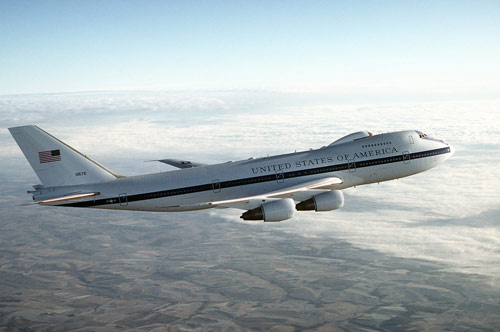
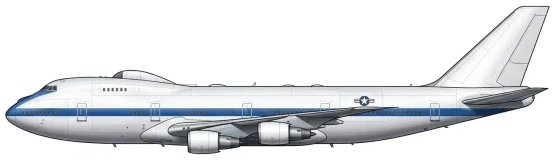
The Boeing E-4 NOAC, sometimes nicknamed the "Flying Pentagon," is an aircraft that was produced in only four copies during the Cold War era. The first version, E-4A, was developed from 1974 with the purpose of serving as an airborne command center in the event of a nuclear war. The four planes were upgraded to become the E-4B version in 1980. Designated NOAC for National Operations Airborne Center, they were designed to support the Pentagon's headquarters and the President of the United States in case of emergency, particularly in the event of a nuclear war.
These aircraft are based on the structure of the Boeing 747-200 and are equipped with the best available communication systems. In addition to conventional radio and satellite links, they have a Very Low Frequency (VLF) system that allows communication with submerged submarines, as well as a communication system that uses waves reflected by meteorites close to Earth, in case satellites are destroyed in the event of a widespread war. With a range of nearly 12,600 km, each plane can carry enough provisions to feed its crew of 112 members for a week. The E-4B can also be refueled in-flight by a tanker aircraft using a receptacle located on the nose of the aircraft.
Starting in 1991, at the end of the Cold War, the four planes were equipped with the latest military telecommunications technologies to provide all types of secure or non-secure communications in support of the Joint Staff during wartime. Since 1994, the E-4B NOAC can be deployed to support the Federal Emergency Management Agency (FEMA) during natural disasters.
In addition to the aforementioned missions, these aircraft are used for other common tasks. One of them serves as transportation for the Secretary of Defense, while another is used to transport high-ranking U.S. military officials around the world, especially during major staff meetings. A third plane is dedicated to transporting generals and high-ranking officials close to the White House, serving as a military relay during the President of the United States' travels.