Mitsubishi F-1 / T-2
Summary
| Category | Combat Aircraft |
| Origin country | 🇯🇵 Japan |
| Manufacturer | Mitsubishi |
| First flight | 20 July 1971 |
| Year introduced | 1977 |
| Number produced | 77 units |
| Average unit price | $22 million |
Technical specifications
| Version: T-2(K) | |
|---|---|
| Crew | 1 pilot |
| Operational range | 2,870 km (1,783 mi) |
| Maximum speed | 1700 km/h (1056 mph) |
| Wing area | 21 m² (226.0 sqft) |
| Wingspan | 7.9 m (25.9 ft) |
| Height | 4.4 m (14.4 ft) |
| Length | 17.9 m (58.6 ft) |
| Service ceiling | 15,240 m (50,000 ft) |
| Empty weight | 6,197 kg (13,662 lbs) |
| Max. takeoff weight | 12,800 kg (28,219 lbs) |
| Powerplant | 2 x turbojets Ishikawa-Harima TF40-801A delivering 4272 kgf each |
| Ejection seat | Daiseru-Weber DW-ES-7J |
Current operating countries
All operators
Armament
Missiles payload:
- Air-to-Air Short-Range Raytheon AIM-9 Sidewinder
Description
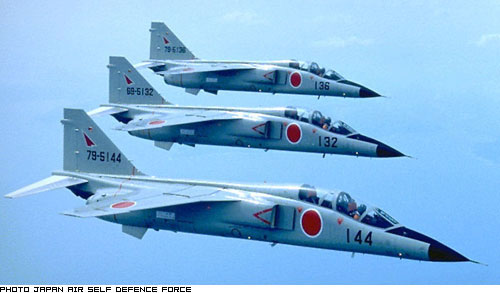
Following the Second World War, Japan was without a modern jet fighter for defensive purposes. Two decades later, the Japanese Air Self-Defense Force (JASDF) began considering the development of a supersonic jet trainer, tentatively named "T-X," to better prepare pilots for Mach 2 fighters like the Lockheed F-104J and McDonnell Douglas F-4EJ, as the existing Fuji T-1 was deemed inadequate. Studies began in 1964-65, with the hope that this trainer would also serve as the basis for a single-seat attack aircraft (SF-X). While considering foreign options like the Northrop T-38 Talon and SEPECAT Jaguar, Japan opted to develop its own design due to factors like nationalism and high royalty costs for licensed production of the Jaguar. In 1967, Mitsubishi's design, led by Dr. Kenji Ikeda, was selected over proposals from Fuji and Kawasaki, and a formal contract for the XT-2 development was issued on March 30, 1968, with Mitsubishi as the prime contractor and Fuji as a subcontractor. The first XT-2 prototype was rolled out on April 28, 1971, and made its first flight on July 20, 1971; it was followed by three more prototypes and became the first Japanese-designed aircraft to break the sound barrier in level flight. A total of 90 production T-2s were built, including 28 unarmed "T-2(Z)s" and 62 armed "T-2(K)s," with the last T-2 rolling off the assembly line in 1988.
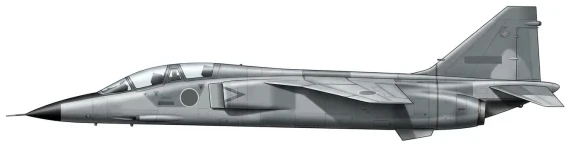
The T-2's design bore a clear resemblance to the two-seat Jaguar, sharing a similar overall configuration; both were powered by two Rolls-Royce Turbomeca Adour turbofans, license-built in Japan by Ishikawajima-Harima Heavy Industries. Constructed primarily from aircraft aluminum alloys with selective titanium use, the T-2 featured high-mounted wings with a leading-edge sweep of 42.5° and a 9° anhedral, along with leading edge root extensions (LERX) and full-span leading-edge slats. Unlike the Jaguar, the T-2 used conventional single-wheeled landing gear and twin spoilers on each wing for roll control. Its tail assembly included slab all-moving tailplanes with a 15° anhedral and ventral fins under each exhaust, complemented by hydraulically operated airbrakes. The engine intakes had fixed rectangular geometry and fuselage splitter plates, as well as auxiliary inlets for increased airflow on the ground. Standard equipment for the armed T-2(K) included a Mitsubishi Electric J/AWG-11 search and ranging radar, a license-built French Thomson-CSF heads-up display (HUD), and various Japanese-built radio and navigation systems.
The T-2(K) variant featured a 20 mm JM61A1 cannon internally mounted. Additionally, the aircraft had one center-line and two underwing hardpoints for external stores. The T-2 could carry AIM-9 Sidewinder air-to-air missiles on wingtip missile rails.
The XT-2 was redesignated T-2 on 29 August 1973, entering service in 1975, with the first unit, the 21st Hikōtai, becoming fully operational on 1 October 1976. A second squadron, the 22nd Hikōtai, followed on 5 April 1978, allowing the North American F-86 Sabre to be phased out of the advanced training role. The "Blue Impulse" aerobatic display team of the JASDF re-equipped with the T-2 in the winter of 1981–82. T-2s were also used by a dedicated Aggressor squadron and as conversion trainers for squadrons operating the Mitsubishi F-1. The T-2 was retired by 2006, being replaced as an advanced trainer by the Kawasaki T-4 and as a conversion trainer by a two-seat version of the Mitsubishi F-2.
Main Variants:
-
XT-2: These were the prototype versions of the T-2, used for testing and development before the aircraft entered full production.
-
T-2(Z): Also known as the T-2A, this was the initial unarmed, two-seat advanced jet trainer variant delivered to the ASDF training squadron in 1975.
-
T-2(K): Also known as the T-2B, this was the armed, two-seat weapons training version of the aircraft.
-
T-2 CCV: This was an experimental "Control Configuration Vehicle" testbed, built from the third T-2 produced, and it included three canards for enhanced maneuverability research.