T-38 Talon
American supersonic jet trainer, active during the Cold War, deployed extensively for NASA astronaut training missions. Key figures: top speed 1,381 km/h, range 1,835 km, service ceiling 15,240 m, max takeoff weight 5,485 kg, built 1,189. In service with 3 air forces as of 2026 — United States (504), Turkey (68), Germany (41).
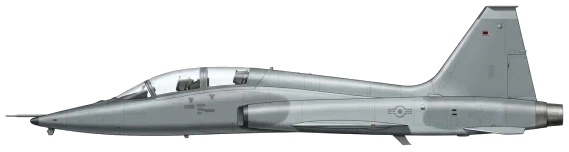

| Crew | 2 |
| Length | 14.1 m (46.4 ft) |
| Wingspan | 7.7 m (25.3 ft) |
| Height | 3.9 m (12.9 ft) |
| Wing area | 16 m² (172.2 sqft) |
| Empty weight | 3,266 kg (7,200 lbs) |
| Max. takeoff weight | 5,485 kg (12,092 lbs) |
| Powerplant | 2 × turbojets General Electric J85-GE-5A 1,746 kgf each |
| Ejection seat | Martin-Baker US16T |
| Maximum speed | 1381 km/h (Mach 1.3) |
| Operational range | 1,835 km (1,140 mi) |
| Service ceiling | 15,240 m (50,000 ft) |
| Climb rate | 170.7 m/s (560.0 ft/s) |


Recent Events — T-38 Talon
1 event →
Description
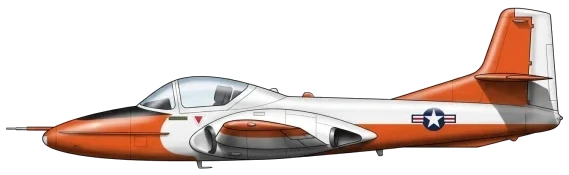
The Northrop T-38 Talon is a two-seat, twin-engined supersonic advanced jet trainer, the first of its kind in the world and the most produced. Derived from the same N-156 lightweight fighter study that yielded the F-5 Freedom Fighter, it first flew in April 1959 and has trained United States Air Force (USAF) pilots since March 1961; 1,187 production aircraft and two prototypes were built before the line closed in 1972. More than six decades on, the upgraded T-38C remains the USAF's bridge to its fighter and bomber fleets, with some 495 aircraft in service as of 2026, and the type also flies with the US Navy, NASA, Turkey and the German Air Force, pending replacement by the Boeing–Saab T-7A Red Hawk.
Development
Northrop's 1952 N-102 Fang fighter study, built around the two-ton General Electric J79, was heading towards a large, expensive aircraft when in 1953 General Electric showed the company a compact engine of some 400 lb (180 kg) delivering 2,500 lbf. Northrop recast its thinking around two of these in a small, agile fighter, the N-156, launched in 1954 for the US Navy's escort carriers. When the Navy committed to large fleet carriers instead, Northrop carried on with its own funds and aimed the single-seat N-156F at the export market.
In the mid-1950s the USAF sought a supersonic trainer to succeed the Lockheed T-33. Northrop proposed a two-seat N-156T; its rival, a two-seat F-100 Super Sabre, had poor spin recovery. Lifecycle cost comparisons carried the argument, and Northrop received a contract for three YT-38 prototypes in June 1956. The first flew on 10 April 1959, and after two YJ85-powered prototypes and four pre-production aircraft, production T-38As entered service on 17 March 1961, flying alongside the Cessna T-37 primary trainer. In 1962 the Talon briefly held the absolute time-to-climb records to 3,000–12,000 m, taken from the F-104 and lost to the F-4 within a month.
Production ran to 1972, overwhelmingly of the T-38A. The fighter side of the family, selected for the Military Assistance Program as the F-5, went on to its own long career through the F-5E/F Tiger II. An estimated 50,000 military pilots have qualified on the Talon.
Design
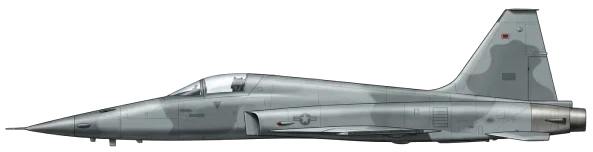
The T-38 is a conventional tandem-seat design with a small, low-set, long-chord wing, a single fin and tricycle undercarriage; the square wingtips and plain roots, without the F-5's leading-edge extensions and missile rails, tell the two apart. Two General Electric J85-GE-5A afterburning turbojets, each rated at 3,850 lbf (17.1 kN, 1,746 kgf), sit side by side in the rear fuselage, fed by wing-root intakes. Maximum takeoff weight is 12,093 lb (5,485 kg); maximum speed is Mach 1.3, about 1,381 km/h (858 mph) at altitude, range 1,835 km (991 nmi) and service ceiling 50,000 ft (15,000 m).
Strict weight control kept the design simple: basic navigation and communications equipment only, no wing fuel, no external stores, and hydraulic flight controls without manual reversion, so a double engine failure leaves the aircraft uncontrollable. The wing was built to 7.33 g and a 4,000-hour fatigue life, adequate for the training syllabus but marginal in aggressive manoeuvring, where wingtip separations were recorded until Northrop fitted thicker-skinned wings. Maintainability shaped the structure: the fin attaches to a keel between the engines, the aft fuselage shell comes off with a handful of fasteners, accessory drives are airframe-mounted, and the engines hang from rails on the keel, so a change takes about an hour.
Viceless by 1960s fighter standards and once judged too easy, the Talon ranked by the 2000s among the more demanding aircraft in the USAF inventory. Weak brakes, small intakes in hot-and-high conditions and sensitivity to throttle handling on approach have contributed to several landing accidents, some fatal. Its agility earned it the nickname "white rocket".
Modernisation
Most surviving USAF T-38As and AT-38Bs became T-38Cs under the Avionics Upgrade Program, fielded with Air Education and Training Command (AETC) from 2001: a head-up display, GPS and inertial navigation and a traffic collision avoidance system. Propulsion modernisation replaced major engine components and added an inlet and ejector modification that raises takeoff thrust at low altitude. The Pacer Classic structural programmes, together with new wings, were meant to extend the airframes' service lives. Availability met the 75 percent goal in 2011 but had slipped to 60 percent by 2015.
Operational History
Air Training Command and the Cold War
Student pilots moved to the T-38 after primary training on the T-37 for supersonic, instrument and formation flying, stalls, single-engine procedures and landing technique. Strategic Air Command flew the type from 1978 to 1991, first to give bomber and tanker copilots flying hours and later as a proficiency aircraft for B-52, B-1, SR-71, U-2, KC-135 and KC-10 crews. The USAF Thunderbirds flew T-38As until the January 1982 "Diamond Crash" took four aircraft in a practice formation; the team moved to the F-16A. AT-38Bs flew fighter lead-in training, and the US Navy used T-38s for dissimilar air combat training until F-5s took over.
Post-Cold War
Air Combat Command and Air Force Global Strike Command inherited SAC's companion-trainer role for U-2 and B-2 pilots respectively, while AETC's T-38Cs prepare pilots for the F-15, F-16, A-10, F-22, F-35 and the three bomber types. Between 1961 and 2005 the fleet logged 25 million hours and lost 150 airframes with 45 fatalities. The USAF launched the T-X replacement programme in late 2010 and in September 2018 chose the clean-sheet Boeing–Saab design over the Hawk, the T-50 and the M-346-derived T-100.
The 2020s
Delays to the T-7A have kept the Talon in training far longer than planned, and fleet health now constrains pilot output: engine overhaul shortfalls dragged mission-capable rates towards 58 percent, and the USAF planned to divest 17 unrepairable airframes in fiscal year 2026. The 12 May 2026 loss of a Columbus AFB T-38C over Lamar County, Alabama, from which both pilots ejected, triggered a fleet-wide operational pause of more than a week before flying resumed, with the investigation still open.
Operators
As of 2026 the USAF flies about 495 T-38s, and the US Navy about ten, principally at the Naval Test Pilot School at Patuxent River. The German Air Force bought 46 T-38As in 1968, since upgraded to T-38C standard, stationed at Sheppard AFB, Texas, in US markings for joint training with American pilots; 41 remain. Turkey operates 68 T-38Ms rebuilt with a glass cockpit by Turkish Aerospace. NASA's T-38N fleet at Ellington Field, Houston, keeps astronauts current and serves as chase aircraft. Portugal (1977–1993), Taiwan (returned 1998) and South Korea (30 aircraft 1999–2009 pending the T-50) are former operators; a few fly privately in the United States.
Accidents
More than 210 losses and ejections have been recorded, with 149 USAF fatalities since 1960; four NASA astronauts died in Talon crashes between 1964 and 1967. Recent fatal accidents include a landing collision in November 2019, a February 2021 landing crash at Montgomery, Alabama, that killed both crew, and a November 2021 collision on approach to Laughlin AFB that killed a student pilot. The pilots ejected safely from the November 2022 loss near Columbus AFB and the May 2026 Alabama crash.
Future and Replacement
The T-7A Red Hawk cleared its production decision on 23 April 2026, when the USAF approved a $219 million low-rate initial production lot of 14 aircraft; initial operational capability is set for 2027 and the first student pilots for 2028, although full-rate production has slipped towards 2029. The Talon will remain the USAF's advanced trainer until the T-7A reaches full production.
Variants
- YT-38: Two prototypes with YJ85-GE-1 engines and four pre-production aircraft, later redesignated YT-38A and T-38A; company designation N-156T.
- T-38A: Production advanced trainer, 1,139 built.
- AT-38B: Weapons trainer conversion with gunsight and centreline pylon for a gun pod, rockets or practice bombs.
- T-38C: T-38A with the Avionics Upgrade Program suite and structural renewal; the standard USAF variant.
- T-38N: Former USAF and NASA-assigned T-38As with modernised avionics, weather radar and flight management system.
- T-38M: Turkish Air Force T-38As rebuilt with a full glass cockpit by Turkish Aerospace under project ARI.
- DT-38A / QT-38A / NT-38A / GT-38A: Drone director, target drone, test and ground-trainer conversions.
Frequently Asked Questions
What type of aircraft is the T-38 Talon?
What is the maximum speed of the T-38 Talon?
What is the range of the T-38 Talon?
When did the T-38 Talon first fly?
How many T-38 Talon have been built?
Which countries operate the T-38 Talon?
What is the service ceiling of the T-38 Talon?
- OCT 52026 Updated Description overhauled: T-38C modernisation, fleet figures, recent accidents and the T-7A Red Hawk transition
- OCT 52026 Updated Maximum takeoff weight and first flight date corrected
- OCT 52026 Updated Thrust corrected to the afterburner rating
- JUL 232026 Updated Sources and cross-references refreshed
- APR 72026 Updated Sources and cross-references refreshed
- APR 52026 Updated Ejection seat added
- JAN 122026 Updated Range updated in a site-wide editorial pass