Fuji T-5
Japanese turboprop-driven primary trainer aircraft, introduced in the late 1980s, used for training naval aviators. Key figures: top speed 357 km/h, range 945 km, service ceiling 7,620 m, max takeoff weight 1,805 kg, built 40. In service with 1 air force as of 2026 — Japan (32).
| Crew | 2 |
| Length | 8.4 m (27.6 ft) |
| Wingspan | 10 m (32.8 ft) |
| Height | 2.9 m (9.5 ft) |
| Wing area | 16.5 m² (177.6 sqft) |
| Empty weight | 1,082 kg (2,385 lbs) |
| Max. takeoff weight | 1,805 kg (3,979 lbs) |
| Powerplant | 1 × Allison Model 250-B17D 261 kW each |
| Maximum speed | 357 km/h (222 mph) |
| Operational range | 945 km (587 mi) |
| Service ceiling | 7,620 m (25,000 ft) |
| Climb rate | 8.6 m/s (28.2 ft/s) |

Description
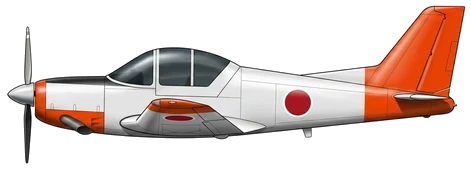
The Fuji T-5, or KM-2Kai, is a Japanese turboprop-driven primary trainer aircraft developed by Fuji Heavy Industries for the Japan Maritime Self-Defense Force (JMSDF). Developed as a replacement for the piston-engined Fuji KM-2 (which was derived from the Beechcraft T-34 Mentor), the aircraft's development began by refitting a KM-2 with an Allison Model 250 turboprop engine in place of its original Lycoming piston engine. This initial prototype, designated the KM-2D, conducted its first flight on 28 June 1984 and was certified on 14 February 1985. The KM-2Kai was developed as a subsequent iteration of the KM-2D. The JMSDF ordered the KM-2Kai as the T-5 in March 1987. Deliveries began in 1988, and production totaled 40 aircraft.
Design
The T-5 is an all-metal low-wing cantilever monoplane. It is powered by a single Allison Model 250-B17D turboprop engine rated at 261 kW (350 hp), driving a three-bladed constant-speed propeller. The aircraft features retractable tricycle landing gear, with the main gear retracting inwards and the nose gear retracting rearwards. The enclosed cabin is equipped with a sliding canopy, replacing the car-type side doors used on the original KM-2. The cockpit has dual controls with side-by-side seating for a student and an instructor in the aerobatic version, and four seats arranged in pairs in the utility version.
Operational History
The T-5 is operated by the Japan Maritime Self-Defense Force, serving with the 201 Air Training Squadron at Ozuki Air Field. It replaced the original KM-2, which is no longer in service.
Variants
- KM-2D: A developmental variant that mated the original KM-2 airframe and car-type side doors with an Allison Model 250 turboprop engine.
- KM-2Kai: A modernization of the KM-2D featuring a sliding canopy and side-by-side cockpit seating, ordered into production as the T-5.
Frequently Asked Questions
What type of aircraft is the Fuji T-5?
What is the maximum speed of the Fuji T-5?
What is the range of the Fuji T-5?
When did the Fuji T-5 first fly?
How many Fuji T-5 have been built?
Which countries operate the Fuji T-5?
What is the service ceiling of the Fuji T-5?
- AUG 142026 Updated Short designation registered as an alternate name
- JUL 12026 Created Page created: Fuji T-5