T-34 Mentor
American military trainer aircraft, widely utilized from the 1950s, notable for its significant role in military flight training. Key figures: top speed 396 km/h, range 1,311 km, service ceiling 9,144 m, max takeoff weight 4,300 kg, built 2,300. In service with 4 air forces as of 2026 — Taiwan (34), United States (17), Argentina (10) and 1 other.
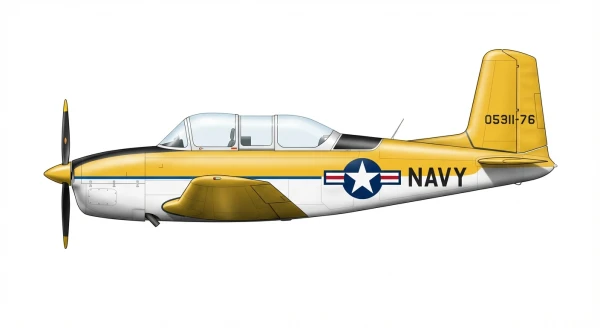
| Length | 8.8 m (28.7 ft) |
| Wingspan | 10.2 m (33.3 ft) |
| Height | 2.9 m (9.6 ft) |
| Wing area | 16.7 m² (179.6 sqft) |
| Empty weight | 2,960 kg (6,526 lbs) |
| Max. takeoff weight | 4,300 kg (9,480 lbs) |
| Powerplant | 1 × turboprop Pratt & Whitney Canada PT6A-25C 559 kW each |
| Maximum speed | 396 km/h (246 mph) |
| Operational range | 1,311 km (815 mi) |
| Service ceiling | 9,144 m (30,000 ft) |
| Climb rate | 7.5 m/s (24.6 ft/s) |
-
 Taiwan
34
Taiwan
34
-
 United States
17
United States
17
-
 Argentina
10
Argentina
10
-
 Peru
3
Peru
3
-
 Dominican Republic
0 +7
Dominican Republic
0 +7
Recent Events — T-34 Mentor
1 event →
Description
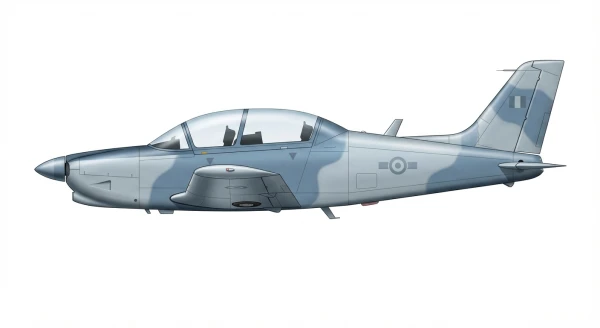
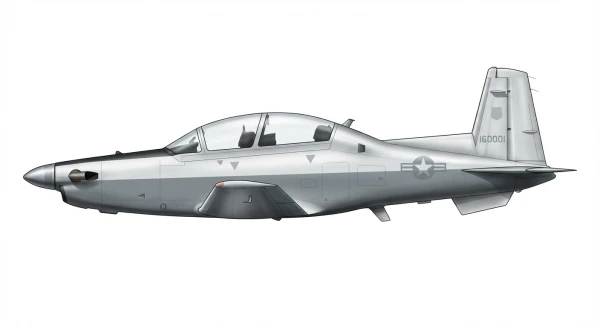
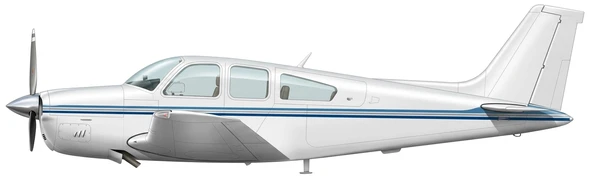
The Beechcraft T-34 Mentor is an American single-engine, propeller-driven military primary trainer derived from the Beechcraft Model 35 Bonanza. Designed by Beechcraft, it entered service with the United States Air Force in 1953 and the United States Navy in 1955. The aircraft was produced in both piston-engined and turboprop-powered configurations, remaining in active service for more than seven decades.
Development
Walter Beech developed the aircraft as the Beechcraft Model 45 private venture to offer an economical alternative to the North American T-6 Texan. The Model 45 made its first flight on December 2, 1948, piloted by Vern Carstens. Production began in 1953 with USAF orders for the T-34A, followed by USN T-34B production in 1955. Licensed manufacturing was conducted in Canada by Canadian Car and Foundry (125 aircraft), in Japan by Fuji Heavy Industries (173 aircraft), and in Argentina by FMA (75 aircraft). Total production of piston-engined versions reached 1,904 aircraft, while turboprop T-34C production ran from 1975 to 1990.
Design
The T-34 features a narrow fuselage with a two-seat tandem cockpit, a bubble canopy, and conventional unswept tail control surfaces. Structural limits were set at +10g and -4.5g. Early variants were powered by Continental E-185 or E-225 piston engines, while the T-34C introduced a 550 shp Pratt & Whitney Canada PT6A-25 turboprop engine, Beech Baron wings, and Beech Duke landing gear.
Armament
The armed T-34C-1 variant features four underwing hardpoints providing a total payload capacity of 1,200 lb (544 kg). The hardpoints can carry flares, incendiary bombs, rocket pods, gun pods, and antitank missiles.
Operational History
The USAF acquired 450 T-34As before replacing them with the Cessna T-37 in the late 1950s, transferring remaining aircraft to aero clubs, foreign militaries, and the Civil Air Patrol. The US Navy operated the T-34B and later the T-34C, which served as its primary trainer for over 35 years until replacement by the T-6 Texan II. Export customers included Argentina, Colombia, Japan, Spain, Taiwan, and Turkey. During the 1982 Falklands War, four Argentine Naval Aviation T-34C-1s deployed for reconnaissance; one was damaged by a Royal Navy Sea Harrier on May 1, and all four were destroyed on Pebble Island on May 15.
Variants
-
T-34A: Initial U.S. Air Force primary trainer variant powered by a Continental piston engine.
-
T-34B: U.S. Navy trainer variant featuring differential braking control, additional wing dihedral, and adjustable rudder pedals.
-
T-34C Turbo-Mentor: Turboprop-powered primary trainer fitted with a Pratt & Whitney Canada PT6A-25 engine.
-
T-34C-1: Export light attack variant equipped with four underwing hardpoints for weapons carriage.
-
Model 73 Jet Mentor: Jet-powered experimental derivative fitted with a single Continental J69 turbojet engine in the rear fuselage.
Frequently Asked Questions
What type of aircraft is the T-34 Mentor?
What is the maximum speed of the T-34 Mentor?
What is the range of the T-34 Mentor?
When did the T-34 Mentor first fly?
How many T-34 Mentor have been built?
Which countries operate the T-34 Mentor?
What is the service ceiling of the T-34 Mentor?
- AUG 62026 Updated Description updated
- JUL 232026 Updated Sources and cross-references refreshed
- APR 72026 Updated Picture credits updated in a site-wide editorial pass
- FEB 72026 Updated Top speed added
- JAN 122026 Updated Range updated in a site-wide editorial pass