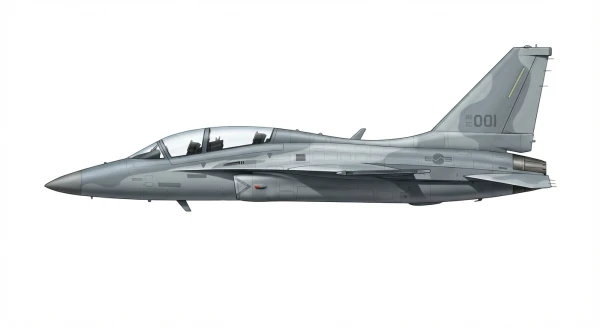
T-5 Brave Eagle
Korean light combat aircraft, developed in the 21st century, designed primarily for basic flight training purposes. Key figures: top speed 1,030 km/h, range 1,350 km, service ceiling 13,000 m, built 17. In service with 1 air force as of 2026 — Taiwan (50).
| Crew | 2 |
| Length | 13.7 m (44.9 ft) |
| Wingspan | 9 m (29.5 ft) |
| Height | 4.6 m (15.1 ft) |
| Empty weight | 4,500 kg (9,921 lbs) |
| Powerplant | 2 × turbofans Honeywell F124-GA-200 2,835 kgf each |
| Ejection seat | Martin-Baker Mk 12 |
| Maximum speed | 1030 km/h (640 mph) |
| Operational range | 1,350 km (839 mi) |
| Service ceiling | 13,000 m (42,651 ft) |
| Climb rate | 48.0 m/s (157.5 ft/s) |

Description
The AIDC T-5 Brave Eagle (勇鷹, Yǒngyīng) is a transonic advanced jet trainer and light attack aircraft built by the Aerospace Industrial Development Corporation for the Republic of China Air Force. Derived from the F-CK-1 Ching-kuo fighter, it was selected in 2017 to replace the AT-3 and F-5 trainer fleets, first flew in 2020 and is intended to fill both peacetime training and wartime combat roles.
Development
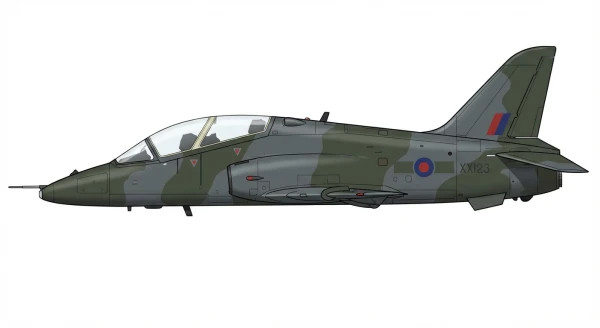
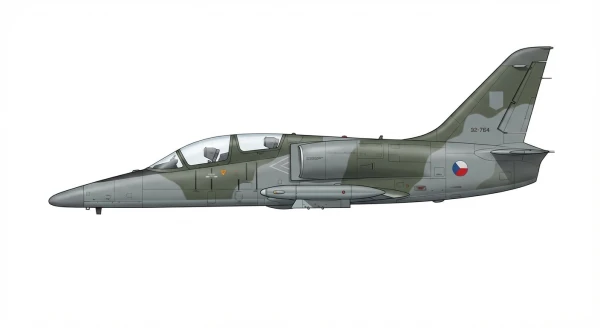
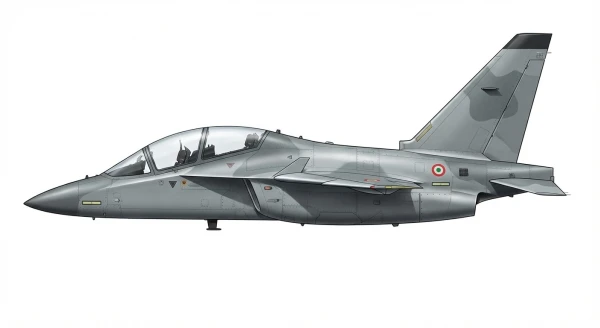
The Advanced Jet Trainer programme began in the early 2000s, with the ROCAF seeking 66 new-build aircraft to replace its AIDC AT-3 and Northrop F-5 trainers. Three options were considered: an upgraded AT-3 MAX, a derivative of the F-CK-1 designated XAT-5, and the Alenia Aermacchi M-346 Master, for which AIDC signed an assembly memorandum of understanding in 2014; the KAI T-50 Golden Eagle was also evaluated. In 2017 the XAT-5 won the tender, with development and production assigned to AIDC and the National Chung-Shan Institute of Science and Technology, four prototypes planned and programme cost projected at TWD 68.6 billion (US$2.2 billion). The United States approved export of components for 132 Honeywell/ITEC F124 engines the same year. AIDC's project name was Blue Magpie; following a public naming contest, President Tsai Ing-wen designated the type "Brave Eagle" at the roll-out of the first prototype, A1, on 24 September 2019. Internal flight testing was completed by March 2021, ROCAF testing followed from Taitung Air Base in July 2021, and the first production aircraft, serial 11003, flew on 21 October 2021.
Design
The airframe shares the F-CK-1's engines but incorporates roughly 80% new components, including a composite fuselage, with more than 55% of parts made in Taiwan. It is slightly larger than the F-CK-1 and carries more fuel; the aerofoil was revised with thicker wings to improve low-speed, low-altitude stability and increase internal fuel volume. The F-CK-1 ram air scoop was redesigned with Eaton Corporation, two laser powder bed fusion aluminium parts replacing 22 original components. Meggitt supplies main wheels, carbon brakes and brake control systems, and Martin-Baker the ejection seats. Power comes from two Honeywell/ITEC F124-200TW turbofans of 27.8 kN each, giving a maximum speed of 1,030 km/h, a 13,000 m ceiling and 1,350 km range at a maximum take-off weight of 7,500 kg. NCSIST is developing an airborne AESA radar, with Tron Future Tech offering a competing gallium nitride AESA; Pyras Technology was contracted in 2019 for radar and communications antennas.
Armament
The aircraft has two hardpoints. Cleared stores include the Sky Sword I and AIM-9 air-to-air missiles and the AGM-65 Maverick.
Operational History
The ROCAF had received 56 of 66 planned aircraft as of May 2026. On 15 February 2025 a T-5 suffered a double engine failure and crashed into the sea five nautical miles from Taitung City; pilot Lin Wei ejected and was treated at Mackay Memorial Hospital's Taitung Branch. The fleet was grounded pending investigation and the flight data recorder was recovered in March 2025.
Variants
Frequently Asked Questions
What type of aircraft is the T-5 Brave Eagle?
What is the maximum speed of the T-5 Brave Eagle?
What is the range of the T-5 Brave Eagle?
When did the T-5 Brave Eagle first fly?
How many T-5 Brave Eagle have been built?
Which countries operate the T-5 Brave Eagle?
What is the service ceiling of the T-5 Brave Eagle?
- AUG 302026 Updated Description updated
- AUG 62026 Updated Description updated
- AUG 52026 Updated Powerplant updated in a site-wide editorial pass
- JUL 232026 Updated Sources and cross-references refreshed
- APR 82026 Updated Empty weight added
- APR 72026 Updated Sources and cross-references refreshed
- APR 52026 Updated Ejection seat added