Gerbera
Russian multi-purpose unmanned aerial vehicle designed for kamikaze, reconnaissance, and decoy missions, first deployed in 2024 during the Russo-Ukrainian war. Key figures: top speed 160 km/h, range 600 km, max takeoff weight 18 kg, unit price $0.01M.
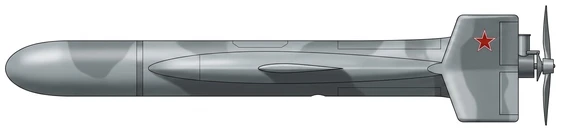
| Length | 2 m (6.6 ft) |
| Wingspan | 2.5 m (8.2 ft) |
| Max. takeoff weight | 18 kg (40 lbs) |
| Powerplant | 1 × DLE60 |
| Maximum speed | 160 km/h (99 mph) |
| Operational range | 600 km (373 mi) |


Description
The Gerbera is a Russian multi-purpose drone designed as a simplified, lower-cost counterpart to the Iranian-designed Shahed-136. While Russian social media attributed its development to the Gastello Design Bureau, the Defense Intelligence of Ukraine identifies the Chinese company Skywalker Technology as the developer. Skywalker Technology assembles the drone kits and ships them to the Alabuga drone factory in Yelabuga, Russia, for final assembly. Production cost is estimated at approximately $10,000 per unit. The drone uses electronic components from Analog Devices, Texas Instruments, NXP Semiconductors, STMicroelectronics, U-Blox, and XLSEMI.
Design
The Gerbera features a cropped delta-wing airframe constructed from a plywood internal frame covered by a polystyrene foam body. Power is provided by a pusher propeller driven by an internal combustion engine, typically a 60 cc DLE60 engine from Mile Hao Xiang Technology or a 70 cc Stinger engine from RCGF Stinger. Sensor and communication equipment includes a Topotek KHY10S90 stabilized camera and a Xingkay Tech Mesh Network XK-F358 modem. This modem allows interconnected drones to share data and act as signal repeaters, improving resistance to electronic warfare. The drone's operational range is estimated at 300 kilometers, though the sanctions database of the Defense Intelligence of Ukraine indicates a flight range of 600 kilometers.
Armament
The Gerbera can be armed with small warheads containing up to 5 kilograms (11 lb) of explosives, compared to the 50-to-90-kilogram warheads of the Shahed-136. Many units are deployed unarmed.
Operational History
The drone was first deployed by Russian forces in July 2024 during the Russo-Ukrainian war. Initially used primarily as unarmed decoys under Russia's "Operation False Target" to overwhelm Ukrainian air defenses, armed versions were documented in tactical strike roles by April 2025. Ukrainian forces have engaged Gerberas using FPV interceptor drones, such as the Sting interceptor. In July 2025, two Gerbera drones launched from Belarus entered Lithuanian airspace; one crashed near Šumskas on July 10, and a second, carrying 2 kilograms of explosives, crashed at the Gaižiūnai military training area on July 28. On September 9, 2025, multiple Gerbera drones entered Polish airspace during a larger drone incursion, leading to engagements by NATO F-35 fighter aircraft.
Variants
- Kamikaze: Equipped with an explosive warhead of up to 5 kilograms for direct-impact strike missions.
- Reconnaissance: Outfitted with a stabilized camera and network modem for intelligence-gathering and surveillance.
- Decoy: An unarmed configuration designed to mimic the radar and visual signature of the Shahed-136 to exhaust air defenses.
Frequently Asked Questions
What type of aircraft is the Gerbera?
What is the maximum speed of the Gerbera?
What is the range of the Gerbera?
How much does a Gerbera cost?
- AUG 12026 Updated Manufacturer updated
- JUN 162026 Created Page created: Gerbera