IAI Scout
Israeli reconnaissance unmanned air vehicle, developed in the 1970s, used for battlefield surveillance and reconnaissance missions. Key figures: top speed 176 km/h, service ceiling 4,600 m, max takeoff weight 159 kg.
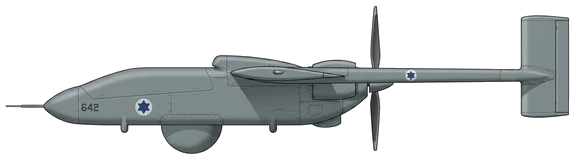
| Length | 3.7 m (12.1 ft) |
| Wingspan | 5.0 m (16.3 ft) |
| Height | 0.9 m (3.1 ft) |
| Empty weight | 96 kg (212 lbs) |
| Max. takeoff weight | 159 kg (351 lbs) |
| Powerplant | 1 × piston engine 16 kW each |
| Maximum speed | 176 km/h (109 mph) |
| Endurance | 7 hours |
| Service ceiling | 4,600 m (15,092 ft) |
Description
The IAI Scout (Hebrew: זהבן, "Oriole") is a reconnaissance unmanned air vehicle (UAV) developed in Israel during the 1970s by Israel Aircraft Industries (IAI) to compete with the Tadiran Mastiff. The design project was led by Charley Attali, David Harari, and Michael Shefer, who were awarded the 1981 Israel Defense Prize. Following a 1984 U.S. Navy request for a battlefield UAV, IAI and Tadiran merged their efforts to form the Mazlat division (now Malat), which consolidated production and continued to market refined versions of the Scout.
Design
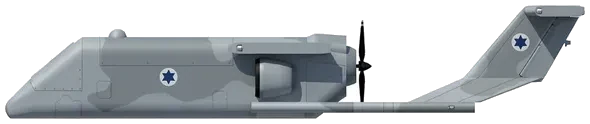
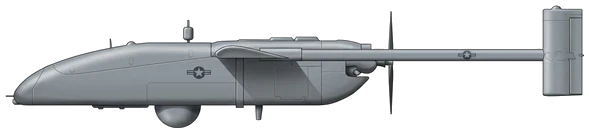
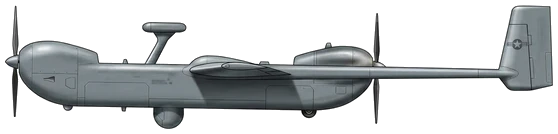
The Scout is configured with a twin-boom tail and a pusher propeller. It is powered by a single 16 kW (22 hp) piston engine, enabling a maximum speed of 176 km/h, a service ceiling of 4,600 m, and an endurance of 7 hours and 30 minutes. Dimensions include a length of 3.68 m, a wingspan of 4.96 m, and a height of 0.94 m. The aircraft has an empty weight of 96 kg, a gross weight of 159 kg, and a payload capacity of 38 kg. It carries imaging sensors in a turret located underneath the fuselage. Equipped with fixed landing gear, the Scout typically operates from runways using an arresting-wire hook for short landings, though it can also launch via a truck-mounted hydraulic catapult and recover into a net.
Operational History
The South African Defence Force first operated the Scout in combat during Operation Protea against Angola in 1981. During the 1982 Lebanon War, the Israeli military utilized the Scout and Mastiff alongside Samson decoys to locate Syrian surface-to-air missile (SAM) sites in the Bekaa Valley, resulting in the destruction of all 28 sites. The Scout was operated by the Israeli Air Force, the Israeli Army, and the Republic of Singapore Air Force. The type was retired from service with Israel and Singapore in the early 1990s, when it was replaced by the IAI Searcher.
Frequently Asked Questions
What type of aircraft is the IAI Scout?
What is the maximum speed of the IAI Scout?
Which countries operate the IAI Scout?
What is the service ceiling of the IAI Scout?
- JUL 272026 Updated Name updated
- JUL 62026 Created Page created: Scout