KAI KT-100
Summary
| Category | Military Training Aircraft |
| Origin country | 🇰🇷 South Korea |
| Manufacturer | KAI |
| First flight | 20 July 2011 |
| Year introduced | 2015 |
| Number produced | 23 units |
| Average unit price | $0.6 million |
Technical specifications
| Version: KC-100 Naraon | |
|---|---|
| Operational range | 1,900 km (1,181 mi) |
| Maximum speed | 389 km/h (242 mph) |
| Wingspan | 11.3 m (37.0 ft) |
| Height | 2.7 m (8.9 ft) |
| Length | 8.0 m (26.3 ft) |
| Service ceiling | 5,304 m (17,402 ft) |
| Empty weight | 1,089 kg (2,401 lbs) |
| Max. takeoff weight | 1,633 kg (3,600 lbs) |
| Powerplant | 1 x pistons engine Continental TSIOF-550-K delivering 235 kW each |
Current operating countries
| Country | Units | ||
|---|---|---|---|

|
South Korea | 23 | |
All operators
Description
Korean Aerospace Industries KC-100 is a four-seat light aircraft intended for general aviation purposes, such as small-scale commercial and commuting activities, flight training, and leisure and private flights. It possesses an all-composite airframe, being constructed primarily from carbon fibre, which reduces overall weight, simplifies manufacture, and reduces maintenance costs. Access to the cabin is via gull-wing doors on both sides of the fuselage. Significant attention was paid to the KC-100's aerodynamics; the wing employs a laminar flow airfoil and has winglets, while the flight controls incorporate an aileron-rudder interconnection (ARI) system aimed at augmenting lateral stability. The avionics incorporates the Avidyne Entegra II glass cockpit, which includes the flight control system, dual high-resolution integrated flight displays, MLB700/MLX770 data link, FMS900w flight management system, digital VHF radio, and DFC100 autopilot, with an airborne collision avoidance system as a key safety feature. The KC-100 is powered by a single American-built Continental TSIOF-550-K turbocharged 315 hp (235 kW) piston engine, controlled via a full authority digital engine (FADEC) system, driving a Hartzell-built composite three-blade ASC-II propeller at 2500 rpm. It is equipped with a TKS anti-icing system, along with air conditioning and a supplemental oxygen system, as standard equipment, and can be outfitted with a Spin Recovery Parachute System (SRPS) as an optional extra.
Throughout the majority of its existence, Korean Aerospace Industries (KAI) had been principally engaged in both Korean government and military projects, such as the KUH-1 Surion and T-50 Golden Eagle. Desiring to move beyond military projects, KAI launched development of the KC-100 during 2008, aiming to produce a civil aircraft that could be reasonably certified under KAS Part 23. The intention was to develop the aircraft using a high proportion of indigenously developed technology, refined by guidance provided by KOCA. KAI engineers aimed to reduce weight and fuel consumption through extensive use of composite materials, targeting a 10% improvement in fuel efficiency compared to contemporary aircraft in its class. The design adopted was largely traditional, pairing a low-mounted wing with a conventional tail. By May 2010, the preliminary design phase had been completed and construction of the first prototype was set to commence. On 15 June 2011, the first prototype performed its maiden flight, and the flight test programme commenced immediately thereafter. On 22 March 2013, the flight test programme was officially completed, and one week later, type certification was granted to the KC-100.
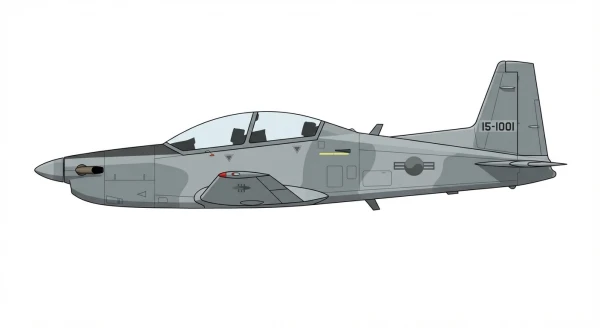
In May 2014, the South Korean Air Force (SKAF) academy signed an agreement to acquire a military trainer version of the KC-100, known as the KT-100, marking the first mass production contract for the aircraft. The KT-100 fleet was intended to replace the 20 Ilyushin Il-103 aircraft at the academy, serving to introduce students to the fundamentals of flight. The first KT-100's maiden flight occurred on October 5, 2015, with deliveries of all aircraft expected by the end of 2016.
Main Variants:
-
KC-100: This is the base four-seat light aircraft variant, designed for general aviation purposes such as commercial activities, flight training, and leisure flights.
-
KT-100: A military trainer variant of the KC-100, it is used by the South Korean Air Force to familiarize students with flying, replacing the existing Ilyushin Il-103 aircraft.