T-50 Golden Eagle
South Korean supersonic trainer jet, utilized since 2005 with notable deployment in Iraq and the Philippines. Key figures: top speed 1,840 km/h, range 1,851 km, service ceiling 16,764 m, max takeoff weight 13,472 kg, unit price $25M, built 200. In service with 5 air forces as of 2026 — South Korea (107), Iraq (24), Indonesia (16) and 2 others.
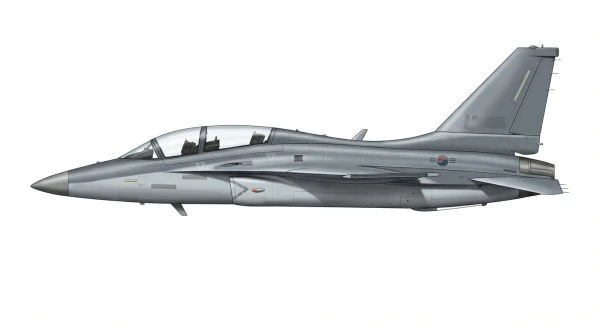
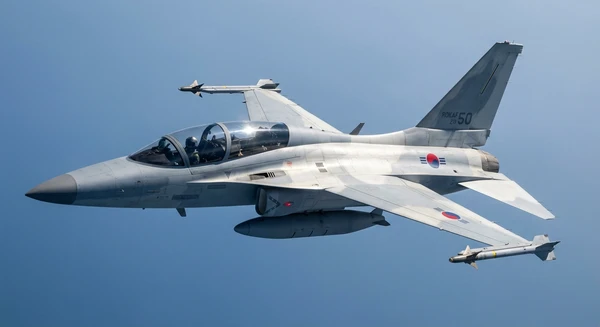
| Length | 13.0 m (42.6 ft) |
| Wingspan | 9.2 m (30.1 ft) |
| Height | 4.8 m (15.7 ft) |
| Wing area | 23.7 m² (255.0 sqft) |
| Empty weight | 6,441 kg (14,200 lbs) |
| Max. takeoff weight | 13,472 kg (29,701 lbs) |
| Powerplant | 1 × turbofan General Electric F404-GE-102 5,409 kgf each |
| Ejection seat | Martin-Baker Mk 16K |
| Maximum speed | 1840 km/h (Mach 1.84) |
| Operational range | 1,851 km (1,150 mi) |
| Service ceiling | 16,764 m (55,000 ft) |
| Climb rate | 198.0 m/s (649.6 ft/s) |
-
 South Korea
107 +17
South Korea
107 +17
-
 Iraq
24
Iraq
24
-
 Indonesia
16 +4
Indonesia
16 +4
-
 Thailand
14
Thailand
14
-
 Poland
12 +36
Poland
12 +36
Recent Events — T-50 Golden Eagle
4 events →

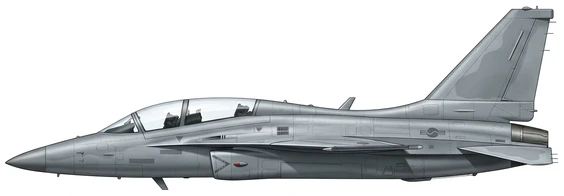
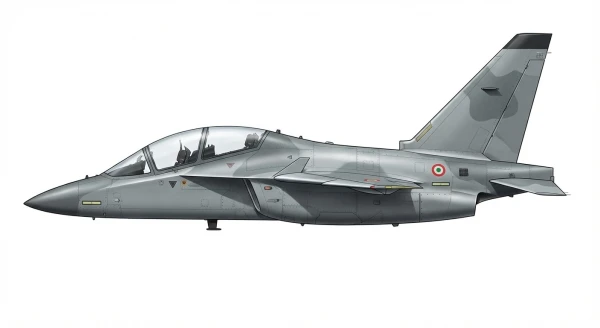
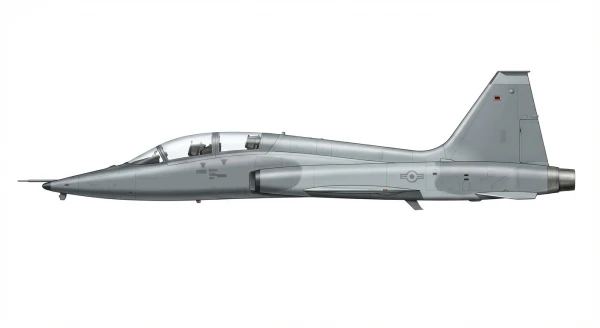
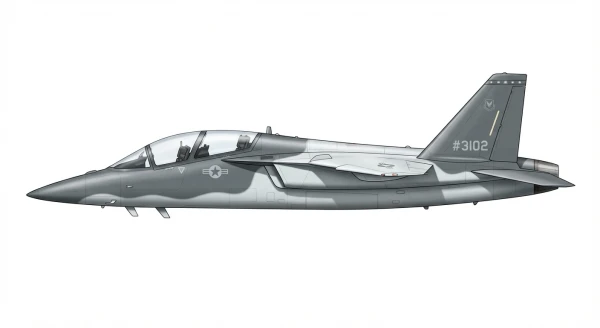
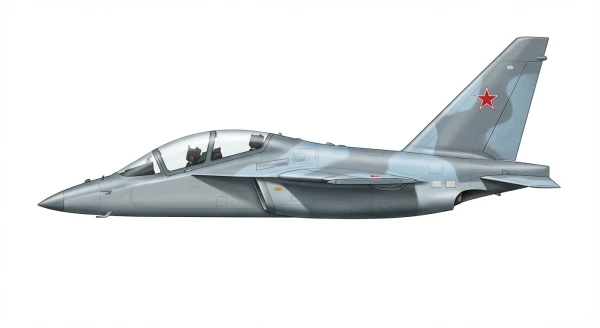
Description
The T-50 Golden Eagle is a family of South Korean supersonic advanced trainers and light combat aircraft. Developed by Korea Aerospace Industries (KAI) in partnership with Lockheed Martin, the T-50 was conceived in the late 1990s to replace the aging fleet of trainer aircraft used by the Republic of Korea Air Force (ROKAF). It made its first flight on August 20, 2002. The development aimed to produce an aircraft capable of both training new pilots and performing light combat missions, effectively serving a dual role. It was also designed with export in mind, targeting the global market for trainer and light attack aircraft.
Development
The development of the T-50 Golden Eagle was a substantial undertaking that involved collaboration between Korea Aerospace Industries (KAI) and Lockheed Martin. With an initial focus on meeting the needs of the Republic of Korea Air Force (ROKAF), the developers aimed to create an aircraft that could not only serve as an advanced trainer but also perform light combat roles, thereby achieving a versatile multi-role capability.
Design
The design was influenced by Lockheed Martin's extensive experience in fighter aircraft, notably drawing on some technologies from the F-16 Fighting Falcon. The aircraft features a single-engine layout with a digital fly-by-wire control system, providing high maneuverability and ease of control. The cockpit is equipped with a glass panel, incorporating a hands-on-throttle-and-stick (HOTAS) control system to minimize pilot workload. The T-50 also boasts advanced avionics, including multi-mode radar and a modern electronic warfare suite, which contribute to its light combat capabilities.
Another notable feature is its aerodynamic design. The aircraft employs a leading-edge root extension (LERX), which allows for better agility and control at various speed ranges.
Armament
The T-50 Golden Eagle is equipped to carry a variety of weapons, making it more than just a training aircraft—it has light combat capabilities as well. The aircraft comes with a single internal General Dynamics 20mm rotary cannon and has provisions for carrying external armaments.
In terms of external ordnance, the T-50 has seven hardpoints: one under the fuselage and three under each wing. These hardpoints are capable of carrying a range of munitions, including air-to-air missiles such as the AIM-9 Sidewinder, air-to-surface missiles like the AGM-65 Maverick, and various types of precision-guided bombs. It can also carry rocket pods and external fuel tanks to extend its range or endurance.
The aircraft's avionics suite is equipped to handle these weapons systems efficiently. Its multi-mode radar allows for effective targeting, and the advanced fire-control system is designed to manage various types of munitions.
A dedicated light-combat derivative, the FA-50 Fighting Eagle, expands on these capabilities with more advanced radar and avionics for multirole missions; it is covered on its own page.
Operational History
The T-50 Golden Eagle entered service with the Republic of Korea Air Force (ROKAF) in 2005 as an advanced trainer, used primarily for pilot training and by the ROKAF "Black Eagles" aerobatic team.
Internationally, the T-50 family has been exported to several countries — Indonesia (T-50i), Iraq (T-50IQ), Thailand (T-50TH). The combat-optimised FA-50 derivative, its exports (Philippines, Poland, Malaysia) and its first combat use are covered on its own page.
Variants
-
T-50A: This is the basic trainer variant, designed primarily for pilot training. It lacks the advanced avionics and weapon systems found in the combat versions but retains high maneuverability and performance suitable for training roles.
-
T-50B: This variant is designed for aerobatic performances and is used by the ROKAF's aerobatic team, the Black Eagles. It shares many similarities with the T-50A but includes smoke generators and specialized avionics for aerobatic displays.
-
TA-50: This is a light attack variant equipped with a radar and an internal 20mm cannon. It has the ability to carry a variety of air-to-air and air-to-ground munitions. It serves as an intermediate step between the basic T-50A trainer and the more advanced FA-50 combat variant.
-
FA-50 Fighting Eagle: The most combat-capable, multirole light-fighter derivative (and its FA-50PH / GF / PL / M exports) — covered in detail on its own page.
-
T-50i: Customized for the Indonesian Air Force, this variant is primarily intended for training but retains some light attack capabilities.
-
T-50IQ: Specifically tailored for the Iraqi Air Force, this variant focuses on training but also has light attack capabilities, similar to the TA-50.
Frequently Asked Questions
What type of aircraft is the T-50 Golden Eagle?
What is the maximum speed of the T-50 Golden Eagle?
What is the range of the T-50 Golden Eagle?
When did the T-50 Golden Eagle first fly?
How many T-50 Golden Eagle have been built?
Which countries operate the T-50 Golden Eagle?
How much does a T-50 Golden Eagle cost?
What is the service ceiling of the T-50 Golden Eagle?
- AUG 52026 Updated Climb rate added; powerplant updated
- JUL 232026 Updated Sources and cross-references refreshed
- JUN 302026 Updated Description updated
- APR 72026 Updated Sources and cross-references refreshed
- APR 52026 Updated Ejection seat added
- FEB 72026 Updated Wing area and top speed added
- JAN 242026 Updated Price updated