RQ-2 Pioneer
American-Israeli unmanned aerial vehicle, developed in the late 20th century, used primarily for reconnaissance, surveillance, and artillery targeting from 1986 until 2007. Key figures: range 185 km, service ceiling 4,600 m, max takeoff weight 205 kg, built 175.
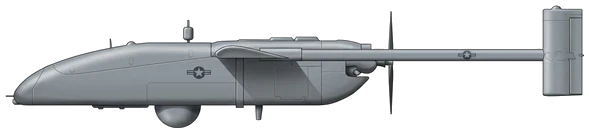
| Length | 4.3 m (14.1 ft) |
| Wingspan | 5.2 m (16.9 ft) |
| Height | 1.0 m (3.3 ft) |
| Max. takeoff weight | 205 kg (452 lbs) |
| Powerplant | 1 × ZF Sachs 2-stroke 2-cylinder horizontally-opposed piston engine 19 kW each |
| Operational range | 185 km (115 mi) |
| Endurance | 5 hours |
| Service ceiling | 4,600 m (15,092 ft) |
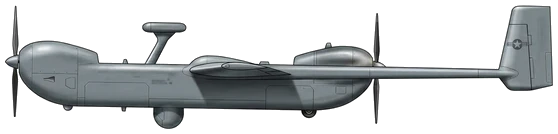
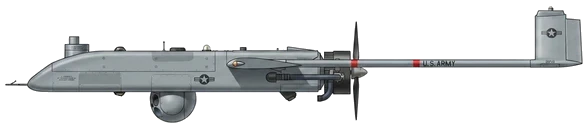
Description
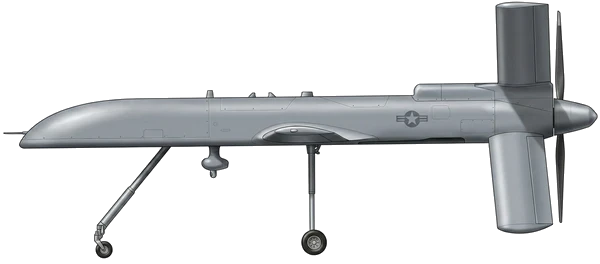
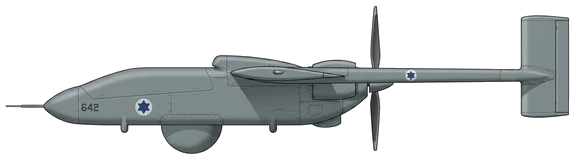
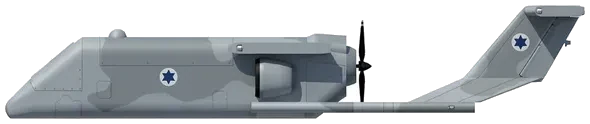
The AAI RQ-2 Pioneer is an unmanned aerial vehicle (UAV) developed jointly by AAI Corporation and Israel Aircraft Industries. The designation "R" denotes reconnaissance, "Q" indicates an unmanned aircraft system, and "2" identifies it as the second in its series. The program grew out of testing of the Tadiran Mastiff UAV by the United States and Israeli militaries. Based on the IAI Scout, the Pioneer was modified at the request of the US Navy to carry a larger payload. This modification replaced the original Limbach two-cylinder two-stroke engine and its 71 cm propeller with a Fichtel & Sachs (ZF Sachs) two-cylinder two-stroke engine driving a 74 cm propeller. Alternatively, the aircraft could use a 28.3 kW (38.0 hp) UEL AR-741 rotary engine.
Design
The aircraft has a wingspan of 5.151 m, a length of 4.3 m, a height of 1.006 m, and utilizes a NACA 4415 airfoil. It has a gross weight of 205 kg and a fuel capacity of 44 to 47 liters. The Pioneer carries a 75-pound (34 kg) payload, consisting of a gimbaled electro-optical/infrared (EO/IR) sensor or a Dual Sensor (12DS/POP-200/POP-300). It transmits real-time analog video via a C-band line-of-sight data link. The aircraft flies for up to five hours, has a range of 185 km, and reaches a service ceiling of 4,600 m. Launch options include rocket assist for shipboard operations, catapult, or runway takeoff. Recovery is achieved via a net for shipboard operations or arresting gear.
Operational History
The US Navy, Marine Corps, and Army operated the Pioneer from 1986 until 2007, when the US Navy retired the system and replaced it with the Shadow UAV. International operators include Israel, the Republic of Singapore Air Force, the Sri Lanka Air Force, and the Sri Lanka Navy. Initially deployed aboard the battleship USS Iowa for gunnery spotting, its missions expanded to reconnaissance, surveillance, target acquisition, battle damage assessment, search and rescue, and psychological operations. The Pioneer deployed in conflicts in the Persian Gulf, Somalia (UNOSOM II), Bosnia, Kosovo, and Iraq. During the 1991 Gulf War, a Pioneer launched from the battleship USS Wisconsin observed Iraqi troops surrendering on Failaka Island. During the same conflict, a US Army UAV platoon operated the system from KKMC and later from a metal runway constructed by combat engineers during Operation Sand Hawk.
Frequently Asked Questions
What type of aircraft is the RQ-2 Pioneer?
What is the range of the RQ-2 Pioneer?
How many RQ-2 Pioneer have been built?
Which countries operate the RQ-2 Pioneer?
What is the service ceiling of the RQ-2 Pioneer?
- JUL 232026 Updated Sources and cross-references refreshed
- JUL 12026 Created Page created: RQ-2 Pioneer